settler colonial studies blog
  • about
  • definition
  • books
  • journal

« Older posts
Newer posts »

Monumental settlers: Cynthia C. Prescott, ‘Monuments to Midwestern Pioneer Mothers and Native Women’, Middle West Review, 9, 2, 2023, pp. 21-36

28Feb23

Excerpt: This essay will argue that in contrast to better-known monuments in the Far West, which largely featured “cowboys and Indians” memories of the Old West or solo pioneer mothers embodying Euro-American civilization, most midwestern monuments erected between the 1890s and 1930s emphasized the process of U.S. westward expansion or White homemaking.1 Midwestern pioneer monuments, which outnumbered those in the Far West, celebrated the family values long associated in popular memory with America’s supposed rural heartland. 


Filed under: Uncategorized   |  Closed

The Midwest at the centre (of settler colonialism): David Roediger, ‘Settler Colonialism and Imagining the Nation’s Center as its Right’, Middle West Review, 9, 2, 2023, pp. 165-168

28Feb23

Excerpt: ‘the white Midwest as a specifically settler colonial project‘.


Filed under: Uncategorized   |  Closed

The bone of the settler colonial matter: Casey Pallister, ‘The Bone Hunters: New Visions of an Ossified Past’, Great Plains Quarterly, 42, 3, 2022, pp. 191-209

28Feb23

Abstract: During and following the decimation of the North American bison herds in the late nineteenth century, bison bones became a significant yet short-lived extracted resource. This article argues that while the gathering of bones on the prairies represents the endpoint of the once great herds, the story of bone hunting also aligns with industrial and settler colonial histories. Bone hunting proved a well-organized capitalist enterprise that fits within a broader story of industrial expansion and worker exploitation in the American West. An examination of bone hunters also reveals Native Americans, both on and off reservations, to be the primary laborers in the Great Plains, demonstrating continuity not only in their reliance on bison but also in their long history of adaptation to the American market economy. Bison bone hunting also played an important role in furthering the cause of settler colonialism through white imaginings of the West. Settler colonist memories of the enterprise largely supplanted the contributions of Native American bone hunters with stories of white bone hunter experiences of privation, exploitation, and bootstrapping.


Filed under: Uncategorized   |  Closed

Okinawan diasporic indigeneities (against settler colonialism): Ryan Buyco, ‘”Finding New Routes”: Visualizing an Oceanic Okinawa in Laura Kina’s Holding On (2019)’, Verge: Studies in Global Asias, 9, 1, 2023, pp. 189-214

28Feb23

Abstract: This essay argues that Laura Kina’s art series Holding On (2019) makes visible an “oceanic Okinawa”—that is, a discourse in the Okinawan diaspora that draws from Indigenous critiques in the Pacific to challenge the marginalization of Okinawa within the United States–Japan relationship. The methodological approach I use is one that examines Holding On in relation to the larger oceanic context that this series embraces. Yet to analyze Kina’s work this way requires an engagement with Asian American studies’ discussions of Asian settler colonialism given its influence in framing Indigenous and Asian relations in recent years. Holding On affiliates itself with the Pacific to express the collective agency of Okinawans and Indigenous peoples everywhere and disrupt the colonial processes that marginalize Okinawans from their lands.


Filed under: Uncategorized   |  Closed

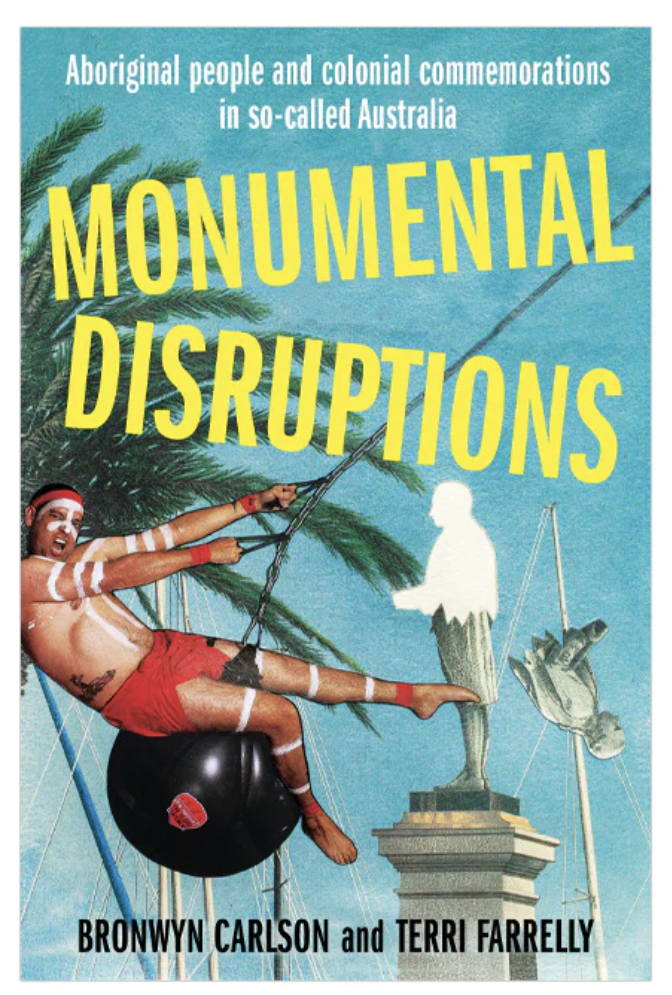
Settler colonial monuments: Bronwyn Carlson, Terri Farrelly, Monumental DisruptionsAboriginal people and colonial commemorations in so-called Australia, AIATSIS, 2023

27Feb23

Description: What is the place of Australia’s colonial memorials in today’s society? Do we remove, destroy or amend? Monumental Disruptions investigates how these memorials have been viewed, and are viewed, by First Nations people to find a way forward. In June 2020, on the heels of Australia’s James Cook anniversary commemorations and statue-toppling Black Lives Matter protests in the USA, dozens of police were sent to guard a statue of Cook in Hyde Park, Sydney. Despite the police presence, two women spraypainted ‘sovereignty never ceded’ across the statue. Scenes like this are being repeated around the world as societies reassess memorials that no longer reflect today’s values. Should they be removed, destroyed or amended? Monumental Disruptions looks for answers. It investigates why commemorations were erected, their meaning for Aboriginal people in Australia, both then and now, and it compares Australia’s experience with that overseas. Those who question colonial commemorations have been called ‘UnAustralian’; but, in Australia, Aboriginal and non-Aboriginal communities are working together to forge new ways to mark the past. This timely book is essential reading for anyone interested in how a society commemorates and acknowledges its complex history.


Filed under: Uncategorized   |  Closed

The many languages of settler colonialism: Adam Dahl, ‘Beyond the Anglo-World: Settler Colonialism and Democracy in the Americas’, Polity, 2023

26Feb23

Abstract: This essay argues that delimiting the settler colonial analytic to colonial legacies in the “Anglo-world” risks disavowing its congruent relationship with other colonial ideologies such as those of the Spanish imperial world. In examining Alexis de Tocqueville’s comparisons of Anglo- and Spanish American colonization alongside Latin American writers like Lorenzo de Zavala and Domingo Faustino Sarmiento, it shows how they occupied a common discursive terrain in grappling with the prospects for democracy in the new world. For Tocqueville, the failure of Spanish American democracy compared to the United States stems from the different systems of land colonization at work in each context. Sarmiento and Zavala provide different accounts of American colonization that exhibit both intersections with and departures from Tocqueville. Bringing these writers together shows how settler colonial ideologies and imaginaries in the Americas circulated in a shared hemispheric space and reciprocally shaped one another in contingent ways.


Filed under: Uncategorized   |  Closed

Biogeopolitical settler colonialism: René Dietrich, Kerstin Knopf (eds), Biopolitics, Geopolitics, Life, Settler States and Indigenous Presence, Duke University Press, 2023

26Feb23

Description: The contributors to Biopolitics, Geopolitics, Life investigate biopolitics and geopolitics as two distinct yet entangled techniques of settler-colonial states across the globe, from the Americas and Hawai‘i to Australia and Aotearoa/New Zealand. Drawing on literary and cultural studies, social sciences, political theory, visual culture, and film studies, they show how biopolitics and geopolitics produce norms of social life and land use that delegitimize and target Indigenous bodies, lives, lands, and political formations. Among other topics, the contributors explore the representations of sexual violence against Native women in literature, Indigenous critiques of the carceral state in North America, Indigenous elders’ refusal of dominant formulations of aging, the governance of Indigenous peoples in Guyana, the displacement of Guaraní in Brazil, and the 2016 rule to formally acknowledge a government-to-government relationship between the US federal government and the Native Hawaiian community. Throughout, the contributors contend that Indigenous life and practices cannot be contained and defined by the racialization and dispossession of settler colonialism, thereby pointing to the transformative potential of an Indigenous-centered decolonization.


Filed under: Uncategorized   |  Closed

Bugging settler colonialism: Liron Shani, ‘Predatory Fleas, Sterile Flies, and the Settlers: Agricultural Infrastructure and the Challenge of Alien-Native Dichotomies in Israel/Palestine’, Cultural Anthropology, 38, 1, pp. 87-112

26Feb23

Excerpt: I show agricultural infrastructure to be a political enterprise: it establishes hierarchical boundaries between communities and strengthens land control. It also establishes and maintains human–non-human boundaries, often resulting in compounding ecological harm. Yet a focus on the various dimensions of agricultural infrastructure within a given context of settler colonialism contributes a more nuanced approach than forcing dichotomous contrasts between alien versus native, settler versus local.


Filed under: Uncategorized   |  Closed

Settler colonialism is (not) in the water: Joseph Pugliese, ‘Intercorporeity of Animated Water: contesting anthropocentric settler sovereignty’, Angelaki: Journal of the Theoretical Humanities, 28, 1, 2023, pp. 22-35

26Feb23

Abstract: In this essay, I examine the relationality between life and water in the context of its intercorporeal manifestations. Drawing on key aspects of Merleau-Pontian phenomenology, my concern is to reflect on water’s enfleshment of life and its complex ecologies of intercorporeity. These Merleau-Pontian key aspects, I note, are in close dialogue with a number of Indigenous cosmo-epistemologies that envisage the world as constituted by profound ecologies of intercorporeal relationality. The loci of my analysis are the Sonoran Desert and the lands of the Tohono O’odham people, all situated within the ongoing violent relations of power unleashed by the forces of settler colonialism, including the partitioning of Indigenous nations by the Mexico–US border, the ecological devastation left in the wake of the construction of the Trump border wall and the increasingly fraught situation of undocumented migrants attempting to cross the US border. The bodies of water that I discuss in this essay disclose the cycles of life and death that turn on the presence and absence of water. These cycles are increasingly ensnared in aquapolitical regimes of governmentality that, in settler colonial contexts, unleash lethal effects that kill both bodies of water and the entities that depend on them for life.


Filed under: Uncategorized   |  Closed

Housing settler colonialism: Elizabeth Korver-Glenn, Sofia Locklear, Junia Howell, Ellen Whitehead, ‘Displaced and unsafe: The legacy of settler-colonial racial capitalism in the U.S. rental market’, Journal of Race, Ethnicity, and the City, 2023

26Feb23

Abstract: Unsafe rental units are disproportionately located in communities of color, resulting in numerous detrimental effects for residents’ health and socioeconomic well-being. Yet, scholars disagree regarding the mechanisms driving this phenomenon. Exogenous capitalism theories emphasize socioeconomic factors while setter-colonial racial capitalism theories emphasize the racist policies and practices that incentivize unequal investment and maintenance. We empirically adjudicate between these mechanisms by merging restricted-access versions of the American Housing Survey, the Rental Housing Finance Survey, and the American Community Survey at a Census Restricted Data Center. Our findings demonstrate neighborhood White proportion is a key mechanism shaping the condition of rental units even when controlling for neighborhood socioeconomic status, property features, and renter demographics. We argue these results support settler-colonial racial capitalism theories and discuss the implications of these findings for future research and housing policy.


Filed under: Uncategorized   |  Closed
« Older posts
Newer posts »

  • Settler colonialism is a global and transnational phenomenon, and as much a thing of the past as a thing of the present. Settlers 'come to stay': they are founders of political orders who carry with them a distinct sovereign capacity.
  • If you're a scholar, and you find some of your work featured on the blog, then chances are that we want it for our journal.
  • what’s new

    • Pleading settlers: Darren Reid, ‘Letters to the Editor as Performative Imperial Citizenship: Settler Letters to British Newspapers in the late Nineteenth Century’, Britain and the World, 19, 1, 2026
    • Teaching as a right relation: Aimee de Ney, Remembering Right Relations: A Land-Centered Framework for Settler Teacher Transformation, PhD dissertation, Antioch University, 2026
    • The waters of settler colonialism: Alana Sayers, Revitalizing Hupač̓asatḥ navigational knowledge: Mapping the waters of settler-colonialism using a critical, coastal, community-based consciousness, PhD dissertation, University of Victoria, 2026
    • Settler colonialism as a warning: Mason McCarthy, ‘Deforestation as a Consequence of Viking Settlement: A Case Study of Iceland’, JUST, 10, 2026
    • The ‘choice’ of settlers: Gavin Meyer Furrey, ‘Native Voice, Settler Choice: Oceti Sakowin Charter Schools and the Contradictions of South Dakota School Choice Policies’, Ethnic Studies Review, 49, 1, 2026, pp. 90-109
    • The selective memory of settlers: Angel M. Hinzo, ‘Not Your “Queen”, Not Your “Sq**w”: Reclaiming Ho-Chunk Histories of Hąpoguwįga and Challenging Settler Memory’, Native American and Indigenous Studies, 13, 1, 2026, pp. 100-126
    • It’s the political economy of settler colonialism, s: Phil Henderson, Shiri Pasternak, ‘The Political Economies of Ongoing Settler Colonialism’, Native American and Indigenous Studies, 13, 1, 2026, pp. 266-272
    • The women of settler colonialism: Carla Joubert, Barberton Daisies: Women and Settler Colonialism in the Zuid Afrikaansche Republiek and Alberta in the Nineteenth Century, PhD dissertation, Western University, 2026
    • Introducing Barriers to Truth and Justice in Settler-Colonial Australia: Dan Tout, Emma-Jaye Gavin, Julia Hurst, ‘Omtroduction’, in Dan Tout, Emma-Jaye Gavin, Julia Hurst (eds), Barriers to Truth and Justice in Settler-Colonial Australia: Why Won’t Settlers Listen? Springer, 2026, pp. 1-21
    • Spying settlers: Merve Gönlühoş Elmas, ‘Espionage as a Settler-Colonial Practice: The Case of the Palestine–Syrian Front During World War I’, Middle East Critique, 2026
    • Mennonite settler colonialism in Ukraine: John R. Staples, Johann Cornies, the Mennonites, and Russian Colonialism in Southern Ukraine, University of Toronto Press, 2024
    • The key words: Clare Corbould, Hilary Emmett, ‘Settler Colonial Keywords for New Area Studies: Land, Labour, and Language in Mark Twain’s Following the Equator (1897)’, in Clare Corbould, Hilary Emmett, Sarah Garland, Malcolm McLaughlin, Thomas Ruys Smith, John Wills (eds), American Studies in the Age of New Area Studies: Infinite Space, Routledge, 2026
    • Indigenous and at home: Jacek Anderst , Keziah Bennett-Brooka, Tamara Mackean, ‘Flipping the script on Aboriginal and Torres Strait Islander people and housing: a call for strengths based discourse in Australian housing research’, International Journal of Housing Policy, 2026
    • Settlers and their pests: Jodie Evans, Abbi Virens, ‘Nuisance Over Nuance: A Critical Discourse Analysis of the Common Brushtail Possum (Trichosurus vulpecula) in Aotearoa New Zealand’s Online Media’, New Zealand Geographer, 2026
    • Dance! Miguel Martínez, ‘Danza Azteca as a form of resistance to White Settler colonialism’, International Journal of Human Rights Education, 10, 2026, pp. 1-17
  • contribute

    email the editor


Blog at WordPress.com.
  • Subscribe Subscribed
    • settler colonial studies blog
    • Join 282 other subscribers
    • Already have a WordPress.com account? Log in now.
    • settler colonial studies blog
    • Subscribe Subscribed
    • Sign up
    • Log in
    • Report this content
    • View site in Reader
    • Manage subscriptions
    • Collapse this bar

Loading Comments...