The surviving transcripts of Adelaide composer Hooper Brewster-Jones’s lecture broadcasts given in the early 1930s on Adelaide’s recently established ABC radio station 5CL reveal a cosmopolitan Australian composer eager to engage with other cultures. His cosmopolitanism is very much a rooted even provincial one, clearly embedded in his particular historical and cultural context. Nonetheless, the story of Brewster-Jones’s broadcasts helps to destabilise and complicate the picture of early twentieth-century Australian musical history. His encounters with musics modern, ancient and exotic add a missing page
to Australian broadcasting history and challenge the received orthodoxy of Australian music from this period as a pale imitation of English pastoralism.
Filed under: Uncategorized | Closed
colonisers deserve our gratitude
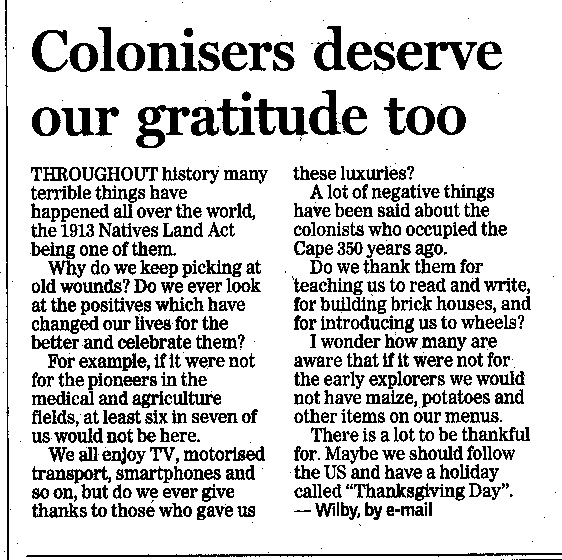
The Times (SA) (5/8/2013).
Filed under: Uncategorized | Closed
cape land rights reloaded
Our right to the land is entrenched in history. It is undisputed.We have ancestral rights to the land because it was not granted or sold to anybody. The land belonged to aborigines who were there long before Europeans settled.
[…]
But colonialists took the aborigines and classified them as coloured.
Then these “coloureds” had to go through a restitution process. But this process only further alienated them from their land, as it required property rights and title deeds. Even the Land Restitution Act alienated the aborigines, because its cut-off date was 1913.
Jan Cronje in conversation with Tania Kleinhans for IoL.
Filed under: Uncategorized | Closed
The archaeology of colonialism can destabilize orthodox historical narratives because of its critical engagement with multiple lines of evidence, revealing ways that different perspectives can complement or contradict what was assumed to be known about the past. In Oceania, archaeology that blends evidence from landscapes, sites, and artifacts with written documents as well as oral traditions reveals the role of indigenous people in shaping colonial encounters across the region over the last five centuries. The challenge lies with how to interpret this material in terms of ongoing struggles over land, resources, and identity in the region today, encapsulated by the tension between global and local.
Filed under: Uncategorized | Closed
Growing up in the small River Murray town of Wellington, South Australia as the twentieth century turned, Henrietta (Ruth) Sabina Heathcock (nee Rayney) enjoyed a childhood shaped as much by Ngarrindjeri Aboriginal friends and elders, as by her close-knit Anglo-Irish family. The Rayney family lived on the eastern, Aboriginal, side of town, where Ngarrindjeri had lived for millennia, and where, in the 1880s, a group of Ngarrindjeri families from nearby Point McLeay Mission had been granted hard-won title to farm the land and raise their families (Jenkin 1979, 229-231). Wellington, indeed, was one of a number of pockets across colonial Australia where lived processes of negotiation and exchange between Aboriginal peoples and newcomers blurred social boundaries and mapped dynamic inter-cultural terrains on the frontier (see for example Hughes 2012, Balint 2012, Ryan 2011, Landon and Tonkin 1999, Yu 1994). Reflecting on her childhood friendships forged at Wellington in the first two decades of the 1900s, Ruth Heathcock recalled, ‘I went to school with Aboriginal children. Skin colour? It was all the same to me. I didn’t even know it existed’ (Hughes 1986).
In the following article I explore continuities in the nature of cross-cultural intimacy over time by examining the friendships that Ruth Heathcock sustained with Aboriginal people at Wellington, and later across a range of other sites. These played out against a backdrop of restrictive race-based legislation that attempted to foreclose possibilities for such connectivity in early and mid-twentieth century Australia.
Filed under: Uncategorized | Closed
poetry @ uws
Poetic Craft and White-Settler Colonialism: A workshop on Australian and South African poetics. 13-14 September 2013, University of Western Sydney Bankstown campus (Bullecourt Ave, Milperra).
This workshop will bring together eminent Australian and South African poets and critics to con-sider how poets in societies with a white settler history think about their world through their poetry making. The subject is not white settler colonialism as a theme in poems, but as a limiting circum¬stance within which poets are concerned to develop particular idioms and techniques. How does this particular form of colonialism condition the aspiration to articulate truth in verse? What are the problems and politics of poetic craft generated by the settlement process and its aftermath? By comparing Australia and South Africa, we hope to avoid discussion of national ‘characteristics’, but, at the same time, to head off easy generalisations about postcolonialism or transnationalism. Our attention is on poetry’s material, approached in its regional specificity and through parallels in technical problems encountered during the global colonial expansion and its aftermath.
Filed under: Uncategorized | Closed
mapuche terrorism: chile
Ben Emmerson, the UN’s special rapporteur on Human Rights and Counter-Terrorism, said a long-running dispute over land rights could boil over into serious violence at any moment.
[…]
Mr Emmerson said the state had repeatedly discriminated against the Mapuche and used anti-terrorism legislation against them “in a confused and arbitrary fashion that has resulted in real injustice”.
Gideon Long for BBC News.
Filed under: Uncategorized | Closed
James Lehning, European Colonialism since 1700 (Cambridge University Press, 2013).
This masterful synthesis provides a much-needed, complete survey of European colonialism from 1700 to decolonization in the twentieth century. Written by an award-winning author, this advanced undergraduate and graduate level textbook bridges, for the first time, the early modern Atlantic empires and the later Asian and African empires of ‘high imperialism’. Viewing colonialism as a phenomenon of contact between Europe and the rest of the world, the author takes an ‘entangled histories’ approach, considering the surprising ways in which the imperial powers of Spain, Portugal, Great Britain, France and the Netherlands displayed their identities in colonial settings, as much as in their imperial capitals. The author illuminates for students the common themes of colonial government, economic development and cultural contact across empires, and reveals the ways in which these themes played out, through contrast of the differing development, structure and impact of each empire.
Filed under: Uncategorized | Closed
It would be more logical to recognize only settler colonies as colonies per se and refer to all other results of expansion as dependencies. The loss of colonies is incomparably more dangerous for empires than the loss of dependencies. Trying to hold on to dependencies is meaningless, but to neglect the colonies is reckless.
‘Colonies vs. Dependencies: An Invitation to a Discourse’, by Vladislav Inozemtsev for Russia in Global Affairs, reproduced on one page at Valdai.
Filed under: Uncategorized | Closed
The International Law Commission’s 2001 Draft Articles on State Responsibility declares that, besides restitution and compensation as a means of accountability for an international wrong, satisfaction may also be offered. Article 37 states that satisfaction may take the form of an expression of regret or a formal apology. This is a movement away from the Chorzow Factory Case PC1J Series A no 17 4 (1928) where it was held that a breach of an international obligation demands full reparation for the injury caused. Article 37 is more in line with the Genocide Convention Case 2007 ICJ Rep 43 where it was held that state responsibility could arise at a political level. In the Rainbow Warrior Affair 20 RIAA 217 (1990) the tribunal considered that a French declaration of responsibility was, inter alia, an appropriate form of redress for using force against the territorial integrity of New Zealand. It is submitted that Australian Prime Minister Rudd’s 2008 formal apology for the removal of aboriginal children from their parents (the ‘Stolen Generation’) and South Africa’s 1998 Truth and Reconciliation Commission are examples of an expression of regret or formal apology as set out in article 37 of the ILC’s Draft Articles on State Responsibility. It is submitted that in so doing Australia and South Africa have accepted accountability for breaches of ius cogens norms and erga omnes obligations.
Filed under: Uncategorized | Closed

