Editors introduction:
The historical sociologist Martin Shaw was asked, as a genocide scholar rather than a specialist on Israel-Palestine, to contribute to an edited book that examined that conflict in a perspective based on the growing awareness of settler colonialism as a context of genocide. He drafted his chapter but the book, for various reasons, did not appear. However, one of its editors, Nur Masalha, asked him to submit the paper to the interdisciplinary journal that he edits: it appeared as ‘Palestine in an international historical perspective on genocide’ in Holy Land Studies (Vol 9, No 1, 2010, pp 1–25). Coincidentally, Shaw was asked to contribute to a conference organized by the Wiener Library in London in June 2010, on ‘The Holocaust and other genocides’, at which the main speaker was Omer Bartov. It turned out that Bartov’s paper, among other criticisms of genocide scholarship (directed principally against Dirk Moses and Donald Bloxham), attacked ‘the idea that there is a link between assertions of the Holocaust’s centrality and uniqueness and the legitimization of the State of Israel as a colonial entity with its own history of ethnic cleansing and genocidal potential’. He also commented that ‘statements by historians of genocide about Zionist ideology and Israeli policies are mostly rhetorical expressions of opinion, not scholarly analyses of the politics and practices of nation-building and ethnic displacement’. In the light of this, Shaw thought Bartov might be interested in his own take in the issues involved in relating the genocide perspective to the Palestine situation, and sent him his article. In what follows, Shaw first summarizes his article for readers of Journal of Genocide Research; after this, we publish the email exchange in which Bartov criticizes Shaw’s approach, Shaw replies, and Bartov concludes the discussion.
and a bit of Bartov’s conclusion:
… while it is true that some countries such as Australia or the US have begun to look back at genocidal aspects of their past, the fact remains that their various ‘sorries’ have never in any way been seen as delegitimizing their exist- ence and sovereignty, even in the case of Germany and many other European states that were involved in the Holocaust.
Filed under: Genocide, Israel/Palestine, Scholarship and insights | Closed
From Waatea News Update:
The head of a new demographic research unit wants the government to encourage young Maori families to move back from Australia.
At yesterday’s launch of the National Institute of Demographic and Economic Analysis at Waikato University, Professor Natalie Jackson said for the first time in New Zealand’s history, fewer people are entering the labour market than are retiring. She says the situation will get worse from next year as post-war baby boomers reach retirement age.
“It’s not a case of trying to bluff people. It’s about government getting serious and saying, ‘we have got this gaping hole in our age structure where we are missing an enormous number of say 18 to 35-year-olds.’ That’s the key age of young Maori in Australia and if we want them back we have to do something seious which says ‘if you come back we will really try to help you,’” Professor Jackson says.
Filed under: media, New Zealand | Closed
Traci Watson for National Geographic News:
Five hundred years before Columbus sailed the ocean blue, a Native American woman may have voyaged to Europe with Vikings, according to a provocative new DNA study.
Analyzing a type of DNA passed only from mother to child, scientists found more than 80 living Icelanders with a genetic variation similar to one found mostly in Native Americans.
[…]
Historical accounts and archaeological evidence show that Icelandic Vikings reached Greenland just before 1000 and quickly pushed on to what is now Canada. Icelanders even established a village in Newfoundland, though it lasted only a decade or so.
Filed under: Europe, media, Science | Closed
quick, colonise them!
Bare to the waist and sporting rings in their upper lips, these are the extraordinary first pictures of a tribe lost in the heart of the Amazon rainforest.
The natives are totally unknown to anthropologists, speak an unrecognisable language and do not even have a name for themselves.
The nomads had been hunting for food and were tracked back to a temporary village constructed from cane and palm leaves.
It was there that staff from the National Institute of Development of Andean, Amazonian and Afro-Peruvians (Indepa) studied them in secret for almost a year.
via Daily Mail.
Filed under: media | Closed

In lieu of an abstract, here is a preview of the article.
The notion of “sovereignty” is saturated with the certainty of jurisdictional and territorial authority over peoples and places. Yet nothing is simultaneously so certain and yet so fraught with precariousness as the practice of sovereignty— globally or locally. This uncertainty is read through the sign of its failure: territories that fissure and are fought over by force and by fiat, as well as by a precedential practice that continues to reinscribe states with their right to govern, and in the case of democratic systems, laws to also check the exercise of that governance. This uncertainty is especially precarious and, in different ways, onerous in Indian country.
Indian country may be conceptualized as spaces of Indigeneity that are framed by settler regimes. Once independent and autonomous, the spaces that are conceptualized and peopled and known as “Indian country” now have limited forms of political autonomy that may be exercised, but, in a double-bind situation, that autonomy is exercisable only because recognition is conferred upon those peoples to exercise this autonomy. This recognition, often temporalized in a moment (that of “treaty making,” for example) guarantees Indian polities their sovereign status.
Filed under: law, Scholarship and insights, Sovereignty, United States | Closed
native title today in n$w
About 400 hectares of land at North Tuncurry will be developed for housing.
The CEO of the Native Title Services Corporation, Warren Mundine, says hopefully this will be the first of similar agreements.
“I think this is a good template that we can now take across the state of New South Wales,” he said.
“We could have outcomes that help in the socio-economic development of townships and across New South Wales.
“As well as the benefits that flow on then to the Aboriginal people, where they become partners, and within the process and they also have economic outcomes that benefit everyone.”
Mr Mundine says the agreement is a good win which will allow the Worimi Birpai people of Foster Tuncurry to be part of the region’s growth.
“It’s an agreement which recognises Aboriginal people’s rights in this area,” he said. “At the same time, it has a socio-economic outcome for the people of the Forster Tuncurry area. It’s the first of its kind agreement here in New South Wales, so it was quite a revolutionary, and a very good agreement.”
From the ABC, whose headline reads ‘Native Title win could pave way for others’.
But this claim was retracted, surrendered and can never be resurrected. What was won was money, not Native Title (capitalised or not).
Quoting Tony Kelly: “They have agreed to forgo the Native Title claim, in return for a payment of $10 million over the next 30 years, provided this development goes ahead.”
This is a win of some kind or other: money is still important, after all, and it’s a whole lot better than nothing. Mundine and his enterprise worked hard to reach an agreement over a claim where none might ever have been made. Well done.
Well before the 30-year period winds up, however, this 400 hectare region of golf-course fronted coastal land will be carved up into hundreds of residential blocks, prime for the construction of those beautifully bourgeois houses we all envy/hate. Just who lives in those houses, I’d say, will decide whether this one is a ‘win’ or not.
Either that, or what is actually done with all that money, will decide whether this one is a ‘win’ or not.
Filed under: Australia, law, media | Closed
This book presents new material and shines fresh light on the under-explored historical and legal evidence about the use of the doctrine of discovery in Australia, Canada, New Zealand and the United States.
North America, New Zealand and Australia were colonised by England under an international legal principle that is known today as the doctrine of discovery. When Europeans set out to explore and exploit new lands in the fifteenth through to the twentieth centuries, they justified their sovereign and property claims over these territories and the indigenous peoples with the discovery doctrine. This legal principle was justified by religious and ethnocentric ideas of European and Christian superiority over the other cultures, religions, and races of the world. The doctrine provided that newly-arrived Europeans automatically acquired property rights in the lands of indigenous peoples and gained political and commercial rights over the inhabitants. The English colonial governments and colonists in North America, New Zealand and Australia all utilised this doctrine, and still use it today to assert legal rights to indigenous lands and to assert control over indigenous peoples.
Written by indigenous legal academics – an American Indian from the Eastern Shawnee Tribe, a New Zealand Maori (Ngati Rawkawa and Ngai Te Rangi), an Indigenous Australian, and a Cree (Neheyiwak) in the country now known as Canada, Discovering Indigenous Lands provides a unique insight into the insidious historical and contemporary application of the doctrine of discovery.
and the beautiful cover artwork depicting a Cree woman and boatfuls of white men:
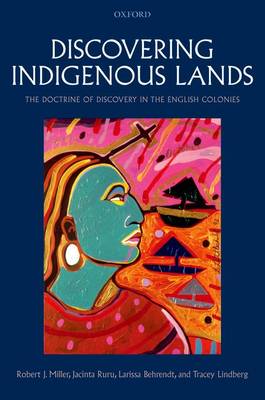
Filed under: Australia, Canada, law, New Zealand, Scholarship and insights, United States | Closed
Lorenzo Veracini, Settler Colonialism: A Theoretical Overview (Palgrave 2010).
Settler colonialism is a global and transnational phenomenon, and as much a thing of the present as a thing of the past. In this book, Lorenzo Veracini explores the settler colonial ‘situation’ and explains how there is no such thing as neo-settler colonialism or post-settler colonialism because settler colonialism is a resilient formation that rarely ends. Not all migrants are settlers: settlers come to stay, and are founders of political orders who carry with them a distinct sovereign capacity. And settler colonialism is not colonialism: settlers want Indigenous people to vanish (but can make use of their labour before they are made to disappear). Sometimes settler colonial forms operate within colonial ones, sometimes they subvert them, sometimes they replace them. But even if colonialism and settler colonialism interpenetrate and overlap, they remain separate as they co-define each other.
Filed under: Scholarship and insights | Closed
In The Political Uncommons, Kathryn Milun presents a cultural history of the global commons: those domains, including the atmosphere, the oceans, the radio frequency spectrum, the earth’s biodiversity, and its outer space, designated by international law as belonging to no single individual or nation state but rather to all humankind. From the res communis of Roman property law to early modern laws establishing the freedom of the seas, from the legal battles over the neutrality of the internet to the heritage of the earth’s genetic diversity, Milun connects ancient, modern, and postmodern legal traditions of global commons. Arguing that the logic of legal institutions governing global commons is connected to the logic of colonial doctrines that dispossessed indigenous peoples of their land, she demonstrates that the failure of international law to adequately govern the earth’s atmosphere and waters can be more deeply understood as a cultural logic that has successfully dispossessed humankind of basic subsistence rights. The promise of global commons, Milun shows, has always been related to subsistence rights and an earth that human communities have long imagined as ‘common’ existing alongside private and public domains. Utilizing specific case studies, The Political Uncommons opens a way to consider how global commons regimes might benefit from the cross-cultural logics found where indigenous peoples have gained recognition of their common tenure systems in Western courts.
Filed under: law, Scholarship and insights | Closed


