Summary: All life on earth is affected by the intensifying impacts of climate change, biodiversity loss, and pollution. Planetary health science is emerging as a crucial framework to address the health of the planet and its inhabitants. Indigenous Peoples’ knowledge systems have evolved over millennia and are grounded in principles such as interconnectedness of all living things. As a discipline, the tenets of planetary health draw upon Indigenous science and approaches; however, the extent of ethical engagement has not been examined. We conducted a systematic review of all articles published in The Lancet Planetary Health up to October 2025, to assess the recognition and integration of Indigenous knowledge systems. 1137 of 1172 articles reviewed contained no Indigenous research features or perspectives. Although the number of articles engaging with Indigenous knowledge systems has increased over time, these publications are predominantly commentaries, with relatively few original research articles. The Lancet Planetary Health was launched with the aim of informing a “radical civilisational transformation”. Based on the findings of this systematic review, we suggest that decolonising planetary health science should be integrated into this civilisational transformation.
Abstract: This study examines whether Japanese colonial settlement in Manchuria has affected contemporary rural income. We construct a novel dataset covering 290 districts across Northeast China, and employ an instrumental variable strategy, based on the 1934 Japanese population share, to identify the effect as cleanly as the historical setting allows. Our district-level analysis reveals a robust negative association between colonial settlement and present-day rural income, which is consistent with the long-run persistence of colonial institutions on rural development beyond the European colonial context.
Excerpt: On September 4, 1883, three hundred Lakhˇóta and Dakhˇóta people from the Standing Rock Agency of the Great Sioux Reservation rode into Mandan, Dakota Territory, a boomtown adjacent to the Northern Pacific Railroad just west of the Missouri River (fig. 14.1). With them were the US Indian agent James McLaughlin, who left an account of this event; and the Huŋkpaphˇa Lakhˇóta Chief Sitting Bull (Thˇath ˇáŋka Íyotake), who seven years earlier had been one of the prime movers behind the battle that defeated the US Seventh Cavalry at Pezi Sla (Greasy Grass, a.k.a. Little Bighorn). Leaving their horses behind, the travelers commenced the long wait for their train.1 As they waited, Pullman cars filled with European and American “ladies and gentlemen” …
Abstract: ‘Settler carcerality in Southern California’ examines how, during the first half of the twentieth century, US federal officers, local police, and county sheriffs patrolled the territory of what is now known as Southern California – the traditional homelands of the Cahuilla, Kumeyaay, Luiseño, Serrano, and Cupeño peoples – surveilling and arresting California Native people and white and Mexican residents who interacted with them, often under the pretense of regulating the liquor trade. The intensifying imposition of US laws on Indigenous sovereign nations introduced new power relations between Indian subjects, state officials, and non-Indians who engaged with these communities. This article explores how these policed relations interfered in tribal governance, supplemented surveillance during the national Prohibition era, and disciplined Native participation in New Deal work programs. Theorizing ‘settler carcerality’ reveals that US-state targeting of a seemingly small minority population carried resonant effects beyond the reservation territories of Southern California Native communities. Indexing the assaults of settler carcerality also exposes its failures and the endurance of social relations and political practices that exceeded its punishing rule.
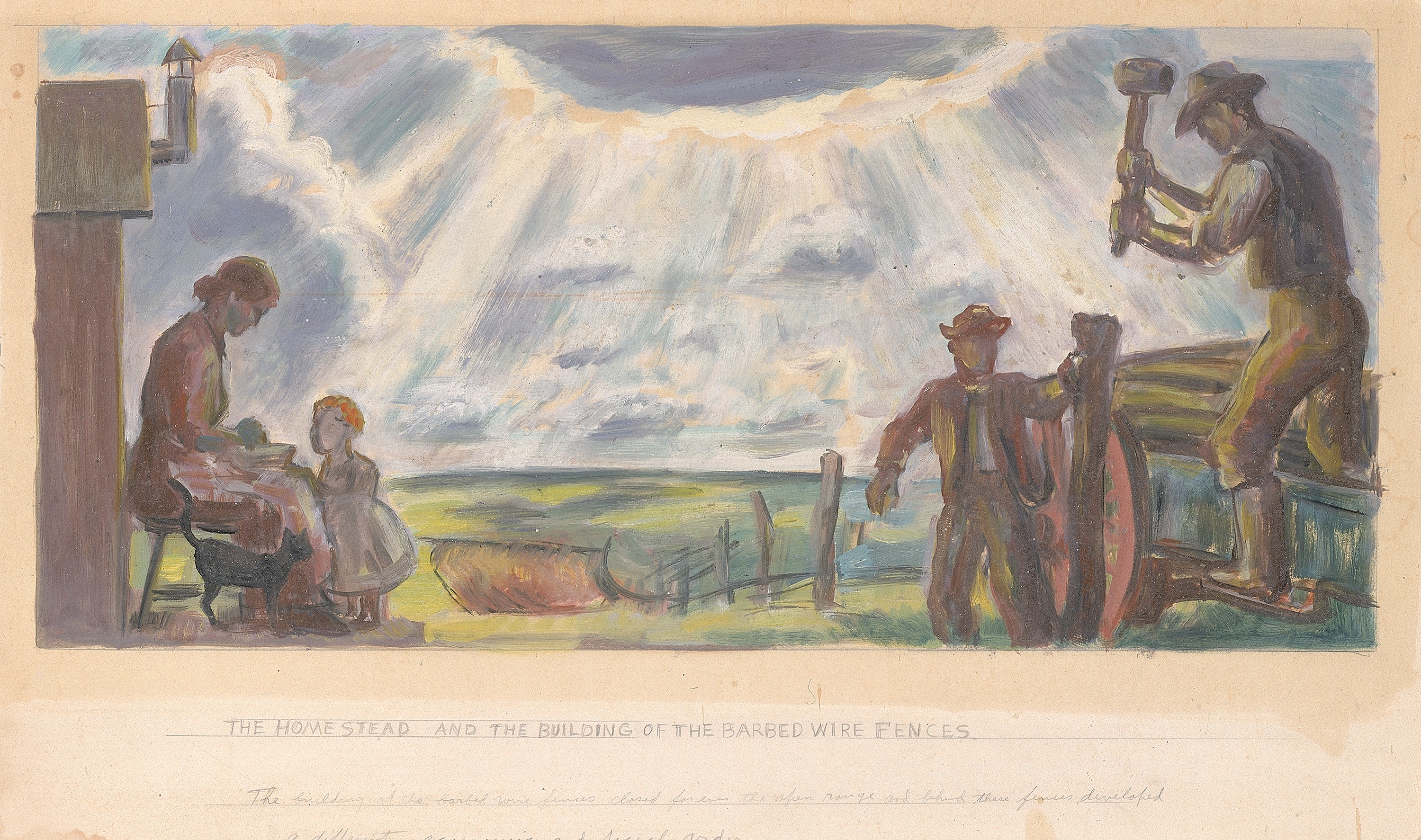
Excerpt: The Homestead Act was a policy enacted by the United States government on 20 May 1862 to encourage westward expansion. Passed during the American Civil War (1861-1865), the act offered 160 acres (65 ha) of public domain land to any citizen who had never taken up arms against the federal government. Though the land did not cost any money, it was not completely free. Prospective farmers were required to live on and ‘improve’ the land for five years before the property would legally become theirs. Though a large percentage of farms would fail, the Homestead Act encouraged hundreds of thousands of American families to move out West. Before it was discontinued in 1976, the act led 270 million acres of land to be claimed and settled by US citizens.
From this entry:
Abstract: This dissertation investigates processes ‘upstream’ of mineral extraction in Ontario, Canada- a key jurisdiction in the global mining industry. Critical analyses of mining have largely focused on operating mines. I examine the processes of discovering and delineating mineral deposits, understudied despite their significance for where, how, and with what social and environmental consequences mining occurs. My research looks upstream of mining in order to understand the knowledge practices, financial instruments, policies, and social relations that undergird extraction and its effects, building on this geographic tradition and extending it through asking, how are extractive futures re/produced? In looking upstream of extraction, I speak to a strand of radical geography scholarship that illuminates potential futures. Through examining how potential is produced by and through mineral exploration, my work interrogates the ways in which potential is used to reproduce capitalist and settler-colonial relationships. I ask what an understanding of how extractive capital and colonial governance structures absorb crises and use them as an opportunity to extend their reach, can teach scholars about the work of scaffolding alternatives.
Abstract: This dissertation recovers the life and work of Alonzo Wardall (1845–1918) to argue that the Populist revolt of the late nineteenth century was, at its core, a rebellion against the collapse of the settler-colonial economy. Known to contemporaries as the “father of cooperatives,” Wardall, a Union veteran, Iowa farmer, and tireless cooperative organizer, spent four decades as an “Authorized Agent,” the principal salesman and business manager, for farmers’ cooperative businesses. Settlers, like Wardall, who came West in the 1850s and 1860s expected that free land and hard labor would secure their independence. Republican Reconstruction broke that promise, rebuilding the economy around railroads, eastern capital, and big business. The middle-class revolt that followed is best understood as “Middle Border Populism,” a liberal, entrepreneurial, petit-bourgeois radicalism native to the borderland stretching from the Midwest across the Plains and into the Canadian Prairies. Wardall’s career as a middle-class radical questions the chronological categorization that merges Populism with Progressivism, highlights a transnational geography often overlooked due to the field’s emphasis on Kansas and Texas, and challenges the enduring image of Populists as backward provincials—demonstrating that middle-class radicalism has never been exclusive to the left or the working class.
Description: The Occupied Palestinian West Bank is central to the Israeli colonial project. It serves as a significant example of occupation. Yet little is understood about how Israeli rule over this area operates. Drawing on extensive fieldwork in Israel and Palestine, including interviews with state officials, settlers and military personnel, this book examines the evolution of Israeli rule over the West Bank since 1967. The book situates this post-1967 machinery within the longer history of the Zionist settler-colonial project, revealing that contemporary state-settler dynamics reproduce a division of labour with roots that predate 1948. In the book, Youssef Mnaili argues that Israeli governments have increasingly relied on Jewish settlers, approximately 700,000 civilians established in the occupied territories to perform key security and administrative roles. This reliance allows the state to distance itself from controversial practices such as surveillance and violence. Rather than representing a fundamental rupture, the disagreements between state and settlers reflect a shared colonial logic:one camp produces facts on the ground whilst the other produces legitimacy. At the same time, however, the book reveals that a paradox emerges: while the Israeli government attempts to regulate the settlers, it inadvertently strengthens their control over the land, rendering the occupation effectively permanent.In highlighting the state’s dependence on settlers for military recruitment and ground operations, Youssef Mnaili offers a unique perspective on the shifting power dynamics between the Israeli state and the settlers. He concludes that the state-settler relationship is not a disagreement over whether to pursue the colonial project, but rather a division of labour over how to run it, how fast, and at what cost. Any durable resolution to the occupation must therefore reckon with this shared foundational commitment.
Abstract: Indigenous-specific racism in the health system perpetuates significant harm for First Nations, Inuit, and Métis Peoples despite extensive system-wide commitments to Indigenous Cultural Safety. This article argues that Indigenous-Specific Anti-Racism must be foregrounded as a foundational approach to achieve Indigenous Cultural Safety. Indigenous Cultural Safety was developed to address conditions that make care unsafe for Indigenous Peoples; however, limitations in its implementation restricts its ability to confront settler colonialism, institutional power, and produce structural change. These limitations include its reduction to culturally responsive approaches, siloed cultural safety training that operates independently of organizational culture, and a focus on patient-provider interactions rather than systems-wide transformation. Indigenous-Specific Anti-Racism is a structural, action-oriented approach grounded in Indigenous thought leadership, inherent Indigenous rights, and relational accountability, focused on dismantling racist settler colonial structures. This discussion highlights the requirement of explicitly naming racism, locating institutional responsibility, and embedding anti-racism in decision-making.
Have a WordPress.com account? Log in now.