stephen howe on zobritish worlds, settler worlds, world systems, killing fields, and zooids.
a bit of the conclusion in lieu of abstract:
It was suggested at the outset here that the study of British imperialism has in recent years, and in an almost unprecedented way, spawned a series of new or revived con- cepts, presented as alternatives, supplements or correctives to the ideas of the British Empire. I have sought to track a number of these, from Belich’s ‘Anglo- world’, through Darwin’s ‘British world system’ and ‘unfinished empire’ or Stern’s ‘company state’, to Mantena’s refigured and broadened notion of ‘indirect rule’. One could, naturally, extend the inventory considerably further yet, with multiple concep- tual (re)coinages which have been suggested or elaborated in recent work on the British and other imperial systems. Let me, however, instead finish, tongue again slightly in cheek, with (as they used to say on the children’s TV programme Blue Peter) one I just made earlier. Literally just the day before beginning work on this essay, I came across the concept of the zooid—from biology, though actually I found it via one of the great jazz composers, Henry Threadgill. A ‘zooid’ is a living cell or organism that is within another organism, but which has independent freedom of movement: zooids are often part of biological ‘colonies’—conglomerations of organisms that function collectively: a near-perfect description, I think, as a term for many bits of and actors within what we can, maybe, just about still call the British Empire.
Filed under: Empire, Scholarship and insights | Closed

Voltairenet.org reports of a poster campaign that has been up and running in New York subways for the last month. ‘This operation is promoted by the American Freedom Defense Initiative (AFDI), a pro-Israel organization that attempts by various means to stoke fear of Islam’. On her blog, the AFDI’s executive director insists this is ‘FANTASTIC!’ and asks for donations to allow her ad campaign to ‘go national’.
Filed under: Israel/Palestine, media, Political developments, United States | Closed
Through an analysis of an inquiry into the death of an Aboriginal man in custody, I argue that the contemporary colonial relationship between white settlers and those whom they have dispossessed is spatially and racially organized as one between modern subjects and those who must be assisted into modernity. Law, in the form of an inquiry, serves to confirm these arrangements. In Part One, Redemption, I begin with the inquiry’s conclusion that Frank Paul was intrinsically vulnerable. In Part Two, Memorializing, I unravel Frank Paul’s story, showing the imprinting of colonial power on his body. In Part Three, Cleansing, I show that the Aboriginal body must be repeatedly evicted from the civilized spaces of the settler. In Part Four, Abandonment, when the cleansing ritual proves lethal, death is declared comprehensible, given the body’s incompatibility with modern life. In Part Five, Death Worlds, I suggest that the Downtown East Side of Vancouver, Canada where Frank Paul lived is maintained as a death world where humans are reduced to the status of the living dead. Throughout, I argue that Frank Paul must be understood and remembered as an Aboriginal man whose body bore the imprint of an ongoing colonialism.
Filed under: Canada, Political developments, Scholarship and insights | Closed
How have intersections between nation states, extranational corporations (exercising sovereignty) and indigenous communities responded to the increasing demand for natural resources, and the globalization of both corporations and movements for indigenous justice? This commentary responds to three case studies and offers broader ideas about competing sovereignties in the era of globalization.
Filed under: Africa, Canada, law, Scholarship and insights, Southern Africa, Sovereignty, United States | Closed
The Ju/’hoansi are a poor people with few resources living in the Kalahari Desert along the border between Namibia and Botswana. In Namibia, 200 of them occupy their traditional lands in the Nyae Nyae Conservancy, living under customary law with some measure of control over their lands. Diamond exploration occurs in many parts of Namibia but includes substantial instrusion on Ju/’hoansi lands, with almost no legal protections. Namibia, as a developing nation with its own problems, relies extensively on diamond exports and has a mining law that encourages these explorations. In a world with increasing demands on natural resources, existing legal regimes to protect indigenous peoples are inadequate.
Filed under: Africa, law, Scholarship and insights, Southern Africa | Closed
rebecca hamlin on refugee status and international law in australia, canada and the united states
International law provides nations with a common definition of a refugee, yet the processes by which countries determine who should be granted refugee status look strikingly different, even across nations with many institutional, cultural, geographical, and political similarities. This article compares the refugee status determination regimes of three popular asylum seeker destinations—the United States, Canada, and Australia. Despite these nations’ similar border control policies, asylum seekers crossing their borders access three very different systems. These differences have less to do with political debates over admission and border control policy than with the level of insulation the administrative decision-making agency enjoys from political interference and judicial review. Bureaucratic justice is conceptualized and organized differently in different states, and so states vary in how they draw the line between refugee and nonrefugee.
Filed under: Australia, Canada, law, Scholarship and insights, United States | Closed
I thought they wiped all the Aborigines from Tasmania out. […] I don’t see him representing black people, or coloured people. I don’t see him in the communities, I don’t see him doing the things I do to people, and fighting for the people. […] He’s got a white woman, he’s got white kids. I keep it real, all day every day.
Anthony Mundine, via ABC News.
Filed under: Australia, media, Quote | Closed
penn and the indians
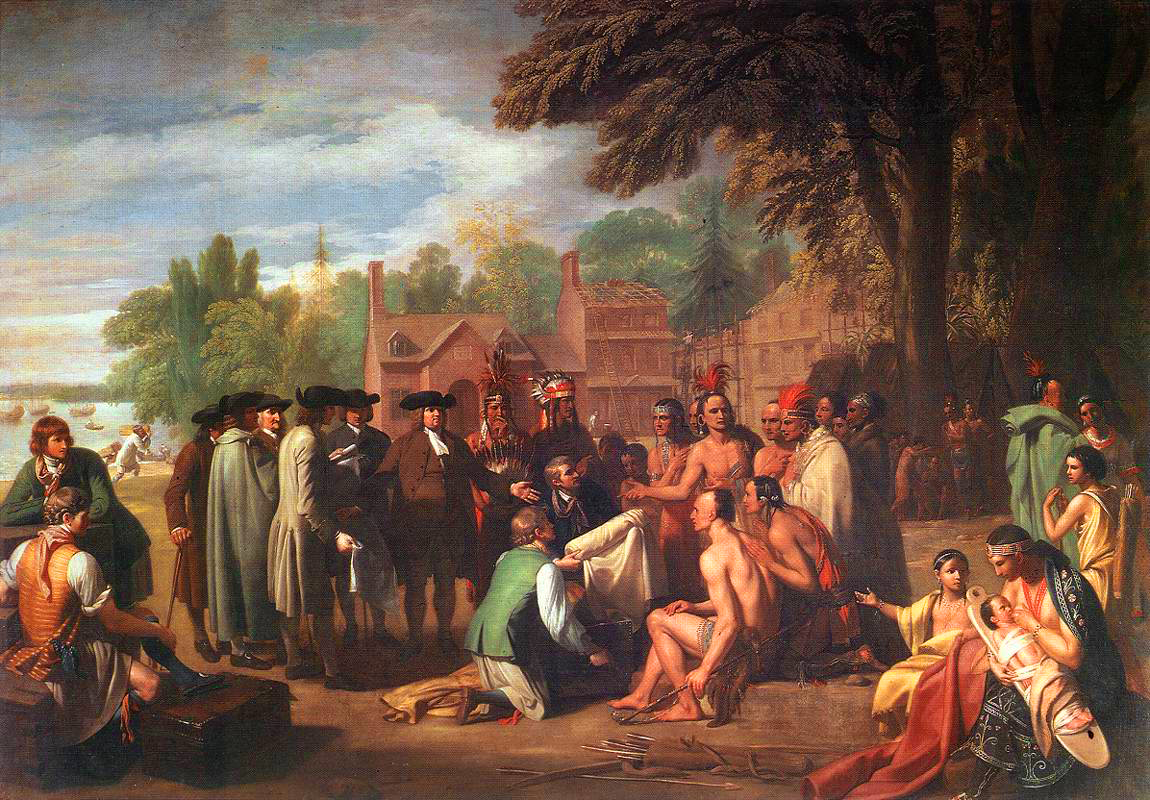
Benjamin West, The Treaty of Penn with the Indians (1772). Oil on canvas. Pennsylvania Academy of Fine Arts, Philadelphia. Wikicommons.
Filed under: art | Closed
The latest issue of Arena Journal — Stolen Lands, Broken Cultures: The Settler-Colonial present — will be launched in Melbourne.
Settler-colonial attitudes go to the core of tensions in the world today, but are by and large ignored. They stand at the centre of the possibility of a nuclear exchange in the Middle East, as well as at the moral core of what it means to be human in relations between Indigenous and non-indigenous cultures. The forum/launch will include discussion of some of the issues around settler-colonial practices both historically and in the present.
Speakers: Patrick Wolfe, Lorenzo Veracini, John Hinkson
Chair: Paul James
Arena Centre, 2 Kerr Street, Fitzroy
6.30 pm Tuesday 6th November.
Filed under: Australia, launch | Closed
bit in lieu of abstract:
It is a mistake to imagine that Native peoples held political power only when they could align themselves with European empires and nation-states. Native peoples held power when they controlled territory and when they used political, military, and economic power to assert place and belonging on a continent undergoing massive transformation. The history of modern North America is a story of contact between immigrants and indigenous peoples that gave rise to concepts like race, nation, and sovereignty, which gave shape to the new nations of North America: indigenous tribal nations and composite nation-states.
Grounding the history of the West within the story of the emergence and evolution of a Native New World makes the history of indigenous peoples central to the history of North America. It also underscores the significance of settler colonialism to the history of the United States and the history of America’s western expansion. In the Old Northwest, the United States had to work hard as a colonizing power to make Anishinaabewaki into an American space. Michigan remained a territory until 1837, and Wisconsin and Minnesota were not even organized as territories until 1836 and 1849, respectively. In each of these places, Native peoples lost territory, but they resisted removal to Indian Territory and maintained reservations on tribal homelands. Even more remarkable, their mixed-race Anishinaabe relatives won the right to vote, sanctioned by Congress, during a century when Americans restricted the franchise to white men and excluded Indians and people of African and Asian descent from citizenship. In order to understand how some Anishinaabeg fought—and succeeded—in remaining Indians on their homelands whileothers used their Indianness to gain political power and citizenship in America’s newly created western territories, we need to understand the long trajectory of contact in North American history that begins in the West with the history of the Native New World.
Filed under: Scholarship and insights, United States | Closed


