The majority of the 160,000 convicts transported to Australia in the nineteenth century were European, yet a small number of colonial subjects were also incorporated into Britain’s Antipodean penal settlements. These included Aboriginal prisoners from the New South Wales frontier. By the 1850s a few Aboriginal convicts were incarcerated at Cockatoo Island, Sydney Harbour, where their comparatively high rate of death attracted administrative attention. This article situates these deaths in custody within the broader history of convict transportation. As well as an analysis of comparative death rates it uses a series of case studies to explore the factors that contributed to the higher death rate experienced by Aboriginal convicts in colonial Australia.
Filed under: Australia, Scholarship and insights | Closed
The U.S. Supreme Court ruling in Johnson v. McIntosh established the basic principles that govern American Indian property rights to this day. In the case, more than one Anglo-American purchaser claimed title to the same land in what is now southern Illinois. The Piankeshaw Indians had deeded the land twice—once to speculators in 1775, and again, thirty years later, to the United States by treaty. The Court decided in favor of William McIntosh, who had bought the land from the U.S. government. Writing for the majority, Chief Justice John Marshall declared that the “discovery” of America had given “exclusive title to those who made it”— namely, the European colonizers. According to Johnson, the Piankeshaws did not own what they thought was their land. Indeed, no Indian tribe did.
Blake A. Watson’s examination of Johnson v. McIntosh and its impact offers a comprehensive historical and legal overview of Native land rights since the European discovery of the New World. Watson sets the case in rich historical context. After tracing Anglo-American views of Native land rights to their European roots, Watson explains how speculative ventures in Native lands affected not only Indian peoples themselves but the causes and outcomes of the French and Indian War, the American Revolution, and ratification of the Articles of Confederation. He then focuses on the transactions at issue in Johnson between the Illinois and Piankeshaw Indians, who sold their homelands, and the future shareholders of the United Illinois and Wabash Land Companies.
The final chapters highlight the historical legacy of Johnson v. McIntosh for federal policy with regard to Indian lands. Taught to first-year law students as the root of title for real property in the United States, the case has also been condemned by the United Nations and others as a Eurocentric justification for the subjugation of the Indians. Watson argues that the United States should formally repudiate the discovery doctrine set forth in Johnson v. McIntosh.
The thorough backstory and analysis in this book will deepen our understanding of one of the most important cases in both federal Indian law and in American property law.
Filed under: law, Scholarship and insights | Closed
The dynamics of population and urbanization in South Africa have been recorded by a remarkable set of censuses during the 20th century. These censuses indicate a changing hierarchy of places that is typical of a settler society and of its representations of space and society. Over one century, the official census places and the pattern of population distribution have shifted from a selective colonial view of human settlements to an inclusive postcolonial society view closer to the distribution of the whole population.
Filed under: Scholarship and insights, Southern Africa | Closed
This fascinating look at the cultural and military importance of British forts in the colonial era explains how these forts served as communities in Indian country more than as bastions of British imperial power. Their security depended on maintaining good relations with the local Native Americans, who incorporated the forts into their economic and social life as well as into their strategies. This book uses official British records, traveler accounts, archaeological findings, and ethnographic information to reveal native contributions to the forts’ stories. Based on in-depth research at five different forts, the book considers features that seemed to arise from Native American culture rather than British imperial culture. The book’s perspective reveals that British fort culture was heavily influenced, and in some cases guided, by the very people these outposts of empire were meant to impress and subdue. The book recaptures the significance of small-scale encounters as vital features of the colonial American story, without arguing their importance in larger imperial frameworks. It specifically seeks to reorient the meaning of British military and provincial backcountry forts away from their customary roles as harbingers of European imperial domination.
Filed under: Scholarship and insights, United States | Closed
Today the bulk of tangible wealth around the globe resides in buildings and physical infrastructure rather than moveable goods. This situation was not always the case. Investing in the Early Modern Built Environment represents the first attempt to delve into the period’s enhanced architectural investment—its successes, its failures, and the conflicts it provoked. Not just cultural but clear economic and environmental reasons existed for a rejection of the new architectural agenda. Whatever its efficacy or flaws, it ultimately served as a model worldwide for cityscapes and housing well into the twentieth century.
Filed under: Scholarship and insights | Closed
Introduction
John Hinkson, ‘Why settler colonialism?’.
Time
Edward Cavanagh, ‘History, time and the indigenist critique’.
Elizabeth Strakosch and Alissa Macoun, ‘The vanishing endpoint of settler colonialism’.
Sarah Maddison, ‘Seven generations behind: Representing native nations’.
Bodies
Mary O’Dowd, ‘Embodying the Australian nation and silencing history’.
Gaia Giuliani, ‘The colour lines of settler colonialism’.
Hokulani K Aikau, ‘More than preserving a polynesian paradise’.
Spaces
Alice Robinson and Dan Tout, ‘Unsettling conceptions of wilderness and nature’.
Tracey Banivanua Mar, ‘Settler-colonial landscapes and narratives of possession’.
Melissa Lovell, ‘A settler-colonial consensus on the northern intervention’.
Deirdre Howard-Wagner, ‘Reclaiming the northern territory as a settler-colonial space’.
Palestine: Past and Present
John Docker, ‘Orientalism and zionism: Dismantling Leon Uris’s “exodus”‘.
Patrick Wolfe, ‘New Jews for old: Settler state formation and the impossibility of Zionism: In memory of Edward W. Said’.
Afterword
Lorenzo Veracini, ‘Settler colonialism: A global and contemporary phenomenon’.
Filed under: Africa, Asia, Australia, Éire, Canada, Empire, Europe, Genocide, Hawaii, Human Rights, Israel/Palestine, Latin America, middle east, New Zealand, Pacific, postcolonialism, Scholarship and insights, Southern Africa, United States | Closed
savages
‘Bushman’, ‘Maori’ and ‘Aborigine’, from the Savages series (2007-8), by artist Joe Levickas.
Filed under: art | Closed
book launch, ipcs
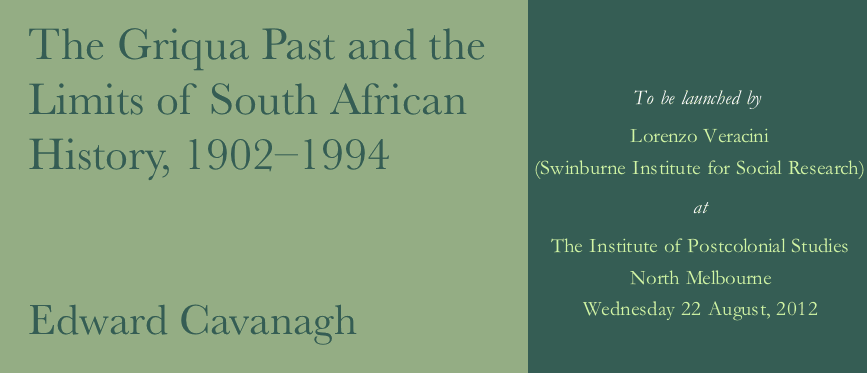
This book shows that the Griqua people are commonly misunderstood. Today, they do not figure in the South African imagination as other peoples do, nor have they for over a century. Cavanagh argues that their comparative invisibility is a result of their place in South Africa’s national narrative: an impediment that has precluded the Griqua from a number of new sources of redress for socio-economically disadvantaged peoples in the transformation era, in particular the program of land restitution developed in 1994. In this revisionist analysis of South African historiography, which connects with scholarship on other regions and peoples, the author analyses over a century’s worth of historical studies and identifies a number of narrative frameworks that have proven resilient to change over this time. The Griqua, in particular, have fared poorly compared to other peoples. They appear in, and disappear from, this body of work in a number of consistent ways, almost as though scholars have avoided re-imagining their history in ways relevant to the present. This book questions why that might be the case.
The book will be launched by Lorenzo Veracini, Queen Elizabeth II Fellow at the Swinburne Institute for Social Research. His research focuses on the comparative history of colonial systems and settler colonialism. He is the author of Settler Colonialism: A Theoretical Overview (2010) and Israel and Settler Society (2006). In 2010 he cofounded the journal settler colonial studies, and is currently the journal’s managing editor.
Edward William Cavanagh is a non-indigenous Australian, formerly a student of the Australian National University, the University of Alberta, Swinburne University of Technology and the University of the Witwatersrand. He is currently an Ontario Trillium Foundation Scholar, and will prepare a comparative legal history of companies within the British Empire from the sixteenth century to the twentieth century, as a graduate student at the University of Ottawa. He specialises on the history of settler colonies, particularly focusing on matters relating to land and sovereignty. His scholarship attempts to explore some of the ways we can understand and address indigenous rights both in the past and in the present, both within and across national boundaries. He is the co-founder and reviews editor of the journal settler colonial studies, and he has authored a number of journal articles in the separate fields of history and law. The Griqua Past and the Limits of South African History, 1902-1994 is his first monograph.
The Institute of Postcolonial Studies is an independent organisation committed to advancing the recognition of cultural difference, and encouraging mutual engagement and reconciliation. The Institute building was once a pub on the route to the Victorian goldfields, but has since been extensively remodelled to suit contemporary needs. The renovation of the building was overseen and designed by architect Shelley Penn and the gardens and plantings are overseen by landscape architect Mary Chapman.
Filed under: launch, public lecture, Scholarship and insights, Southern Africa | Closed
Institute for Social Transformation Research, in cooperation with the School of History and Politics, Faculty of Arts @ University of Wollongong, New South Wales, Australia, 24 & 25 September 2012.
Click here for the complete Collaborative Struggle program, featuring Henry Reynolds, Lorenzo Veracini, Ilan Pappé, and others.
Filed under: public lecture, Scholarship and insights | Closed

