From DOMINION OF CANADA ANNUAL REPORT OF THE DEPARTMENT OF INDIAN AFFAIRS FOR THE YEAR ENDED 30th JUNE 1896.
available online here.
Filed under: Canada | Closed
This article compares American and Russian colonization of continental interiors and the consequences for the indigenous Sioux and Kazakhs, focusing on imperial perceptions, social and economic dislocation, political sovereignty, and sedentarization. It provides a critical, comparative analysis of internal colonization exercised by the United States and Russia.
Filed under: Europe, Scholarship and insights, United States | Closed
Amanda Nettelbeck, ‘Remembering indigenous dispossession in the national museum: The National Museum of Australia and the Canadian Museum of Civilization’, Time & Society 21, 1 (2012).
Recent decades have seen the escalation of debate across western democracies that were once sites of the British Empire about how to remember the history of colonialism. This essay will consider how these debates have manifested in relation to the history of indigenous dispossession and its remembrance in Australia and Canada, which not only share many parallels in their stories of settlement but also in their recent efforts to come to terms with historical injustices against indigenous peoples. In examining how these debates have taken shape in the representation of national history in Australia’s and Canada’s recently established national museums, this essay will question the degree to which public historical consciousness in these former settler societies demonstrates a political imperative to remember historical injustices on the one hand, and on the other hand an enduring desire to forget them in favour of a more unifying story of the nation.
Filed under: Australia, Canada, Scholarship and insights | Closed
alison bashford on malthus
Alison Bashford, ‘Malthus and colonial history’, Journal of Australian Studies 36, 1 (2012).
It is rarely recognised—either by scholars of Australian history or of Thomas Robert Malthus—that the famous political economist wrote about New South Wales and Van Diemen’s Land in later editions of Essay on the Principle of Population. This occasional lecture examines just what he said about Aboriginal people in 1803, at a time when native people and their land was high on many a colonial agenda. This Lecture suggests the need to analyse Malthus’s Essay in the light of colonial historiography as well as economic history.
Filed under: Australia, Empire, Scholarship and insights | Closed
Canberra’s teepee man William Woodbridge has taken his fight to stay on Lake Ginninderra to the Supreme Court.
The 21-year-old lodged an interlocutory injunction with the court yesterday to stop what local Ngambri elder Shane Mortimer labelled an “unlawful forced removal” from the floating home.
Filed under: media | Closed
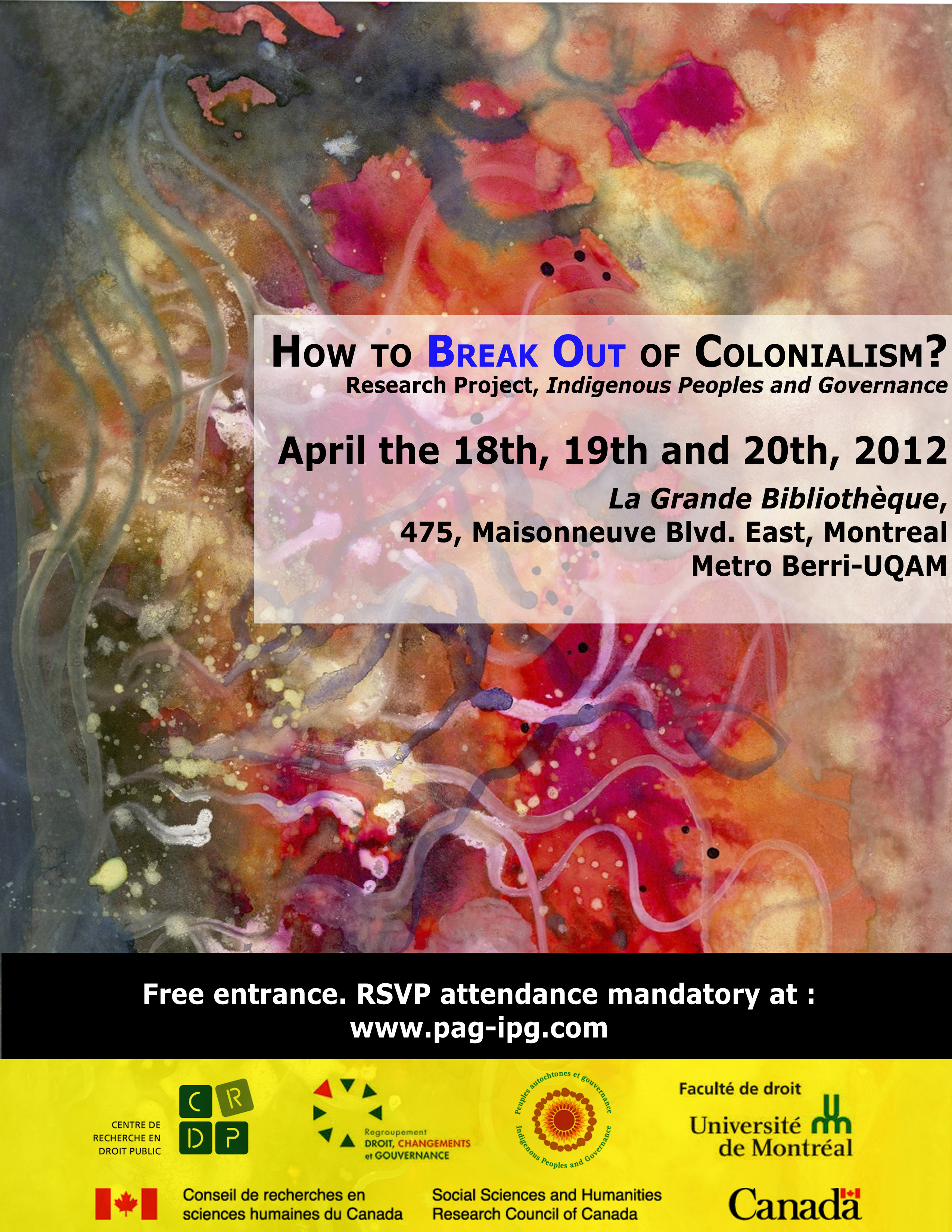
How to Break out of Colonialism? April 17, 18, 19 et 20 2012 @ Grande Bibliothèque de Montréal.
Hat-tip, TR.
Filed under: Canada, Seminar | Closed
Our genetic markers have come to be regarded as portals to the past. Analysis of these markers is increasingly used to tell the story of human migration; to investigate and judge issues of social membership and kinship; to rewrite history and collective memory; to right past wrongs and to arbitrate legal claims and human rights controversies; and to open new thinking about health and well-being. At the same time, in many societies genetic evidence is being called upon to repair the racial past and to transform scholarly and popular opinion about the “nature” of identity in the present.
Genetics and the Unsettled Past considers the alignment of genetic science with commercial genealogy, with legal and forensic developments, and with pharmaceutical innovation to examine how these trends lend renewed authority to biological understandings of race and history.
This unique collection brings together scholars from a wide range of disciplines to explore the emerging and often contested connections among race, DNA, and history. Written for a general audience, the book’s essays touch upon a variety of topics, including the rise and implications of DNA in genealogy, law, and other fields; the cultural and political uses and misuses of genetic information; the way in which DNA testing is reshaping understandings of group identity for French Canadians, Native Americans, South Africans, and many others within and across cultural and national boundaries; and the sweeping implications of genetics for society today.
Filed under: Scholarship and insights, Science | Closed
James Belich, ‘Review: Jerry H. Bentley (ed.), The Oxford Handbook of World History’, English Historical Review (2012).
Relevant extract (but the review is worth canvassing in its entirety, absolutely):
Duara’s decision to exclude settler colonialism from his ‘modern imperialism’ is also problematic. The hard fact is that three and one-third (Russian Asia) of the world’s six inhabited continents are still dominated by people of European settler descent. His Africa-partitioning Berlin ‘Act’ of 1885 (p. 389) was in fact a congress, and his relatively benign take on Japanese imperialism in Manchuria and Korea is intriguing but highly contestable.
Filed under: Africa, Asia, Australia, Éire, Canada, Empire, Europe, Hawaii, Israel/Palestine, middle east, New Zealand, Pacific, Scholarship and insights, Southern Africa, United States | Closed
Mark Rifkin, ‘The Transatlantic Indian Problem’, American Literary History (2012), 1-19.
bit in lieu of abstract:
All three of these studies valuably indicate the significance of Indianness beyond a semi-ethnographic, and potentially fetishizing and exoticizing, concern with the lifeways of Indigenous peoples. Yet they also tend to treat the figure of the Indian as a mobile trope which can be read either as signifying principally in the somewhat insulated space of European reception or as a repeating (and relatively unchanging) marker of the limits of colonial modernity. In this way, their version of the transnational turn largely brackets consideration of the ways the production and dissemination of Indianness interfaces with particular strategies of settler governance. Attending to work within Indigenous studies that addresses the connection between figurations of Indianness/Aboriginality and the administrative management, dislocation, and erasure of Indigenous peoples might help reconnect the generic image to the sociopolitical processes affecting those so represented. Moreover, the transnational here appears as movement between fairly discrete sites, and the political, economic, and cultural affiliations among them seem to bear little on how Indianness is interpreted. There is a growing body of work focusing on the creation of transnational networks among peoples whose lands are claimed by different settler states and the use of international fora and discourses to do so.16 And scholarship increasingly has turned to the ways associa- tions among Indigenous peoples within the boundaries of the same settler state can be understood as transnational, highlighting their existence as distinct polities and the specificity of their ways of enacting diplomatic and other relations not routed through the political imaginary of the nation that presents them as part of its “domestic” space. Still, largely unaddressed are the ongoing forms of connection between imperial centers and spaces of settlement and among settler states themselves once independent. What role do figures of Indianness play in forging, mediating, regulating, and disavowing networks of settlement across geopolitically differentiated spaces? How does the production of the Indian as a problem—an obstruction, mystery, remnant—participate not only in local settler projects and programs but in broader formations of interdependence, investment, and influence? Although these three studies do not pursue such questions, they do implicitly raise them, indirectly gesturing toward the value of a different sort of transnational turn within Indigenous Studies.
Filed under: literature, Scholarship and insights | Closed

