From introduction:
Vincent Ward’s Vigil (1984) and Jane Campion’s The Piano (1993) can be considered as significant points in the filmic depiction of the settler psyche. These films depict the settler struggling against the land – a desire to tame and cultivate “wildernesses” into a manageable environment. From Alisdair Stewart’s tenuously planted fence-posts in The Piano to Birdie’s archaic derrick in Vigil, the (male) settler is positioned living against the land rather than within it. However, Vigil and The Piano offer another instance of settling in the form of the child-settler, a character negotiating ambivalent feelings encompassing both environmental and familial factors. The child-settler is the settler par excellence; the child who is to grow up in the growing settler colony is symbolic of “potential” in the settler polity, the society to come, emphasised in the parallels between settlement and growing up. Both are characterised by an impossibility of return, as settlement implies the intention to stay and the growing child cannot return to an earlier phase of existence. That these child-settler characters are girls rather than boys displaces another archetypal settler character: that of the Man Alone, erasing any assumed inheritance along paternal lines. Rather than the son acquiring the father’s struggles against the land, the girl functions as a witness to tensions orchestrated within the bounds of the domestic space linked to the mother, and the external landscape connected with the father. Thus, for Toss in Vigil and Flora in The Piano settlement is an anxious process, articulated in their ambivalence towards their environments and compounded by their inclusion in a triangulated familial relationship that results in destabilised space being figured domestically, but also externally. The final “place” of settlement is determined to lie “elsewhere,” a site removed from the setting of the bulk of the narrative.
This article takes the child-settler’s witnessing of the “primal scene” – an occurrence in both narratives – as a locus of anxiety in which the child is triangulated within the parental couple yet simultaneously wholly outside it. Neither narrative places the primal scene as witnessed by infants or very young children; rather, Toss and Flora are older (roughly twelve and nine respectively), and within the ‘latency stage’ of Sigmund Freud’s model of the stages of psychosexual development. For Toss and Flora, their positions as child-settlers are inherently anxious due to the particular emphasis on reality and the denial of phantasy characteristic of the latency stage. This anxiety is augmented by the arrival of a stranger, a thorn that twists the organisation of familial relations and by extension destabilises the settler-family’s grasp on the landscape. Moreover, the very presence of the child-settler rejects the positioning of the mother (and by extension, landscape) as ‘virgin’ soil – a myth that premises settler colonialism as the first “act” of cultivating a foreign landscape. This myth erases indigenous presence and prior inhabitation, which are invisible in Vigil, or relegate the indigenous population to the background as fauna, “authenticating” the exotic wilderness, as in The Piano.
Filed under: literature, New Zealand, Scholarship and insights | Closed
The Native American and Indigenous Studies Association 2012 Meeting is set to roll for June. Its program is available here.
Filed under: Uncategorized | Closed
With the appearance in 2010 of an essay by Martin Shaw, ‘Palestine in an International Historical Perspective on Genocide’, Holy Land Studies has taken the hermeneutic initiative in bringing together into the one field of analysis two areas that have usually been kept separate, genocide studies and studies of the history of Palestine-Israel. In an important challenge to contemporary scholarship, Shaw makes a cogent critique of the notion of ‘ethnic cleansing’ as euphemistic and perpetrator-inflected. I follow Shaw in translating ‘ethnic cleansing’ as ‘genocide’ of a group or society by deploying the terms and argument of Raphaël Lemkin, the creator of the concept of ‘genocide’ and prime mover in the 1948 UN Convention on genocide.
Filed under: Genocide, Israel/Palestine, Scholarship and insights | Closed
Thursday, May 10, 2012 6275 Bunche Hall 2:30 p.m. – 6 p.m.
Session I: 2:30p.m.—4 p.m Aziz Rana (Cornell University) will present his book, The Two Faces of American Freedom . Discussant: Lorenzo Veracini (Swinburne University of Technology and Visiting Professor at UCLA)
Session II: 4:30—6 p.m. Craig Yirush (UCLA) will present his book, Settlers, Liberty, and Empire: The Roots of Early American Political Theory . Discussant: Patrick Wolfe (Stanford University and La Trobe University)
Convened by Gabriel Piterberg (UCLA).
Filed under: Seminar | Closed
In their influential work on settler colonialism, Patrick Wolfe and Lorenzo Veracini explained that settler societies are not only predicated upon the structural elimination of Indigenous societies, but also on a historical trajectory culminating in settler colonialism’s own self-suppression. This accounts for recent scholarly efforts to deconstruct rhetorical and discursive attempts to represent our multicultural, settler societies as not colonial anymore. In Québec, the situation is even more complex because the francophone majority, on account of its declared state of minorityhood on a continental level, has not only disassociate itself from settler colonialism per se, but its own claims over identity, home, and nationhood appear not to require the rhetorical suppression of a colonial legacy. It is in such context that Gérard Bouchard and Charles Taylor, in their publicly commissioned Report on cultural difference and accommodation practices, defined interculturalism as an alternative to official forms of multiculturalism. In this paper, I argue that, by attempting to theorize the acquired status of a racially neutral concept of ‘Nativeness’, such an understanding of interculturalism completes the political erasure of the settler colonial specificity of Québec’s claim to nationhood and minorityhood.
And find an interview between Robert-Falcon Ouellette and Bruno Cornellier here.
Filed under: Canada, Scholarship and insights | Closed
Allan Greer, ‘Commons and Enclosure in North America’, American Historical Review 117, 2 (2012).
Opening paragraphs:
What were the broad processes by which settlers of European stock created new forms of tenure and wrested control of lands from indigenous peoples, first in the Americas and later across wide stretches of Africa and Oceania? Anyone interested in this basic question about colonization and dispossession in an Atlantic world setting may be tempted to think in terms of a great “enclosure movement” that took shape first in England and Western Europe and then extended overseas to the New World, bringing survey lines, fences, and legal rules fostering exclusive access and transferability. More than one historian has pointed in the direction of such an extended conception of enclosure, although none has so far made the case in detail. “When the English took possession of lands overseas, they did so by building fences and hedges, the markers of enclosure and private property,” write Peter Linebaugh and Marcus Rediker. In relation to the eighteenth and nineteenth centuries, E. P. Thompson has also pointed to a connection between enclosure within England and the imposition of private property across the overseas British Empire, notably in India, where the Permanent Settlement of Bengal (1793) represented a particularly brutal and doctrinaire attempt to establish unitary proprietorship over land. Thompson’s argument about enclosure and colonization appeared in an essay published late in his life, and it touches on North America, New Zealand, and Africa as well as India. Richly suggestive, it remains schematic and preliminary, pointing to a long‐term global movement to privatize the commons that emanated outward from the British Isles. Certainly, there is an intriguing, if rough, coincidence of peak periods of enclosure in England—the Tudor period and the late eighteenth century—with times of imperial expansion and reinvigoration.
Settlers did frequently erect fences, since “enclosure” in that mundane sense of the term played an important part in separating ruminants and crops, the two elements whose coexistence typified European agriculture. It is also true that commodified, individualized forms of property usually followed in the wake of colonization, although the transition may not have been as rapid as some imagine. While the long‐run tendency may indeed have been in the direction of an enclosed private property regime that largely excluded natives, colonization was also accompanied by the establishment of commons. Evidence from seventeenth‐century New Spain, New France, and New England can shed light on the interplay of enclosure and commons in the formation of colonial property regimes in North America. It shows that common property was a central feature of both native and settler forms of land tenure in the early colonial period and that dispossession came about largely through the clash of an indigenous commons and a colonial commons.
Filed under: Canada, Empire, law, Scholarship and insights, United States | Closed
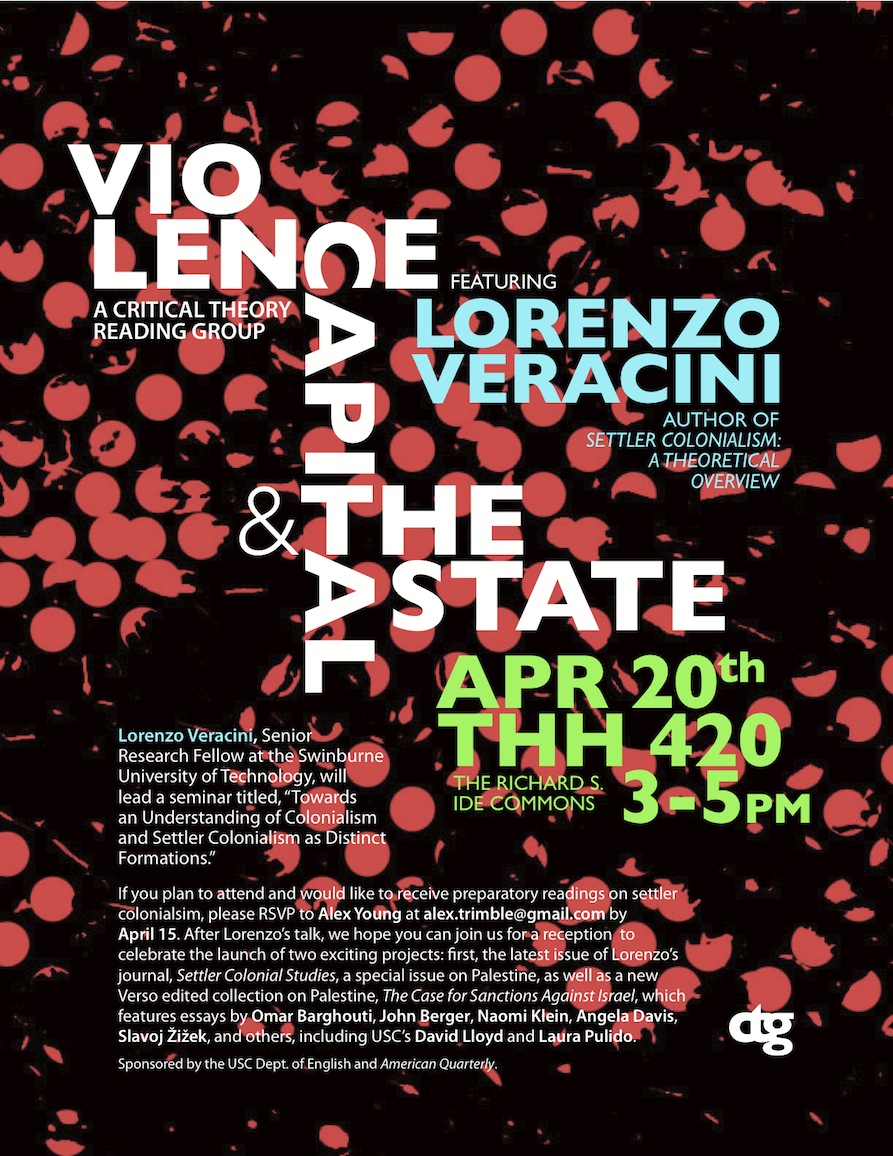
settler colonial studies (‘Past is Present: Settler Colonialism in Palestine’), and a new collection, The Case for Sanctions against Israel are to be launched at University of Southern California on 20 April. Lorenzo Veracini will lead a seminar as well.
Filed under: Israel/Palestine, Scholarship and insights, Seminar | Closed
Alexander Etkind, Internal Colonization: Russia’s Imperial Experience (Polity, 2011).
This book gives a radically new reading of Russia’s cultural history. Alexander Etkind traces how the Russian Empire conquered foreign territories and domesticated its own heartlands, thereby colonizing many peoples, Russians included. This vision of colonization as simultaneously internal and external, colonizing one’s own people as well as others, is crucial for scholars of empire, colonialism and globalization.
Starting with the fur trade, which shaped its enormous territory, and ending with Russia’s collapse in 1917, Etkind explores serfdom, the peasant commune, and other institutions of internal colonization. His account brings out the formative role of foreign colonies in Russia, the self-colonizing discourse of Russian classical historiography, and the revolutionary leaders’ illusory hopes for an alliance with the exotic, pacifist sectarians. Transcending the boundaries between history and literature, Etkind examines striking writings about Russia’s imperial experience, from Defoe to Tolstoy and from Gogol to Conrad.
This path-breaking book blends together historical, theoretical and literary analysis in a highly original way. It will be essential reading for students of Russian history and literature and for anyone interested in the literary and cultural aspects of colonization and its aftermath.
Filed under: Europe, Scholarship and insights | Closed
cfp: contact zones
Relationships between indigenous and settler citizens have been shaped and managed by physical and ideological boundary setting, from the expansion of frontier borders into Indian Country to the reservation system, from residential schools to social welfare programs aimed at indigenous people. As they fight against processes of erasure, indigenous people’s forms of resistance, place-making and efforts toward sovereignty unsettle neatly drawn national, state, provincial, and municipal borders, calling attention to the processes of colonization that reordered lives and lands. This panel explores the effects and affects of these boundary formations and unsettlement, paying special attention to how settler citizens (re)imagine their local landscapes, their indigenous neighbors and predecessors, and their relationships to colonial pasts, contemporary conciliatory campaigns, and local articulations of power and resistance.
How are settler identities negotiated in an era of national apologies (Australia, Canada), truth and reconciliation commissions (Canada, South Africa), and conditional endorsements of the United Nations Declaration on the Rights of Indigenous People? Simultaneously with these national projects of contrition, how are settler identities forming amidst discourses of ‘special’ resource rights, casinos, tax exemptions, and the Rich Indian (USA)? What and where are the meeting grounds of settlers and Indigenous people today; where are the contemporary contact zones of (post)-coloniality (Pratt 1992)? How are physical and ideological borders redrawn and contested? How can anthropological analyses attend to issues of settler colonialism in the United States (Cattelino 2010) and elsewhere?
We invite presenters to consider the ways settler peoples experience, resist, and contribute to grass-roots and state-sanctioned attempts to address historical injustices and contemporary inequalities at the centers and margins of (post)-colonial places. We welcome critical analyses on a range of topics: citizenship, (re)defining the ‘settler state’ or ‘settler society’, sovereignty, inclusion, cultural and economic politics, reconciliation, land claims, treaty rights, and settler affect.
Contact Zones: At the Borders of (In)Visibility, (Post)Colonialism, and In/Exclusion in Settler States
111th AAA Annual Meeting of the American Anthropological Association
November 14-18, 2012
San Francisco, CA
Borders and Crossings
http://www.aaanet.org/meetings/
Session Organizers: Natalie Baloy (University of British Columbia) and Emily Levitt (Cornell University)
For consideration, please send in abstracts by April 9, 2012 to Natalie Baloy and Emily Levitt.
Filed under: Call for papers | Closed
cfp: collaborative struggle
The ‘Arab Spring’ and the ‘Occupy Wall Street’ movements have both, in their very different ways, brought to life the idea that ‘the people’, long thought to be missing, can and do make a difference. This conference is interested in the possibilities these kinds of ‘collaborative struggles’ are opening up for new ways of thinking about politics, citizenship, identity and indeed life itself. What happens when Palestinians and Jews struggle together to defeat the segregation that nourishes the continuation of their conflict? What if a society of white privilege were to give way to an integrative way of life in Australia? This conference discusses different aspects of joint action – or ‘collaborative struggles’ – as the way to exit colonial divisions and oppressive relations in contemporary societies. We assume that the way we choose to struggle is the way we choose to create the new.
University of Wollongong. 25 September 2012.
Filed under: Australia, Call for papers, Israel/Palestine, Scholarship and insights | Closed

