The disintegration of the British National Party (BNP) has removed the threat of the party securing a place in the political mainstream in the UK. But, in coming close to this objective it has succeeded in renewing and legitimising both its own claims to speak on behalf of the indigenous people of Britain, as well as the similar claims of other groups such as the English Defence League (EDL), the English Democrats and the Freedom Party. Rather than assessing the impact of the BNP in terms of the number of votes and councillors, this article contends that the renewal of racist discourse may enable far right views and ideologies to penetrate and gain acceptance in mainstream British society over the next decade. This article examines the re-shaping of the rhetoric of indigeneity by the BNP to legitimise racism. Using articles originally written for the BNP magazine Identity between 2006 and 2008 and extracted from the BNP website in advance of the 2010 elections, this article discursively analyses the way in which the BNP deploys the concept of indigeneity in its constructions of social groups in Britain. It is suggested that the potential (mis)use of indigeneity as a legitimising vehicle for racist and illiberal views and policies is exacerbated by the lack of clear definitional boundaries around the concept of indigeneity itself.
Filed under: Europe, Political developments, Scholarship and insights | Closed
The modern international system is commonly argued to have originated within Western Europe and spread globally during centuries of colonialism. This article argues, instead, that the character of the modern system of territorially sovereign states resulted from a complex interaction between European colonizing polities and events, actors, and spaces in other parts of the globe. In particular, through a process of colonial reflection, many of the foundational ideas and practices of modern statehood were formed in the interactions of Europeans with the unknown, supposedly empty, spaces of the New World in the 16th and 17th centuries. These novel practices were applied only later to politics among states in Europe. Most important among these developments is the ideal of territorial exclusivity as the sole basis for state sovereignty. This analysis also has implications for the study of contemporary international systemic change.
Filed under: Empire, Europe, law, Scholarship and insights, Sovereignty | Closed
Mobility was constitutive of the 19th century British colonial period in the Pacific. The circulation of capital and commodities, technologies of transportation and communication, travelling ideologies and systems of governance and surveillance, as well as the movement of explorers, whalers, labourers, settlers, missionaries, colonial administrators, convicts, soldiers, sojourners, immigrants, and transnational and displaced indigenous peoples, all shaped the politics and the period.
Filed under: Australia, New Zealand, Scholarship and insights | Closed
Robert A. Williams Jr., Savage Anxieties: The Invention of Western Civilization (Palgrave, 2012).
From one of the world’s leading experts on Native American law and indigenous peoples’ human rights comes an original and striking intellectual history of the tribe and Western civilization that sheds new light on how we understand ourselves and our contemporary society. Throughout the centuries, conquest, war, and unspeakable acts of violence and dispossession have all been justified by citing civilization’s opposition to these differences represented by the tribe. Robert Williams, award winning author, legal scholar, and member of the Lumbee Indian Tribe, proposes a wide-ranging reexamination of the history of the Western world, told from the perspective of civilization’s war on tribalism as a way of life. Williams shows us how what we thought we knew about the rise of Western civilization over the tribe is in dire need of reappraisal.
Filed under: Uncategorized | Closed
Robert J. C. Young, ‘Postcolonial Remains’, New Literary History 43, 10 (2012).
Extract in lieu of abstract:
The postcolonial remains: it lives on, ceaselessly transformed in the present into new social and political configurations. One marker of its continuing relevance is the degree to which the power of the postcolonial perspective has spread across almost all the disciplines in the humanities and social sciences, from classics to development theory to law to medi- eval studies to theology—even sociology, under the encouragement of postcolonial-minded scholars such as Arjun Appadurai and Paul Gilroy, has abandoned its former narrow national focus to turn to an interest in globalization in the present. So many disciplines have been, so to speak, postcolonialized, along with the creation of related subdisciplines such as diaspora and transnational studies, that this remarkable dispersal of intellectual and political influence now makes it difficult to locate any kind of center of postcolonial theory: reaching into almost every domain of contemporary thought, it has become part of the consciousness of our era. Inevitably, in each discipline in which it has been taken up, the postcolonial has been subtly adapted and transformed in different ways—in sociology’s turn to globalization, for example, the historical perspective so fundamental to postcolonial studies gets largely removed. But how has the postcolonial itself changed in response to the historical transformations that have been occurring in the last decades, and, even more to the point, how should it change in the future? What conditions and situations have risen to a new visibility? What have been the greatest challenges to postcolonial analysis? And, continuing in the necessary mode of perpetual autocritique, what aspects of its own theoretical framework have limited the reach of its own radical politics?
[…]
In the arena of postcolonial studies, settler colonialism has managed, through its invocation of the tradition of colonial nationalism, to affiliate itself to the emancipatory narratives of anticolonial struggles—witness the widely circulated The Empire Writes Back of 1989, which assimilates all forms of colonial liberation into a single narrative of freedom from the imperial metropolis. What this passes over is the degree to which settler colonies themselves practiced a form of “deep colonialism,” a term recently revived by Lorenzo Veracini, which underscores the extent to which the achievement of settler self-governance enforced the subjection of indigenous peoples and indeed increased the operation of oppressive colonial practices against them. In almost any settler colony one can think of, settler liberation from colonial rule was premised on indigenous dispossession. The emancipatory narrative of postcolonialism was not accessible to those who remained invisible within it. Indeed for them, national emancipation produced a more overpowering form of colonial rule, often enforced by a special contract for indigenous peoples distinct from that between settlers and metropolis.
The postcolonial question that remains is how indigenous emancipa- tion, that is the acquisition of land and rights not mediated or already conditioned by the terms of settler emancipation from which indigenous people were excluded, can be achieved. It also becomes clear that the same paradigm of sovereignty through dispossession applies to many nonsettler colonies, where indigenous minorities or historically excluded groups have found the freedom of a postcolonial sovereignty to mean comparable or even worse forms of oppression than under colonial rule, even if the political structure is that of a democracy.
Filed under: literature, postcolonialism, Scholarship and insights | Closed
Is there a distinctive Antipodean approach to development? In this introduction I take up Raewyn Connell’s challenge to explore the possibilities for knowledge production that reflects Australia’s and New Zealand’s geographical situation of rich peripheral countries and their history of settler colonisation. While Antipodeans’ contributions to development theory have been limited, their work is characterised by close connections between theory and practice. The Antipodes’ positioning as global North in the geographical South has stimulated a search for alternative approaches to development knowledge. This is variously pursued through collaborative research relationships with indigenous communities, close engagement with non-Western cultural frameworks, and a focus on marginal spaces and positions. As the centre of global economic power shifts to the South, existing development relationships and established ways of doing development are increasingly challenged by newly constituted subject positions and coalitions.
Filed under: Uncategorized | Closed
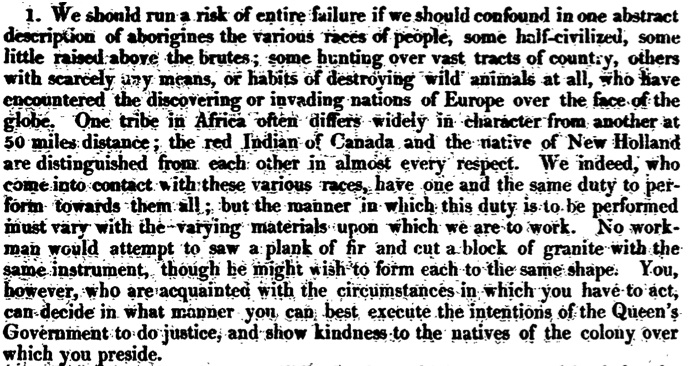
From a House of Commons Parliamentary Paper on Aborigines, no. 627 of 1844.
Filed under: Quote | Closed
broken dreams

Broken Dreams 3 2010
Michael Cook
Bidjara people
digital colour photograph
National Gallery of Australia, Canberra
purchased 2011
One of the pieces in unDisclosed, the 2nd National Indigenous Art Triennial at the National Gallery of Australia, Canberra, May 11 – July 22, 2012.
Lifted from ABC News.
Filed under: art, Australia | Closed
Certain dates are now viewed as classic loci of the time and contradictory temporalities of the postcolonial: 1492 (Columbus’s arrival in America and the expulsion of Jews from Spain); 1603 (Lord Mountjoy’s colonization of the northern counties of Ireland); 1798–1801 (Napoleon’s Egyptian campaign); 1791–1804 (the Haitian revolution); 1810–25(the independence of Brazil and Spanish America); 1833 (the abolition of slavery in the British Empire); 1857 (the bloody Sepoy uprising in Kanpur); 1884 (the Berlin Conference and the scrambling of Africa); 1947 (the independence of India, its partition, and the birth of Pakistan); 1954–62 (Algeria’s war of independence); 1955 (the Bandung Conference); 1955–75 (the Vietnam War); 1994 (the end of apartheid). hese dates are as emblem- atic of the spatial dynamics generated by the events they mark as they are of period demarcation. Of the inaugural dates just listed, 1492 and 1947 may be taken as useful bookends for the discussion here. he explorer’s notorious “discovery” of America was to trigger a wide range of spatializing processes. Sidney Mintz points out that sugar cane was irst carried to the New World by Columbus on his sec- ond voyage, in 1493. In 1516 Santo Domingo was the irst Spanish settlement to ship sugar to Europe, and by 1526 Brazil was shipping sugar to Lisbon in commercial quantities (32–34). Columbus’s sugar cane signaled the progressive incorporation of the West Indies into the world capitalist economy through a particular spatial arrangement of centers and peripheries, the resultant inequalities of which are being worked through to this day. Equally dramatic is 1947, marking the independence and partition of India, which entailed the mass displacement of populations. hese dates appear nonequivalent on irst look, but they share features of historical violence and the processes of space making during and ater the colonial period.
If postcolonialism is necessarily tied to the colonial owing to the simultaneous temporal and discursive framing of the field, it is the entire domain of colonial space making and its aterefects in the contemporary world that gives postcolonialism its significance today. Colonial space making is not merely the constitution of a geographically demarcated reality, though that is important. Colonial space making is first and foremost the projection of a series of sociopolitical dimensions onto geographic space. hese sociopolitical dimensions involve not just society and politics but also economy, culture, and a wide range of symbolic and discursive practices. Colonial space making is thus to be understood in terms of the relations that were structurally generated and contested across interrelated vectors throughout the colonial encounter.
Filed under: Empire, literature, postcolonialism, Scholarship and insights | Closed
Journal of Colonialism and Colonial History 13, 1 (2012).
Ann Curthoys, ‘Indigenous People and Settler Self Government: Introduction’.
Zoë Laidlaw, ‘Slavery, Settlers and Indigenous Dispossession: Britain’s empire through the lens of Liberia’.
Rachel Standfield, ‘Protection, Settler Politics and Indigenous Politics in the work of William Thomas’.
Mark McKenna, ‘Transplanted to Savage Shores: Indigenous Australians and British birthright in the mid nineteenth-century Australian colonies’.
Marilyn Lake, ‘The Gendered and Racialised Self who Claimed the Right to Self-Government’.
John Keane, ‘Restorative Justice: Rethinking the history of the impact of representative democracy upon Indigenous peoples’.
Filed under: Africa, Australia, Canada, Empire, New Zealand, Scholarship and insights, United States | Closed

