Abstract (Summary)
Nearly every country has participated in colonization or has been threatened by colonization. Modeling the processes used by colonizers and the native reaction to colonization will further understanding of current international relationships and past conflicts. This study was conducted to analyze the reactions of three indigenous cultures as they confronted European colonialism in search of a universal independent reaction to territorial encroachment. This is presented in three case studies focused on the Zulu of South Africa, the Moro of the southern Philippines, and the Sioux of the American Great Plains. The analysis model consists of examining settlements, taxation, land redistribution, and disarmament as reactions to changes in economic practices, cultural hegemony, and native religions. The study concludes that the reactions of all three focus cultures fit the same model, and that settlement, taxation, land redistribution, and disarmament are causes for conflict within the focus groups. The conclusion is that native cultures often alter traditional religious practices as a way of resisting colonization in their attempts to regain control of territory.
Filed under: Asia, Scholarship and insights, Southern Africa, United States | Closed
protecting the american home
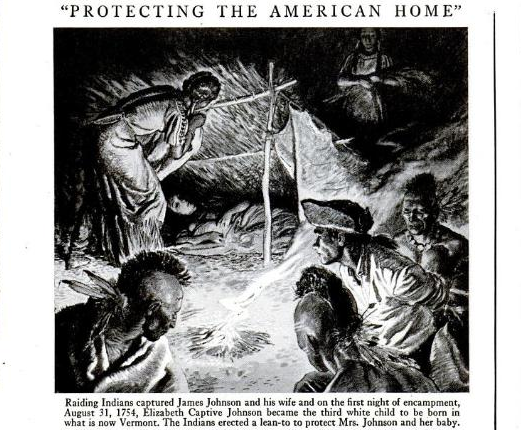
which I found via this fantastic South-Asian-poco-blog, Chapati Mystery.
Filed under: Uncategorized | Closed
easter island
At least 25 people have been injured during clashes between Chilean police and local people on Easter Island.
Witnesses say police fired pellets as they tried to evict several indigenous inhabitants from buildings they occupied earlier this year.
The Rapa Nui group say the buildings were illegally taken from their ancestors several generations ago.
Easter Island, which was annexed by Chile in 1888, is a Unesco World Heritage Site.
Filed under: Latin America, media, Political developments | Closed
An estimated 350 to 600 million indigenous people reside across the globe. Numerous governments fail to recognize its indigenous peoples living within their borders. It was not until the latter part of the twentieth century that the genocide of indigenous peoples became a major focus of human rights activists, non-governmental organizations, international development and finance institutions such as the United Nations and the World Bank, and indigenous and other community-based organizations.
Scholars and activists began paying greater attention to the struggles between Fourth World peoples and First, Second, and Third World states because of illegal actions of nation-states against indigenous peoples, indigenous groups’ passive and active resistance to top-down development, and concerns about the impacts of transnational forces including what is now known as globalization.
This volume offers a clear message for genocide scholars and others concerned with crimes against humanity and genocide: much greater attention must be paid to the plight of all peoples, indigenous and otherwise, no matter how small in scale, how little-known, how “invisible” or hidden from view.
Table of Contents available on Google books
Filed under: Africa, Asia, Australia, Canada, Genocide, Latin America | Closed

thomas mcclendon on the conflict between indirect rule and civilising colonialism in mid-19c natal
White Chief, Black Lords explores the tensions and contradictions between the British colonial civilizing mission and the practice of indirect rule. While the colonial imperative was to transform colonized societies and bring them within “civilized” norms, fiscal limitations frequently resulted in ruling through indigenous authorities and customs. In this book, Thomas McClendon analyzes this deep contradiction by looking at several crises and key turning points in the early decades of colonial rule in the British colony of Natal, later part of South Africa. He focuses a keen eye on the tenure of Theophilus Shepstone as that colony’s Secretary for Native affairs, examining his interactions with subject African communities.
In a series of case studies, including high drama over rebellions by African “chiefs” and their followers and intense debates over the control of witchcraft, White Chief, Black Lords shows that these colonial imperatives led to a self-defeating conundrum. In the process of attempting to rule through African leaders and norms yet to discipline and transform African subjects, the colonial state inevitably was itself transformed and became, in part, an African state. McClendon concludes by spotlighting the continuing importance of these unresolved contradictions in post-apartheid South Africa.
Filed under: Scholarship and insights, Southern Africa | Closed
CFP conference: Colonies and Postcolonies of Law, Princeton University, New Jersey. March 18 2011.
CFP conference, Sites of Citizenship 2011, Kings college London, June 2011.
CFP Conference, THE AMERICAN WEST IN LITERATURE AND FILM, San Antonio, Texas, 20-23 April 2011.
CFP Conference, Imperial Sites of Memory, University of St. Andrews, UK, 2-3 September 2011.
CFP Journal, Arena Journal, Special Issue on Settler Colonialism, DEADLINE EXTENDED TO APRIL 2011.
Filed under: Call for papers | Closed
I have recently got word that the deadline for this call for papers is extended to April 2011, or by negotiation.
Here are the details.
Modernity and colonialism are intimately linked, and colonialism has mobilised people in unprecedented ways. While in many places processes of bloody or incremental decolonisation meant that the invaders returned home; in other settings they stayed. In countries such as Australia, New Zealand, Canada, New Zealand, the United States, Taiwan, and others, the settlers stayed, and remained the dominant power group. In other countries, locales as diverse as Brazil, Hong Kong and South Africa, the colonial settlers (or at least one set of them) were displaced from political power, but maintained considerable economic power. This volume explores the nature and consequence of settler colonialism. We are especially interested in considering the consequences of a system that aims to replace the indigenous inhabitants of a given place: that is, where at least in principle indigenous people are to ‘disappear’ by one means or another.
Amongst other possibilities we encourage contributions that address the implications of the neo-assimilation that seems implicit in the recent ‘Intervention’ into Aboriginal communities in Australia.
In general our focus is on the present, neo-assimilation and displacement.
This issue of Arena Journal will also be published as a book.
Introduction
Part 1. The Embodiment of Settler Colonialism
• What are the consequences of the politics of hybridity?
• How are embodied markers of identity lived and politically contested?
• What happens in those singular cases when the ‘white settlers’ lose their power but stay as a residual colonial population in a postcolonial setting?
• What happens when colonised peoples that were resettled in the context of global displacements find themselves in a postcolonial setting?
• What are the implications of the DNA revolution in understandings about ethnic genealogies and embodied difference?
Part 2. The Time of Settler Colonialism
• How are histories of ‘settlement’ being written and contested?
• What does it mean to have different senses of history (and different ideas about the future) for indigenous and settler peoples in the one nation-state?
• What are the consequences for indigenous peoples of the dominance of modern notions of progress?
• In what ways does it complicate issues of belonging that a generation or more of settlers have been born into a country since the first colonial ‘settlement’?
Part 3. The Space of Settler Colonialism
• How is sovereignty over land legally organised and culturally legitimised?
• How is land and place related to power?
• What happens to indigenous identity when land as a primary source of identity is displaced?
Considerations
• We do not want a series of straight country-by-country, period-by-period, or even comparative studies that just describe the circumstances in different locales.
• We need to distinguish colonialism, postcolonialism, and settler colonialism as related but inherently different global phenomena.
• We want to focus on the present and the recent past. We are interested in using historical references for their consequences for the present.
Submission Date: [april] or by negotiation
information available as a PDF
Lorenzo Veracini, John Hinkson and Paul James
Arena Journal
2 Kerr Street, Fitzroy
Editors: journal@arena.org.au
Filed under: Call for papers | Closed
As Canada celebrates forty years of official multiculturalism (1971), a shifting urban/rural dyad (Neal) is central to its configuration. Its urban centers are positioned as diverse racialized spaces unlike their less diverse and more white rural counterparts. In this paper, I explore the relationships between rurality, whiteness, and multiculturalism through the rise of the redneck in North America and the Canadian Redneck Games in rural Ontario. While seemingly politically incorrect, I argue that these expressions of rural whiteness provide both critique and coherence to liberal whiteness and multicultural policies. Celebrations of rural whiteness uphold the frontier narratives (Furniss), the past which helps structure multiculturalism as a contemporary form of white liberal tolerance of and benevolence toward Indigenous peoples and racialized others. These mutually sustaining narratives constitute a contemporary politics which is unable to address past colonial crimes and contemporary racial violence.
Filed under: Canada, Scholarship and insights | Closed

