In the late nineteenth and early twentieth centuries, indigenous communities in the United States and Australia suffered a common experience at the hands of state authorities: the removal of their children to institutions in the name of assimilating American Indians and protecting Aboriginal people. Although officially characterized as benevolent, these government policies often inflicted great trauma on indigenous families and ultimately served the settler nations’ larger goals of consolidating control over indigenous peoples and their lands.
White Mother to a Dark Race takes the study of indigenous education and acculturation in new directions in its examination of the key roles white women played in these policies of indigenous child-removal. Government officials, missionaries, and reformers justified the removal of indigenous children in particularly gendered ways by focusing on the supposed deficiencies of indigenous mothers, the alleged barbarity of indigenous men, and the lack of a patriarchal nuclear family. Often they deemed white women the most appropriate agents to carry out these child-removal policies. Inspired by the maternalist movement of the era, many white women were eager to serve as surrogate mothers to indigenous children and maneuvered to influence public policy affecting indigenous people. Although some white women developed caring relationships with indigenous children and others became critical of government policies, many became hopelessly ensnared in this insidious colonial policy.
The distinction between extractive and settler colonies should not be seen as a strict dichotomy but as a continuum; many imperial enterprises have combined elements of resource extraction, forced labor, and the appropriation of land.
Filed under: Australia, gender, Scholarship and insights, United States | Closed
Greg Grandin, Fordlandia: The Rise and Fall of Henry Ford’s Forgotten Jungle City, Macmillan 2010
In 1927, Henry Ford, the richest man in the world, bought a tract of land twice the size of Delaware in the Brazilian Amazon. His intention was to grow rubber, but the project rapidly evolved into a more ambitious bid to export America itself. Fordlandia, as the settlement was called, soon became the site of an epic clash. On one side was the lean, austere car magnate; on the other, the Amazon, the most complex ecological system on the planet. Indigenous workers rejected Ford’s midwestern Puritanism, turning the place into a ribald tropical boomtown. And his efforts to apply a system of regimented mass production to the Amazon’s diversity resulted in a rash environmental assault that foreshadowed many of the threats laying waste to the rain forest today.
More than a parable of one man’s arrogant attempt to force his will on the natural world, Greg Grandin’s Fordlandia is “a quintessentially American fable” (Time).
Filed under: Scholarship and insights, United States | Closed
Promised Land Trailer from Yoruba Richen on Vimeo.
Filed under: law, media, Political developments, Southern Africa, Sovereignty | Closed
via Turtletalk
An anthropologist and a legal scholar combine expertise in this innovative book, deploying the history of one California tribe—the Tule River Tribe—in a definitive study of indigenous sovereignty from earliest contact through the current Indian gaming era.
Filed under: law, Scholarship and insights, Sovereignty, United States | Closed
After doing the same for the JCCH, I thought I’d do have a look at the feature articles published in the Journal of Imperialism and Commonwealth History as well. Interesting results (some unexpected).
Comparative or transnational topics (total: 15)
Comparative or transnational topics relating to ‘British world’ (total: 5)
Comparative or transnational topics relating to settler colonialism (total: 1)
Literature or biography (total: 1)
Politics of imperialism (total: 11)
Britain 6
United States 2
Greece 1
Australia 1
Canada 1
Middle East (total: 8 )
Israel/Palestine 2
Arabia 1
Kutch 1
Ottoman empire 1
Iraq 1
Persia 1
Afghanistan 1
South Asia (total: 4)
India 3
Region 1
South East Asia (total: 3)
Burma 2
Malaysia 1
East Asia (total: 8 )
China 6
Hong Kong 1
Region 1
Latin and South America (total: 1)
Argentina 1
North America (total: 2)
United States 1
Canada 1
Caribbean (total: 2)
Bahamas 1
Barbados 1
Oceania and the Pacific (total: 6)
New Zealand 4
Australia 2
North and Central Africa (total: 18 )
Region 3
Sudan 3
West Africa 3
Kenya 2
Central Africa 2
Morocco 1
Mauritius 1
Gold Coast / Ghana 1
North Africa 1
Nigeria 1
Southern Africa (total: 7)
South Africa 6
Zimbabwe 1
Other (total: 4)
Malta 3
Ireland 1
Gibraltar 1
(Any mistakes in the tabling of the data are my own)
Filed under: Call for papers, Scholarship and insights | Closed
Today I tabled up the topics covered in feature articles published by the Journal of Colonialism and Colonial History since the start of 2007. There’s surprisingly little content relating to settler colonial histories, along with a number of other regional gaps as well. See for yourself:
Comparative or transnational topics (total: 3)
Comparative or transnational topics relating to settler colonialism (none)
Literature or biography (total: 4)
Politics of imperialism (total: 6)
Britain 4
United States 1
Germany 1
Middle East (total: 0)
South East Asia (total: 0 )
South Asia (total: 8 )
India 6
Andaman Islands 1
Ceylon 1
East Asia (total: 3)
China 2
Wider region 1
Latin and South America (total: 2)
Mexico City 1
Mexico 1
North America (total: 2)
United States 2
Caribbean (total: 2)
Jamaica 1
Wider Region 1
Oceania and the Pacific (total: 2)
Australia 2
Israel/Palestine (total:0 )
North and Central Africa (total: 11)
Sierra Leone 5
Congo 1
Gabon 1
Sudan and Eritreya 1
Algeria 1
Kenya 1
Tanzania 1
Southern Africa (total: 1)
Zimbabwe 1
(Any mistakes in the tabling of the data are my own.)
See also my similar post on the Journal of Imperialism and Commonwealth History.
Filed under: Call for papers, Scholarship and insights | Closed
the colonizability of africa
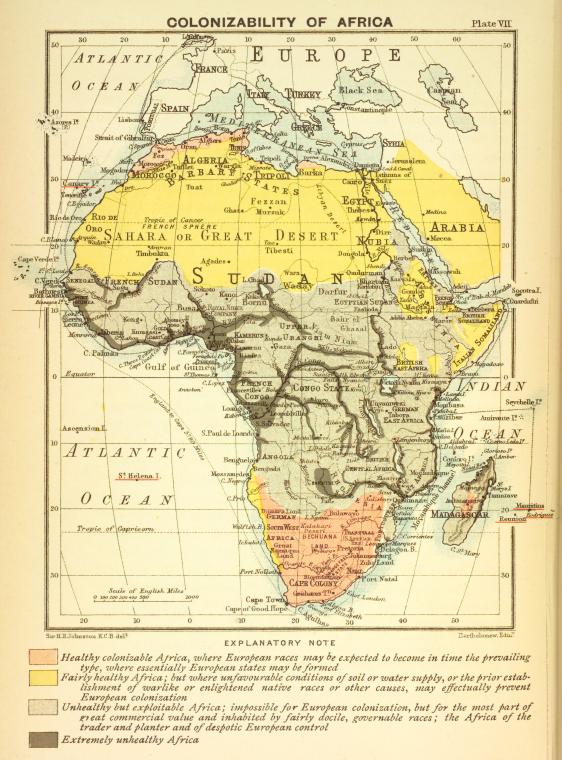
Bartholomew, J. G. (John George), 1860-1920, Colonizability of Africa, Map from Johnson, A history of the colonization of Africa by alien races, 1899. Also held at the New York Picture Library.
via
Filed under: Africa, art | Closed
The expansion of the U.S. in the antebellum period relied on the claim that the nation’s boundaries were both self-evident and dependent on the consent of those enclosed within them. While the removal of American Indians and racism toward former Mexicans has been well-documented, little attention has been paid to the legal rhetorics through which the incorporation of these peoples and their territories was justified, portraying them as actively agreeing to come under the authority of the U.S. Yet even as the creation and extension of U.S. jurisdiction functioned as an imperial system, it did not go unchallenged by dominated populations. In Manifesting America , Mark Rifkin explores how writings by Native Americans and former Mexicans protested the legal narratives that would normalize their absorption into U.S. national space.
Focusing on Indian removal in the southeast and western Great Lakes regions as well as the annexation of Texas and California, the monograph tracks the confrontation between U.S. law and the self-representations of once-alien peoples newly subjected to it. Institutions in the U.S. legitimized conquest by creating forms of official recognition for dominated groups that reinforced the logic and justice of U.S. mappings. But the imposed mappings continued to be haunted by the persistence of earlier political geographies. Examining a variety of nonfictional writings (including memorials, autobiographies, and histories) produced by imperially displaced populations, Rifkin illustrates how these texts contest the terms and dynamics of U.S. policy by highlighting specific forms of collectivity and placemaking disavowed in official accounts. Persuasively argued and anchored with judicious research, Manifesting America provides an overdue chapter in the history of resistance to U.S. imperialism.
Filed under: Scholarship and insights, United States | Closed
Among the thousands who cross the Plains, there are many who have never been refined by either mental or moral culture. The sum total of their religious and political faith consists in Squatter Sovereignty – the right to do as they choose, regardless of all but selfish interests. When such as these get beyond the range of Law and Civilization, a slight cause often makes them reckless and abusive; and many are the cases of violence and murder, of which the world never hears; and as the Authorities at the Forts exercise neither civil nor military jurisdiction over the Emigrants, any outrage may be committed with comparative impunity. But it is the Indians who are generally their most numerous victims. At first they find more excitement in shooting bears and buffaloes, than they did in the States killing rabbits and deer. They grow ambitious and begin to think it would be a great achievement to kill an Indian; and, as most of them are armed with rifles and revolvers, the desire becomes strong to slay one of those whom their own savageness has converted into an enemy […] Thus the poor Indian, by being spoken of as a brute, is cast beyond the pale of a common humanity – where the killing of him ceases to be murder, and no atrocity is considered cruel or unjust.
John Beeson, A Plea for the Indians, 1857.
Filed under: Quote, Sovereignty | Closed

