the struggle on four fronts
Last week the African National Congress celebrated its centenary, marking a full hundred years of valiant struggle against colonialism, settler colonialism, racism and Apartheid in South Africa. All of us who had occasion to work with that great movement and its leaders and militants celebrated too.
Jenerali Ulimwengu for the East African.
Filed under: media, Southern Africa | Closed
jeremiadus’s pilgrimage
I abandoned my thatch, my cobblestones, my tolerant Dutch protectors.
For barren oak trees. On empty shores. Under grey skies. The cold bites me in the arse.I died in great numbers. Half of me died. Most of my women.
I am not a Sachem, God damn it! I cannot heal. I cannot lead. And God did not help us.
We have nothing to give thanks for.I see Natives.
Squanto was not a Wampanoag.
He was a Patuxet.
Captured and sold off in Spain in a bundle,
Packaged with fish and corn.Squanto unbundled himself.
Escaped the Spaniards.
Traveled to England.
Returned alone to the New World.He spoke many languages but had no identity.
His people also had died.
The rest of the poem lives here.
Filed under: art, Quote | Closed
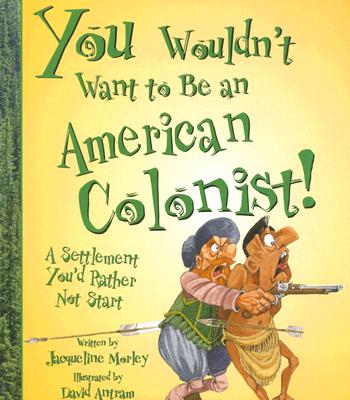
From the blurb:
Are you ready to leave behind your home in England and risk your life in the name of exploration? You will have to face starvation and angry natives if you are going to set up a colony.
Check out the mixed reviews on amazon here, and for the sequel (You wouldn’t want to be an American Pioneer), here.
Filed under: United States, wacky | Closed
janette habashi on palestine, guilt, unofficial histories and the israeli national narrative
Janette Habashi, ‘Colonial Guilt and the Recycling of Oppression: The Merit of Unofficial History in Transforming the State’s Narrative’, Diaspora, Indigenous, and Minority Education 6, 1 (2012).
This article juxtaposes colonial guilt with selective historical memory of Palestinian narratives as presented in the Israeli state-mandated history textbooks. The advancement of colonial guilt imposes a particular subjective truth of oppressed groups’ historical memories. The purpose of colonial guilt is to keep the power structure intact by maintaining a victimhood hierarchy that engages oppressed groups to compete for the highest level on this scale. The current curricula position the Palestinian narratives on a low rank through its historical interpretation as existing in the shadows of other events. This notion is interrupted by the unofficial history in the Palestinian community, which challenges the presumption of colonial guilt and its manifestation in the Israeli educational system.
Filed under: Israel/Palestine, Scholarship and insights | Closed
TOC:
Mauro Barelli: ‘Free, prior and informed consent in the aftermath of the UN Declaration on the Rights of Indigenous Peoples: developments and challenges ahead’.
Marco Odello: ‘Indigenous peoples’ rights and cultural identity in the inter-American context’.
Kristin Hausler: ‘Indigenous perspectives in the courtroom’.
Heather A. Northcott: ‘Realisation of the right of indigenous peoples to natural resources under international law through the emerging right to autonomy’.
Sheryl R. Lightfoot: ‘Selective endorsement without intent to implement: indigenous rights and the Anglosphere’.
Sarah Sargent: ‘Transnational networks and United Nations human rights structural change: the future of indigenous and minority rights’.
Fiona Batt: ‘Ancient indigenous deoxyribonucleic acid (DNA) and intellectual property rights’.
Enzamaria Tramontana: ‘Civil society participation in international decision making: recent developments and future perspectives in the indigenous rights arena’.
Shayna Plaut: ‘‘Cooperation is the story’ – best practices of transnational indigenous activism in the North’
Jennifer Huseman & Damien Short: ‘‘A slow industrial genocide’: tar sands and the indigenous peoples of northern Alberta’
Filed under: Australia, Canada, Human Rights, Latin America, law, New Zealand, Political developments, Scholarship and insights, Science, United States | Closed
John Sandloss and Arn Keeling, ‘Claiming the New North: Development and Colonialism at the Pine Point Mine, Northwest Territories, Canada’, Environment and History 18, 1 (2012).
This paper explores the history of economic, social and environmental change associated with the Pine Point lead-zinc mine, a now-abandoned industrial site and town in the Northwest Territories. Recent perspectives in cultural geography and environmental history have sought to rehabilitate mining landscapes from their reputation as places of degradation and exploitation – the so-called ‘mining imaginary’. We argue that the landscapes of Pine Point epitomise the failures and contradictions of mega-project resource development in the north. While the mine and planned town built to service it flourished for nearly a quarter century, the larger goals of modernisation, industrial development and Aboriginal assimilation were unrealised. Ultimately, the mine’s closure in 1988 resulted in the town’s abandonment and the removal of the rail link, leaving behind a legacy of environmental destruction that remains unremediated. At Pine Point, the forces of mega-project development joined with modern mining’s technologies of ‘mass destruction’ to produce a deeply scarred and problematic landscape that failed in its quest to bring modern industrialism to the Canadian sub-Arctic.
Filed under: Canada, Scholarship and insights | Closed
aboriginal policy studies
aboriginal policy studies is a new online, peer-reviewed and multidisciplinary journal that, on a bi-annual basis, publishes original, scholarly, and policy relevant research on issues relevant to Métis, non-status Indians and urban Aboriginal peoples in Canada. We encourage the submission of articles by and for a wide audience of scholars, researchers, community activists, and policymakers. Though focused on the Canadian milieu, we welcome comparative work from an international Indigenous context pertinent to Canadian readers. A similarly broad scope of methodological approaches is encouraged.
Filed under: Canada, Scholarship and insights | Closed
The Huntington-USC Institute on California and the West is pleased to present:
THE SIGNIFICANCE OF THE FRONTIER IN AN AGE OF TRANSNATIONAL HISTORY
An international symposium on the concept of the frontier in its global contexts
Saturday, February 25, 2012, 8:30 am – 5:00 pm. Friends’ Hall, The Huntington Library, San Marino, CA
All lectures and roundtables are free and open to the public. A luncheon with the participants will be available for $10 (students) and $20 (faculty and public). Please RSVP by contacting icwfrontiersymposium@gmail.com
Sponsored by: The Huntington-USC Institute on California and The West; The Salvatori Fund, Dornsife College of Arts and Sciences; The USC-Huntington Early Modern Studies Institute, The USC English Department, The USC American Studies and Ethnicity Department, Research Division, The Huntington.
Keynote Speakers:
Kerwin Klein, University of California at Berkeley
Patrick Wolfe, La Trobe University
Roundtable Participants:
Jodi Byrd, University of Illinois
Krista Comer, Rice University
Brian DeLay, University of California, Berkeley
Jay Gitlin, Howard R. Lamar Center for the Study of Frontiers and
Borders, Yale University,
Melody Graulich, Utah State University
William Handley, University of Southern California
David Igler, University of California, Irvine
Margaret Jacobs, University of Nebraska at Lincoln
Patricia Nelson Limerick, Center of The American West, University of Colorado
Laura Mitchell, University of California, Irvine
Donald Pease, Dartmouth University
Aziz Rana, Cornell University
Mark Rifkin, University of North Carolina,Greensboro
John Carlos Rowe, University of Southern California
David Wrobel, University of Oklahoma
Filed under: Australia, Seminar, United States | Closed
Paul A. Kramer, ‘Power and Connection: Imperial Histories of the United States in the World’, American Historical Review 116, 5 (2011).
Excerpt:
What would a post-exceptionalist account of U.S. imperial history look like? It would purposively engage in dialogue with other societies’ globalizing historiographies, which have often involved imperial turns. One of the most striking and unremarked developments of the late 1990s and early 2000s was a serious misalignment between U.S. transnational history and a diversity of new imperial histories, richly informed by postcolonial studies, gender analysis, and cultural history, within British, French, German, Spanish, Russian, and Japanese historiographies.33 Except where it referred to European colonial empires in the Americas, or to 1898, “empire” was almost entirely absent from the manifestos calling for a new transnational U.S. history, ironically reproducing an exceptionalism that was ostensibly its chief target. Perhaps, unlike everybody else, U.S. historians could venture outward from nation-based historiography without “empire.”
A post-exceptionalist history of the United States in the world, by contrast, employs categories used in non-U.S. histories precisely to align them for purposes of non-exceptionalist comparison. One concrete example involves the reframing of the “U.S. West,” which, incarnated as the “frontier,” long lived at the center of U.S. exceptionalist narratives. Rigged with impressive explanatory—and exceptionalist—power vis-à-vis the virtues of democracy, Frederick Jackson Turner’s “frontier” parachuted U.S. history safely away from a universe of potential counterparts.
By contrast, some recent scholarship situates the United States within broader histories of modern settler colonialism. This concept, first used within Australian geography, has emerged as the hub of a comparative and inter-imperial history. Defined as the seizure of land and natural resources from indigenous populations, the politico-legal production of “territory,” and governance through the rule of colonial difference, settler colonialism has been identified by historians as a fundamental process in the making of numerous modern societies.
Understanding the U.S. West as the setting for a particular (that is, a unique but unexceptional) instance of settler colonialism raises comparative questions that were not easy to ask about Turner’s frontier: questions about comparative colonial violence, about economic exploitation and environmental management, about legal categories and the claims of subjects and citizens (particularly with regard to land), and about the balance of power between core and periphery during processes of territorial incorporation. Placed in this context, the U.S. West appears as a variation on a global theme, alongside Australia, Argentina, and Algeria.
Filed under: Empire, postcolonialism, Scholarship and insights, United States | Closed
Patrick Brantlinger, ‘Notes on the postmodernity of fake(?) Aboriginal literature’, Postcolonial Studies 14, 4 (2011).
This article examines issues of authenticity in Australian culture. From the very beginning, Australia has been plagued and entertained by literary hoaxes. The recent revelation that Mudrooroo, who was for several decades Australia’s leading Aboriginal author, is of African-white and not Aboriginal descent is an extreme yet typical example of the difficulties faced by many authors and artists who want to claim authentic Aboriginality. How does anyone claim such authenticity when there are no longer any authentic Aborigines (in the sense of indigenes whose culture has not been affected by the invasion of Europeans, modernity, and now postmodernity)? The impossible struggles over authenticity of authors and artists like Mudrooroo and Sally Morgan are a perfect (if ironic) fit with the postmodern stress on inauthenticity, or a commodified and globalized capitalist culture in which everything is a copy, nothing is original (let alone Aboriginal). The ‘Ern Malley’ hoax, the basis for Peter Carey’s postmodern novel My Life as a Fake, is one of many that do not involve Aboriginality, but which show that it is not just Aboriginals who struggle with the problem of authenticity.
Filed under: Australia, literature, Scholarship and insights | Closed

