native title today in n$w
About 400 hectares of land at North Tuncurry will be developed for housing.
The CEO of the Native Title Services Corporation, Warren Mundine, says hopefully this will be the first of similar agreements.
“I think this is a good template that we can now take across the state of New South Wales,” he said.
“We could have outcomes that help in the socio-economic development of townships and across New South Wales.
“As well as the benefits that flow on then to the Aboriginal people, where they become partners, and within the process and they also have economic outcomes that benefit everyone.”
Mr Mundine says the agreement is a good win which will allow the Worimi Birpai people of Foster Tuncurry to be part of the region’s growth.
“It’s an agreement which recognises Aboriginal people’s rights in this area,” he said. “At the same time, it has a socio-economic outcome for the people of the Forster Tuncurry area. It’s the first of its kind agreement here in New South Wales, so it was quite a revolutionary, and a very good agreement.”
From the ABC, whose headline reads ‘Native Title win could pave way for others’.
But this claim was retracted, surrendered and can never be resurrected. What was won was money, not Native Title (capitalised or not).
Quoting Tony Kelly: “They have agreed to forgo the Native Title claim, in return for a payment of $10 million over the next 30 years, provided this development goes ahead.”
This is a win of some kind or other: money is still important, after all, and it’s a whole lot better than nothing. Mundine and his enterprise worked hard to reach an agreement over a claim where none might ever have been made. Well done.
Well before the 30-year period winds up, however, this 400 hectare region of golf-course fronted coastal land will be carved up into hundreds of residential blocks, prime for the construction of those beautifully bourgeois houses we all envy/hate. Just who lives in those houses, I’d say, will decide whether this one is a ‘win’ or not.
Either that, or what is actually done with all that money, will decide whether this one is a ‘win’ or not.
Filed under: Australia, law, media | Closed
This book presents new material and shines fresh light on the under-explored historical and legal evidence about the use of the doctrine of discovery in Australia, Canada, New Zealand and the United States.
North America, New Zealand and Australia were colonised by England under an international legal principle that is known today as the doctrine of discovery. When Europeans set out to explore and exploit new lands in the fifteenth through to the twentieth centuries, they justified their sovereign and property claims over these territories and the indigenous peoples with the discovery doctrine. This legal principle was justified by religious and ethnocentric ideas of European and Christian superiority over the other cultures, religions, and races of the world. The doctrine provided that newly-arrived Europeans automatically acquired property rights in the lands of indigenous peoples and gained political and commercial rights over the inhabitants. The English colonial governments and colonists in North America, New Zealand and Australia all utilised this doctrine, and still use it today to assert legal rights to indigenous lands and to assert control over indigenous peoples.
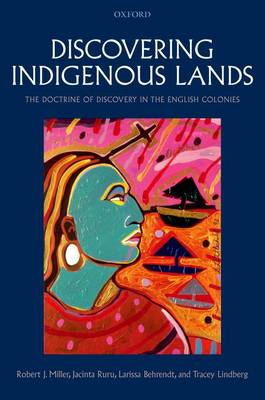
Written by indigenous legal academics – an American Indian from the Eastern Shawnee Tribe, a New Zealand Maori (Ngati Rawkawa and Ngai Te Rangi), an Indigenous Australian, and a Cree (Neheyiwak) in the country now known as Canada, Discovering Indigenous Lands provides a unique insight into the insidious historical and contemporary application of the doctrine of discovery.
and the beautiful cover artwork depicting a Cree woman and boatfuls of white men:
Filed under: Australia, Canada, law, New Zealand, Scholarship and insights, United States | Closed
Lorenzo Veracini, Settler Colonialism: A Theoretical Overview (Palgrave 2010).
Settler colonialism is a global and transnational phenomenon, and as much a thing of the present as a thing of the past. In this book, Lorenzo Veracini explores the settler colonial ‘situation’ and explains how there is no such thing as neo-settler colonialism or post-settler colonialism because settler colonialism is a resilient formation that rarely ends. Not all migrants are settlers: settlers come to stay, and are founders of political orders who carry with them a distinct sovereign capacity. And settler colonialism is not colonialism: settlers want Indigenous people to vanish (but can make use of their labour before they are made to disappear). Sometimes settler colonial forms operate within colonial ones, sometimes they subvert them, sometimes they replace them. But even if colonialism and settler colonialism interpenetrate and overlap, they remain separate as they co-define each other.
Filed under: Scholarship and insights | Closed
In The Political Uncommons, Kathryn Milun presents a cultural history of the global commons: those domains, including the atmosphere, the oceans, the radio frequency spectrum, the earth’s biodiversity, and its outer space, designated by international law as belonging to no single individual or nation state but rather to all humankind. From the res communis of Roman property law to early modern laws establishing the freedom of the seas, from the legal battles over the neutrality of the internet to the heritage of the earth’s genetic diversity, Milun connects ancient, modern, and postmodern legal traditions of global commons. Arguing that the logic of legal institutions governing global commons is connected to the logic of colonial doctrines that dispossessed indigenous peoples of their land, she demonstrates that the failure of international law to adequately govern the earth’s atmosphere and waters can be more deeply understood as a cultural logic that has successfully dispossessed humankind of basic subsistence rights. The promise of global commons, Milun shows, has always been related to subsistence rights and an earth that human communities have long imagined as ‘common’ existing alongside private and public domains. Utilizing specific case studies, The Political Uncommons opens a way to consider how global commons regimes might benefit from the cross-cultural logics found where indigenous peoples have gained recognition of their common tenure systems in Western courts.
Filed under: law, Scholarship and insights | Closed
A group of economists says remote Indigenous communities can earn money by protecting their land.
Professor Owen Stanley from Charles Darwin University wants companies and governments to offset their carbon footprints by paying communities to rehabilitate and protect land across northern Australia.
Some similar programs already exist but professor Stanley says they are underfunded.
“I think we all agree that it would be good if there were a lot more of those programs definitely,” he said
“And that would not only be good for the environment, it would also be good for the communities.”
The discursive convergence of climate change and indigenous issues is a source of great fascination for me.
Filed under: Uncategorized | Closed

kafka’s wish
If one were only an Indian, instantly alert, and on a racing horse, leaning against the wind, kept on quivering jerkily over the quivering ground, until one shed one’s spurs, for there needed no spurs, threw away the reigns, for there needed no reigns, and hardly saw that the land before one was smoothly short heath when horse’s neck and head would already be gone.
Filed under: literature | Closed
Abstract
This article examines attempts to negotiate a perceived residual dominance of settler populations in South Africa and Zimbabwe by means of developmental and cultural policies deemed necessary to restore sovereignty to Africans. Indigenisation has become a preferred strategy for reconstructing post-colonial states in Africa: indigenisation of the economy as part of a Third Chimurenga in Zimbabwe and Black Economic Empowerment in the socio-cultural context of Ubuntu in South Africa. These are issues arising from the regional legacy of contested and uneven transitions to majority rule. Identifying how governments frame the ‘settler problem’, and politicise space in doing so, is crucial for understanding post-colonial politics. Indigenisation in Zimbabwe allows the government to maintain a network of patronage and official rhetoric is highly divisive and exclusivist although couched in terms of reclaiming African values and sovereignty. Revival of Ubuntu as a cultural value system in South Africa facilitates a more positive approach to indigenisation, although Black Economic Empowerment displays elitist tendencies and cultural transformation remains controversial and elusive. The perceived need to anchor policy in socially acceptable (i.e., ostensibly indigenous/traditional) contexts has become a prominent feature of post-colonial politics and is indicative of an indigenous turn in Southern African politics.
Filed under: Scholarship and insights, Southern Africa | Closed
It is however, still a matter, of doubt and perplexity; it is a book sealed to the eyes of man, for the time has not yet come when the Great Ruler of all things, in His wisdom, shall make answer through his inscrutable ways to the question which has puzzled, and still puzzles the minds of the learned civilized world. How came America to be first inhabited by man?
This quote from William Whipple Warren invites us into the topic of this essay: the ways American Indian authors, particularly three contemporary Anishinaabeg writers, engaged with the question of Native American origins during the racially polarized project of “imagining” the nation of the United States throughout the nineteenth century. Answering the question of origins was central to continued colonization in North America; quite simply, Native people had to be explained to be superseded. Since first contact, European Americans have presented myriad answers to the question, How came America to be first inhabited by humans? With the rising importance of print capitalism in postrevolutionary America, explanations of Native origins became widely disseminated and consumed by the public and politicians alike. The accessibility of these theories directly influenced nineteenth-century popular sentiments about American Indians and colonial policies regarding their future. This was most notable with regard to removal policies, which were aimed at accomplishing one of the essential components of the colonial project of the United States, the territorial dispossession of Indian lands. This process was vital to the colonial project, and it stood in stark opposition to the fact that it was on the well-being of indigenous lands that the very survival of indigenous peoples depended. Having answers to the question of Native origins that challenged the magnitude, duration, and even the very legitimacy of Native Americans’ presence and tenure in America offered powerful colonial tools for furthering tribal land dispossession.
In this essay I argue that American Indian authors had a keen understanding of the political and racial implications the varied answers European Americans were offering about their origins held for their communities. By tackling dominant origin theories, they interrupted the white-supremacist discourse surrounding the topic. Their answers were crafted delicately so as to be salient to their predominantly white audiences and yet also actively promote indigenous sovereignty, a sovereignty inherent in peoplehood. This peoplehood was “inseparably linked to sacred traditions, traditional homelands, and a shared history as indigenous people.” With the ongoing colonial project of the United States attempting to strip indigenous groups of key aspects of their peoplehood, including language, sacred history, religion, and land, through “the means of territorial dispossession, assimilation, religious conversion, or outright extermination,” we can understand their answers, which sought to protect this peoplehood, as bold acts of resistance.
Filed under: Scholarship and insights, United States | Closed

- Held at Newberry Library, Chicago
In lieu of an abstract, here is a preview of the article.
What is the value or perceived necessity—for an Indian or for a white man—of changing Northern Cheyenne history? How are a reader’s conclusions affected by her perception of the race of the person altering that history? Why is it acceptable to sell but not tell American Indian history? An examination of the visual and discursive rhetoric of “The Black Horse Ledger,” a Northern Cheyenne ledger book history recorded in the late nineteenth century and later defaced, gives us the opportunity to engage these questions. Native American histories have long been contested ground in both the dominant culture and academia, but “The Black Horse Ledger” provides a rare opportunity to see that battle overtly waged on its pages as unknown parties disfigured the original images and made editorial remarks that serve to reinforce the marred history rather than the original record. The coexisting yet competing accounts contained within the ledger embody the unreconciled Indian and Anglo literacies and histories of the American West. The juxtaposition of these opposing literacies and histories forces readers to negotiate the competing economies of meaning that clash in both form and subject.
“The Black Horse Ledger” not only foregrounds conflicts within academia’s treatment of Native American history but also highlights key points of tension and debate in the study of ledger art. In a discussion of the so-called descriptive texts that have been added to some of the Fort Marion ledgers, Edwin L. Wade and Jacki Thompson Rand argue that multiple handwriting styles are present, many of which do not match known prisoner writing, and warn: “We must be vigilant in questioning whether these captions are relevant to the intent of the artist.”
Filed under: art, media, Scholarship and insights, United States | Closed

