Lisi Krall, Proving Up: Domesticating Land in U.S. History (Albany: State University of New York Press, 2010).
Krall uses the interdisciplinary approach of evolutionary economics to explore the history of land domestication in the United States.
On July 9, 1920, William Krall, a coal miner in Wyoming, was shot by his neighbor in a dispute over water as he attempted to “prove up” and gain title to his homestead. Attempting to understand her grandfather’s passion and determination for making his own 160 acres of land in dry, sagebrush country, Lisi Krall embarked on a unique journey through the interconnections of economy, culture, and land in the history of the United States. She tells the story of the domestication of land in the United States, a story that hinges on the market economy and the agrarian and wilderness ethos as foundational land institutions. Drawing on institutional or evolutionary economics, Proving Up explores in detail the rich and ever-changing intermingling of cultural, economic, and material conditions through American history. Untangling the complicated history of Americans’ experiences with nature, Krall provides a critical focus and a timely contribution to the current debate surrounding our relationship to land and nature.
Michelle Mart’s H-Net Review here.
Filed under: Scholarship and insights, United States | Closed
Cole Harris, ‘The Spaces of Early Canada’, Canadian Historical Review 91, 4 (2010)
Abstract:
This article considers the relationship between the increasingly humanized spaces of early Canada and the patches of settlement that, at Confederation, were assembled into a country. It suggests that Harold Innis correctly identified some of the essential spaces of early Canada as, in his American way, did Frederick Jackson Turner. Both, however, offer limited perspectives: Innis because his analysis ill fit the areas of agricultural settlement where most people lived, Turner because of the imprecisions of his analysis and also because, in early Canada, the bounded nature of agricultural settlement severely constricted the westward expansion on which his analysis turned. But Innis was right about staple trades in non-agricultural areas, and Turner was right that areas of recent agricultural settlement were loci of particularly rapid cultural change. Both analyses can be filled in, and that, particularly with regard to Turner, this article attempts to do. In so doing, it considers the extent to which the early rural societies in Canada, the loci of most lives, can be considered to have been ideologically liberal. It also considers the particular patterns of secondary migration in and beyond bounded settlements, and their relationship to the construction and maintenance of social and cultural difference. Overall, the article suggests that the receptacles within which countries develop are important, that the Canadian and American receptacles were strikingly different, and that the spaces of early Canadian life have their continuing legacies in an ongoing engagement with sparsely settled land and with very different ways of being.
Filed under: Canada, Scholarship and insights, United States | Closed
Dean Itsuji Saranillio, ‘Colliding Histories: Hawai‘i Statehood at the Intersection of Asians “Ineligible to Citizenship” and Hawaiians “Unfit for Self-Government”’, Journal of Asian American Studies 13, 3 (2010)
Abstract:
This essay examines competing narrations of the fiftieth anniversary of Hawai‘i statehood by tracing two mutually constitutive but opposing projects in the post-World War II period—the racial project seeking the liberal inclusion of Asian Americans, particularly Japanese Americans, into a U.S. national polity and a Native Hawaiian project that sought autonomy from the United States. U.S. ambitions for global hegemony during the Cold War found a discursive alliance with selected narrations of Japanese American racial persecution, setting these narratives to public memory through global circulation and publicity, while narrations of Native Hawaiian colonial oppression were designated for historical deletion, through intimidation and containment.
Filed under: Hawaii, Scholarship and insights | Closed
Elaine Freedgood, ‘Fictional Settlements: Footnotes, Metalepsis, the Colonial Effect’, New Literary History 41, 2 (2010)
In lieu of an abstract, here is a preview of the article.
I am going to argue that the nineteenth-century novel is anomalous using as an example an anomalous nineteenth-century novel. The anomalous novel, Catharine Parr Traill’s Canadian Crusoes (1852), is not well-known now, although it was well reviewed and popular in its time, and for about fifty years thereafter. A genre fiction in at least two ways—as a young adult novel and as an adventure fiction—it is also an emigration novel, which may or may not be a genre. It was written in Canada by a pioneer who is often described as “British-Canadian” and who began writing children’s books at the age of sixteen to support herself and her family after her father died. The field, in Pierre Bourdieu’s sense, might best be described as that of “colonial letters.” I mean “letters” in both the sense of belles lettres and in the sense of epistles written home. Anglophone Canadian fiction and travel writing of the nineteenth century was not usually read by Canadians, but rather by Britons in Britain, who might or might not be prospective Canadians. The writers in the field of colonial letters who imagined and constructed fictional settlements such as the ones proposed in Canadian Crusoes “participate in domination, but as dominated agents; they are neither dominant, plain and simple, nor are they dominated.” Parr Traill, as the wife of a British army officer, is mildly privileged in the colonial social hierarchy, but just by virtue of having to participate in emigration, she is among the dominated citizens of nineteenth-century Britain. Her participation in the representation of empire is accordingly complex: her writing encourages emigration to Canada’s forested “north” and also depicts the intense hardship and tragedy that so often attends it.
Filed under: Canada, literature, Scholarship and insights | Closed
Bess Nungarrayi Price, ‘We need to change our law’, Australian Review of Public Affairs Oct. 2010.
My mother and father were born in the desert. They lived their childhood out of contact with whitefellas. They were terrified when they first saw a whitefella. They taught me the Old Law that our people lived by. That Law worked when we were living in tiny family groups taking everything that we needed from the desert. It is Sacred Law. There was strong Law for sacred business. If the sacred Law was broken both men and women could be killed. There was strong Law for who we could marry. Men had the power of life and death over their wives. Young girls were forced into marriage. Men too had no choice in who they married. There was no law for property except that everything must be shared. There was no law for money because we didn’t have any. There was no law for houses, cars, grog, petrol or drugs—we didn’t have any except for bush tobacco which was shared like everything else we had. The only way to punish was physically, by beating or killing the law breaker. They couldn’t be fined, we had no money or wealth to take. They couldn’t be locked up, we had no jails.
Everybody knew what they had to do to make sure that everybody survived. We all knew how to make a living from our country. We lived from day to day. Everybody was taught to fight. We only had our family to defend us. We had no army, no police, no courts. Everybody needed to know how to use a weapon, women and men both learned to fight and knew they would have to do that sometime. We also believe that our Law Man can make magic, they can heal the sick but they can also make people sick and die by magic. That is what all my people believe. We kept the peace by fear of violence and magic.
Now we live in a world ruled by a new law that is not sacred, that doesn’t accept that magic exists. Now we are all equal citizens with human rights. Now we have property, houses, cars, grog, drugs, pornography. Now we live off welfare, other people’s money or we need to get a whitefella education and get a job. We still share everything and this keeps us poor. We can’t say ‘no’ to our family even when we know they are drinkers and gamblers and will waste our money or destroy themselves with it. Now too many of our men still think they have the power of life and death over their wives. My people think all property should be shared and we think whitefellas are just greedy and stingy. We don’t plan for the future, we don’t budget or invest—we share and consume. All this has happened too quickly.
[…]
My community of Yuendumu has been torn apart by feuding. These problems show us that government has failed but is also shows us that Aboriginal Law has failed too. Aboriginal organisations have failed as well. Aboriginal politics that focused on the ‘Stolen Generation’ and ‘Deaths in Custody’ also failed. Aboriginal politicians forgot about our women and kids, forgot about the violence on the remote communities, forgot about the problems we are causing for ourselves. We can’t just keep blaming the government without taking our share of the blame. That is the only way we can find our own way out of these problems.
Our old Law worked really well in the old days but it was not about human rights. It was about unconditional loyalty to kin, to family and following the sacred Law. It was about capital and physical punishment. There were wise old people who tried to make sure that there was justice. But they are all dying now. Those like my own parents who were born and grew up in the bush, are all getting very old and passing away. But even they could not stop the grog and the violence that came from the new world we were living in. There is nothing in our old Law that helps us deal with grog and drugs. All these new things that whitefellas brought in we have no law for. But we still respect our ancestors and we still want to keep our culture. The Two Laws, whitefella and blackfella, are based on opposing principles. My people are confused. If they go the blackfella way they break whitefella law, if they go whitefella way they break blackfella law. Our young men are caught in the middle, they are still initiated into the old Law but they live in a world run by the new law, that’s why they fill up the jails.
[…]
Too many don’t know either law now. We have Aboriginal people who speak out all the time but don’t live in the communities and don’t speak an Aboriginal language—who don’t have any idea what life is like for my people. We have Aboriginal people who others call leaders who we know are only looking after their own families, their own interests and not those of the whole community. We have very good people who want to do the right thing but are too worried and confused and who are continually grieving over the deaths of their loved ones. We have white radicals and NGOs with their own agendas who want to use us like political footballs. When we women talk out about our problems they either ignore us or tell the world that we are liars and trouble makers. Some of my people who carry on about human rights and attack governments every time they try to do anything new run away from their own kin and communities when there is trouble. They never find it hard to find a gullible human rights lawyer to back them up in public but they don’t do anything in their own communities to make things better for their own people.
[…]
Our problem is that we want to keep our culture. We want to respect our ancestors and their Law but we also want to be equal citizens and we want human rights. We can’t do that without changing our Law. But we need to change it ourselves, others can’t do that for us. Only we can solve our own problems and we will do it in our own way. But we really need the support of governments and our fellow citizens. You need to listen to the voices that are usually drowned out by the strong, the noisy and the powerful. You need to find a way to listen to those who don’t speak English, who are the most marginalised and victimised in our own communities. You need to listen to our own women and young people, the ones who don’t have a voice under the old Law. If you really want us to have human rights then you have to find ways to protect the victims of black crime as well as white crime.
Hat tip to Penelope A. for sending word of this
Filed under: Australia, law, Scholarship and insights | Closed
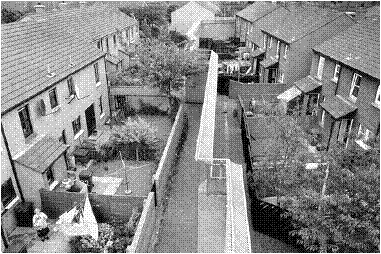
This issue’s “Curated Spaces” features the work of the Belfast photographer Frankie Quinn, with an introductory essay by Gabbi Murphy. The photographs included come from a series taken between 2002 and 2008 that documents life along the walls and barriers, known as “peacelines,” that divide the city of Belfast in Northern Ireland. The walls, many of which were constructed at the height of the recent conflict by the British government, were initially conceived as a temporary measure to separate communities divided along political and religious lines and to control mobility within the insurgent nationalist community. Yet far from being a temporary measure, the walls have increased in number and in height over the years, forming a network of enclaves, ghettos, and deeply divided communities across the city.

Filed under: art, Éire, Scholarship and insights | Closed
This essay traces the struggle for the commons on New Mexico’s Las Vegas Land Grant, a community property claim in New Mexico. Following the U.S.–Mexican War, waves of enclosures undermined communal property relations throughout the region. The Las Vegas grant was particularly appealing to land speculators and commercial cattle operators for its vast grasslands, timber, and rail connections. In the late 1880s a clandestine movement, known as Las Gorras Blancas, responded to the property enclosures and new wage labor relations on the grant with night-riding tactics that included cutting the barbed wire fences that enclosed common property and destroying the rail infrastructure that served the new class of speculators and commercial cattle operators. This essay examines the specific patterns of land speculation in Las Vegas amid the wider capitalist transformation of New Mexico as a means to understand the development and political economy of the Las Gorras Blancas protest.
Filed under: Scholarship and insights, United States | Closed
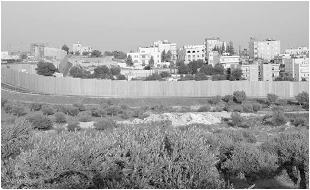
“Ex-Communicated” tells a story about enclosure on the Palestinian landscape through photographic images that reference themes from the enclosures in early modern England and highlight the historically long-standing interplay of power and space. Using Michel Foucault’s spatial notion of power as a theoretical anchor, and the enclosures in England as a historical foundation, the article shows how dominant groups with territorial ambitions enclose and remake landscapes by means of legal changes in property relations and by material changes in landscape architecture. These two instruments enable dominant groups to recast systems of land ownership, occupancy, and use and reconfigure routes of circulation and trespass on the landscape with the aim of forcing subaltern populations into ever smaller territorial spaces and of taking control of the landscape. The Palestinian landscape is part of this historically recurrent pattern of power and enclosure on the land.

Filed under: art, Israel/Palestine, Scholarship and insights | Closed
The association among commons, rights, and freedom has been central to the radical historiographical tradition. This article investigates the origins and limitations of this association. First, it examines the evolution of the association among the three concepts, identifying the important role played by the seventeenth-century English Diggers. The article then examines the intersection of radical commons discourse with colonialism, drawing on the histories of commons in nineteenth-century Australia. This history locates the colonial resonances of Digger concepts, but also their limitations in the colonial context. Contradictorily, as subaltern as white Australian commoners were, the very effectiveness of their commoning activities contributed to the dispossession of indigenous commoners. The article argues for a more nuanced understanding of commons and enclosure in their intersection with colonialism and points out that the important historical preconditions for such a reconceptualization were in any case established by the seventeenth-century Diggers.
Filed under: Australia, Europe, Scholarship and insights | Closed
An Imperial County Indian tribe has filed suit to stop a big solar project on which San Diego Gas & Electric is counting to get large amounts of green power.
The Quechan Indian tribe filed suit in San Diego federal court Friday, seeking an injunction against the Imperial Valley Solar Project, one of the first desert solar farms approved last month by Interior Secretary Ken Salazar.
The 3,500-member tribe says the 10-square-mile project about 95 miles east of San Diego will damage archeological sites.
Filed under: law, United States | Closed

