Thursday 21 October 2010 7:30-9pm
Institute of Postcolonial Studies, North Melbourne
James Belich, Kate Darian-Smith, Lorenzo Veracini
The southern question is figured as a struggle by colonies to liberate themselves from metropolitan centres in order to realise their own destinies at the other end of the world. This includes taking up the challenge of co-existence with peoples originally displaced by the process of colonisation. But what remains of the relation between metropolitan centre and periphery? Is there evidence of exchange between oldland and newland that offers a more reciprocal arrangement? What does this mean for potential solidarity between countries of the periphery?
Professor James Belich is at the Stout Research Centre, University of Wellington. His two volumes on New Zealand history, Making Peoples andParadise Reforged, are considered comprehensive and engaging. His recent publication Replenishing the Earth: The Settler Revolution and the Rise of the Angloworld, 1780-1930 is described in the TLS as ‘one of the most important works on the broad processes of modern world history to have appeared for years.’
Professor Kate Darian-Smith is Professor of Australian Studies and History at the University of Melbourne. Kate has written widely on Australian history and on the British world. Her works include, as co-editor of Britishness Abroad: Transnational Movements and Imperial Cultures, Melbourne University Press, 2007 and Text, Theory, Space: land, literature and history in South Africa and Australia, Routledge, 1996. She is currently working on an ARC-funded project (with Penny Edmonds and Julie Evans) on Conciliation Narratives in British Settler Societies in the Pacific Rim.
Dr Lorenzo Veracini is a Senior Research Fellow at Swinburne University and holds a Queen Elizabeth II Fellowship. He joined the ISR in early 2009 and has studied history and historiography in Italy and the UK before moving to Australia in the late 1990s. He is the author of Israel and Settler Society (Pluto Press 2006) and What is Settler Colonialism? (forthcoming). He is currently writing a global history of settler colonialism and is on the editorial board of the new journal, Settler Colonial Studies.
Institute of Postcolonial Studies
78-80 Curzon Street
North Melbourne
Victoria 3051 Australia (map)
Tel: 03 9329 6381
Admission – $5 for waged, $3 for unwaged, and free for members.
Filed under: public lecture | Closed
This article argues that positive perceptions of American westward expansion played a major (and so far overlooked) role both for the domestic German debate about the necessity of overseas expansion and for concrete German colonial policies during the late nineteenth and early twentieth centuries. During and after the uprising against colonial rule (1904–7) of the two main indigenous peoples, the Herero and the Nama, of German South-West Africa (Germany’s only settler colony), colonial administrators actively researched the history of the American frontier and American Indian policies in order to learn how best to “handle” the colony’s peoples. There exists a substantial literature on the allegedly exceptional enchantment of Germans with American Indians. Yet this article shows that negative views of Amerindians also influenced and shaped the opinions and actions of German colonizers. Because of its focus on the importance of the United States for German discussions about colonial expansion, this article also explores the role German liberals played in the German colonial project. Ultimately, the United States as a “model empire” was especially attractive for Germans with liberal and progressive political convictions. The westward advancement of the American frontier went hand in hand with a variety of policies towards Native Americans, including measures of expulsion and extinction. German liberals accepted American expansionism as normative and were therefore willing to advocate, or at least tolerate, similar policies in the German colonies.
Filed under: Scholarship and insights, Southern Africa, United States | Closed
Frances Peters-Little, Ann Curthoys and John Docker, eds., Passionate Histories: Myth, memory and Indigenous Australia (ANU E-Press, Aboriginal History Monograph 21, 2010).
This book examines the emotional engagements of both Indigenous and Non-Indigenous people with Indigenous history. The contributors are a mix of Indigenous and Non-Indigenous scholars, who in different ways examine how the past lives on in the present, as myth, memory, and history. Each chapter throws fresh light on an aspect of history-making by or about Indigenous people, such as the extent of massacres on the frontier, the myth of Aboriginal male idleness, the controversy over Flynn of the Inland, the meaning of the Referendum of 1967, and the policyand practice of Indigenous child removal.
Filed under: Australia, Scholarship and insights | Closed
Lorenzo Veracini, ‘The Settler Colonial Situation’, Native Studies Review 19, 1 (2010):
This article interprets the settler-colonial situation as fundamentally premised on the irruption into a specific locale of a sovereign collective of settlers. A comprehensive body of historical and postcolonial literature highlights how the colonial situation is premised on the sustained reproduction of a series of exclusive dichotomies. In contrast, this article argues that the settler-colonial situation establishes a system of relationships comprising three different agencies: the settler colonizer, the indigenous colonized, and a variety of differently categorized exogenous “Others.” In this context, indigenous and subaltern exogenous Others appeal to the European sovereign to articulate grievances emanating from settler abuse, the metropolitan agency interposes its sovereignty between settler and indigenous or subaltern exogenous communities, and settlers insist on their autonomous capacity to control indigenous policy. The capacity to manage the population economy of a settler locale is thus a crucial marker of a settler substantive sovereignty. Significantly, however, the settlercolonial situation is generally understood as an inherently dynamic circumstance where indigenous and exogenous Others are understood as progressively disappearing in a variety of ways. Only the settler body politic in its ultimate sovereign assertion against metropolitan interference and against indigenous residues or other insurgencies is expected to survive an inherently temporary triangulation.
Filed under: postcolonialism, Scholarship and insights | Closed
updated scs flyer
Gorn, print one out and stick it up somewhere.
Filed under: Call for papers | Closed
abstract:
Why has the historic Hudson’s Bay Company (HBC) been considered a ‘non-colonial company’ by Canadian historians? Surely those inescapably colonial dyads of insiders/outsiders, rulers/subjects, and Europeans/Natives, suggest otherwise; and as such, we should try comparing it to other colonial forms to better understand its historical presence. This paper introduces the concept of fur trade colonialism as something that is separate to settler colonialism. As is well known in the Canadian historiographical canon, guns, germs and geopolitical upheavals characterised the Indian interior in this early period (1713-63); but what about the ‘settlements’ that hugged the Bay itself? These ‘settlements’, I argue, were not only the sites of contact, but the sites of a perpetual colonial encounter – a shared space in which natives and sojourning HBC men came to live under the slight rule of Bayside governors, who tempered their own moral judgement with the policies laid out by the Company’s London Committee. This paper brings these settlements under the microscope to analyse the means by which – if at all – the ‘home guard’ natives (mostly Cree nation) of the settlements were colonised by the Hudson’s Bay Company.
Keywords: Hudson’s Bay Company; fur trade; colonialism; Cree nation.
Filed under: Canada, Scholarship and insights | Closed
Yet to appear online this one, but some libraries might be subscribed.
Australasian Canadian Studies 1-2 (2009)
Cindy Blackstock, ‘Federation Dialogue: Is this our Canada? Is this our Australia? First Nations Child and Family Safety and Well-being in Two Commonwealth Countries’.
Michelle Eady and Alison Reedy, ‘Crocodiles and Polar Bears: Technology and Learning in Indigenous Australian and Canadian Communities’.
Louise Humpage, ‘What Kind of Policy Matters? Recognition, Redistribution, and Indigenous Health Outcomes in Canada and New Zealand’.
Augie Fleras and roger Maaka, ‘Towards and Indigenous Grounded Analysis Policy Framework as Participatory Constitutional Governance’.
Edward Cavanagh, ‘Fur Trade Colonialism: Traders and Cree at Hudson Bay, 1713-67’.
Nicole St-Onge, ‘Plains Metis Nation: Capturing the Contours of an Identity’.
Sarah Henzi, ‘Resistance and Transformation: Negotiating Political Rhetorics in First Nations Literatures’.
Blanca Tovias, ‘A Hero for all Seasons: A Late Nineteenth-Century Paii in James Welch’s “Fool’s Crow”‘.
Filed under: Australia, Canada, Scholarship and insights | Closed
brock meets tecumseh
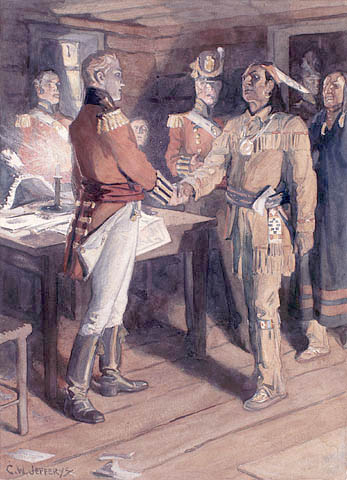
One of many Canadian reconstructions by C. W. Jeffreys, via canata.ca
Filed under: art, Canada | Closed