Modern western Oregon was a crucial site of imperial competition in North America during the formative decades of the United States. In this book, Gray Whaley examines relations among newcomers and between newcomers and Native peoples–focusing on political sovereignty, religion, trade, sexuality, and the land–from initial encounters to Oregon’s statehood. He emphasizes Native perspectives, using the Chinook word Illahee (homeland) to refer to the indigenous world he examines.
Whaley argues that the process of Oregon’s founding is best understood as a contest between the British Empire and a nascent American one, with Oregon’s Native people and their lands at the heart of the conflict. He identifies race, republicanism, liberal economics, and violence as the key ideological and practical components of American settler-colonialism. Native peoples faced capriciousness, demographic collapse, and attempted genocide, but they fought to preserve Illahee even as external forces caused the collapse of their world. Whaley’s analysis compellingly challenges standard accounts of the quintessential antebellum “Promised Land.”
Filed under: Scholarship and insights, United States | Closed
Debunking the Myths of Colonization examines Salman Rushdie’s thesis on the paradoxical nature of colonialism and its horrific impact on the psyche of the colonized. It probes Frantz Fanon’s theories concerning the relationship between colonizers and colonized, and attempts to apply these theories to modern Arabic literature. Like Rushdi and Fanon, many Arab writers have embarked on a journey to the metropolis of their ex-colonial masters. Due to their encounter with English or French culture, they have written memoirs, poems, or fictions in which they have represented themselves and the ‘other.’ Their representations differ markedly according to their own make up as human beings, their class, education, experiences, and gender. Yet what brings them together is their love-hate relationship with the ex-colonizer. In the case of the Palestinian writers, however, there is only bitterness and bewilderment at Israel as a colonizing power in the 21st century and its Jewish citizens, who were once victims in Europe but now have turned into victimizers.
Filed under: Israel/Palestine, literature, Scholarship and insights | Closed
The Dutch involvement in North America started after Henry Hudson, sailing under a Dutch flag in 1609, traveled up the river that would later bear his name. The Dutch control of the region was short-lived, but had profound effects on the Hudson Valley region. In The Colony of New Netherland, Jaap Jacobs offers a comprehensive history of the Dutch colony on the Hudson from the first trading voyages in the 1610s to 1674, when the Dutch ceded the colony to the English.
As Jacobs shows, New Netherland offers a distinctive example of economic colonization and in its social and religious profile represents a noteworthy divergence from the English colonization in North America. Centered around New Amsterdam on the island of Manhattan, the colony extended north to present-day Schenectady, New York, east to central Connecticut, and south to the border shared by Delaware, New Jersey, and Pennsylvania, leaving an indelible imprint on the culture, political geography, and language of the early modern mid-Atlantic region. Dutch colonists’ vivid accounts of the land and people of the area shaped European perceptions of this bountiful land; their own activities had a lasting effect on land use and the flora and fauna of New York State, in particular, as well as on relations with the Native people with whom they traded.
Sure to become readers’ first reference to this crucial phase of American early colonial history, The Colony of New Netherland is a multifaceted and detailed depiction of life in the colony, from exploration and settlement through governance, trade, and agriculture. Jacobs gives a keen sense of the built environment and social relations of the Dutch colonists and closely examines the influence of the church and the social system adapted from that of the Dutch Republic. Although Jacobs focuses his narrative on the realities of quotidian existence in the colony, he considers that way of life in the broader context of the Dutch Atlantic and in comparison to other European settlements in North America.
Filed under: Scholarship and insights | Closed
Peter Limb, Norman Etherington and Peter Midgley, ed., Grappling with the Beast: Indigenous Southern African Responses to Colonialism, 1840-1930 (Brill, 2010)
This volume contributes rich, new material to provide insights into indigenous responses to the colonial empires of Great Britain (South Africa, Swaziland, Botswana, Zimbabwe (Rhodesia)) and Germany (Namibia) and explore the complex intellectual, cultural, literary, and political borders and identities that emerged across these spaces. Contributors include distinguished global scholars in the field as well as exciting young scholars. The essays link global-national-local forces in history by analysing how indigenous elites not only interacted with colonial empires to absorb, adapt and re-cast new ideas, forms of discourse, and social formations, but also networked with “ordinary” people to forge new social, ethnic, and political identities and viable social forces. Translated and other primary texts in appendices add to the insights.
An interesting collection and a step in a new direction for Southern African studies, though one cannot but feel disappointed by its price ( € 119.00 / US$ 176.00 ).
Filed under: Scholarship and insights, Southern Africa | Closed
Jamie Allison, ‘Hamas, Gaza and the blockade’, International Socialism, 128 (13 October 10)
No abstract; here are clippings:
It is Hamas’s insistence on the Palestinian right to resist the occupation and their refusal to negotiate terms that will perpetuate it that earns the organisation the enmity of Israel and the Western powers.
How did Hamas come to occupy this position and does the movement have the capacity to end the blockade and liberate Palestine? Is the organisation really, as one fallen British leftist claimed in response to Israel’s 2009 attack on Gaza, “an anti-Semitic, misogynistic, homophobic, anti trade union, authoritarian, clericalist movement” seeking “the ultimate goal of establishing a theocratic state, where every detail of Palestinian life is governed by its hard-line misinterpretation of the Qur’an”? In what follows I argue against this view and trace Hamas’s origins as a national liberation movement with Islamist characteristics, emerging from the failure of the previous generation of secular and leftist Palestinian organisations. Although its popularity has increased as those movements have waned, Hamas remains trapped in the same contradictions faced by its predecessors: contradictions brought about by a strategic perspective that divorces Palestinian liberation from the struggles for democracy and equality in the wider Arab world.
[…]
There are two basic kinds of settler colonialism, which produce different economic and political relations between the colonists and the colonised. In Australia and most of the Americas the colonists simply destroyed the indigenous population (whom they outnumbered) and took their land. In Africa (Algeria, South Africa, Zimbabwe, the Portuguese colonies) a relatively small number of settlers expropriated the indigenous population but remained economically dependent on their labour. In South Africa in particular, this meant that the black working class played a crucial role in ending apartheid.
The Palestinian experience lies between these two poles. The numbers of colonists and colonised are roughly equal, the Palestinians holding a slight majority when the refugees from the Israeli ethnic cleansing of 1948 are included. Much as the more genocidally minded Israeli liberals might call for it, Israel cannot get rid of the native Palestinian population. Thus the racist idea of a “demographic threat” (the “danger” posed by the relatively higher birth rate of Palestinians compared to Israeli Jews) is not just accepted in Israel: it has been bandied about by the prime minister. The Israeli dilemma is how to get the land without the people. This is why the Israeli vision of a two-state solution is to render the Palestinians politically absent even if they are physically present. The network of physical barriers to Palestinian life, such as the apartheid wall and checkpoints in the West Bank, has partially achieved this aim.
Filed under: Israel/Palestine, Political developments, Scholarship and insights | Closed
Abstract:
Discussions of hybridity have proliferated in cultural geography and in social and cultural theory. What has often been missing from these accounts are the ways in which mixed-race identities have been forged, contested, and embodied spatially. Inspired by recent calls in cultural geography to rematerialize race and drawing from the growing literature on law and geography, this article examines the material dimensions of hybridity, how it was legally produced, gained traction, and slipped in the quotidian spaces of everyday encounters. Focused on late-19th and early-20th-century British Columbia (Canada), I trace the emergence of the ‘half-breed’ as a new racial personage and juridical taxonomy that unsettled racial hierarchies and spatial distinctions between aboriginal and white settler populations. Unlike other colonial contexts, mixed-race peoples on Canada’s west coast did not threaten European superiority alone but were believed to endanger the protection and assimilation of aboriginal peoples. Proximities between ‘half-breeds’ and ‘Indians’ were politically charged for two reasons. First, racial differentiations between these populations were often imperceptible, and second, their putative distinctions were closely bound up with concerns over territory and with aboriginal well-being. The racial opacity of mixed-race peoples created some sites of mobility for those in-between. However, their unknowability shored up the uncertainties of colonial knowledge production and the limits of existing racial repertoires, creating persistent demands for new markers of racial otherness in the process. Crime and immorality became potent signifiers of racial inferiority aimed at differentiating half-breeds from Indians and providing authorities with additional optics through which to problematize and govern their affective and geographical encounters.
Filed under: Canada, law, Scholarship and insights | Closed
From ABC News:
Aboriginal protesters have forced the temporarily closure of an exhibition of paintings at the Wollongong City Gallery. The protesters say the images portray the denigration of Aboriginal people and are highly offensive.
The exhibition called No Country For Dreaming is by nine-times Archibald finalist Paul Ryan.
Aaron Broad Henry helped bring the exhibition to a temporary close.
“I find it very offensive for any man, not matter what colour this person is, to hold a head with an axe in his hand,” he said.
The CEO of the Illawarra Aboriginal Land Council, Sharralyn Robinson, is also appalled.
“I don’t find anything humorous about an Aboriginal boy hanging from a tree and the title saying, ‘the local boy just seen to be hanging around all day’,” she said.
Ryan – who is currently holidaying in Bali – says his intention was to highlight the patronising, exploitative and violent nature of Australia’s colonial past.
He says the paintings are intended to be thought-provoking, not offensive.
“And they are actually being very critical of the colonisers for the way that they treated the Indigenous Australians,” he said.
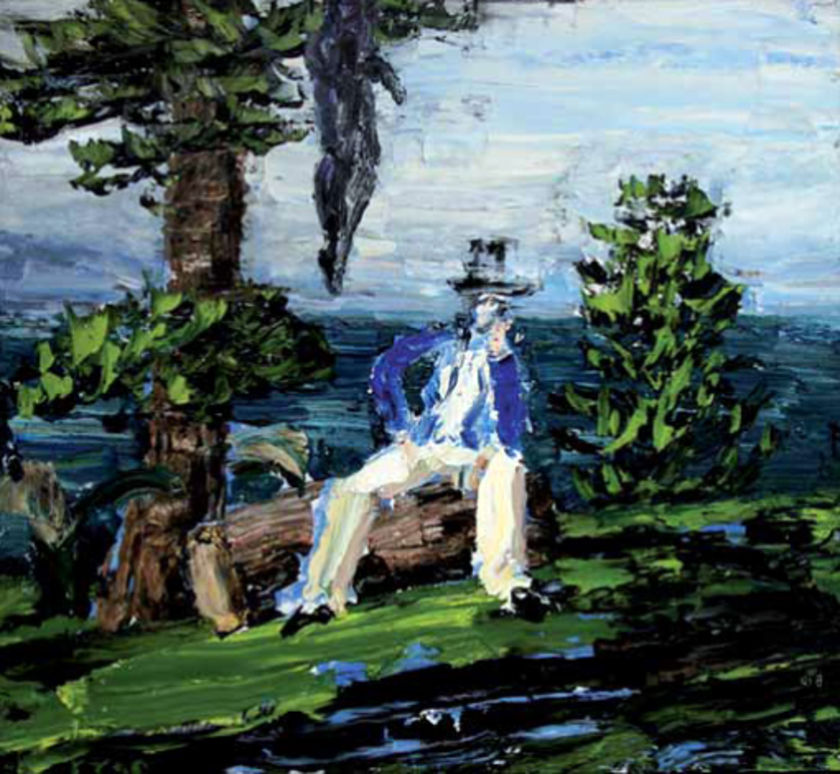
'...hang around all day'
Filed under: art, Australia, Political developments | Closed
Alexandra Harmon, Rich Indians: Native People and the Problem of Wealth in American History (UNC Press, 2010).
Long before lucrative tribal casinos sparked controversy, Native Americans amassed other wealth that provoked intense debate about the desirability, morality, and compatibility of Indian and non-Indian economic practices. Skillfully blending social, cultural, and economic history, Alexandra Harmon examines seven such instances of Indian affluence and the dilemmas they presented both for Native Americans and for Euro-Americans–dilemmas rooted in the colonial origins of the modern American economy. This wide-ranging book looks at controversies concerning Powhatan economic status and aims during the Virginia colony’s first years; the ambitions of some bicultural eighteenth-century Creeks and Mohawks; prospering Indians of the Southeast in the early 1800s; inequality among removed tribes during the Gilded Age; the spending of oil-rich Osages in the Roaring Twenties; resurgent tribal communities from Alaska to Maine in the 1970s; and casinos that have drawn gamblers to Indian country across the United States since the 1990s. Harmon’s study not only compels us to look beyond stereotypes of greedy whites and impoverished Indians, but also convincingly demonstrates that Indians deserve a prominent place in American economic history and in the history of American ideas.
Filed under: Scholarship and insights, United States | Closed
I am the corn, the beans, the squash, the sweet potatoes, and tomatoes on your dinner table. I am the gratitude you express every fourth Thursday in November.
[…]
I am the Indian in your living room.
I am the Great Law of Peace. I am the plan for the U.S. Constitution given you by the clan mothers of the Iroquois Federation. I am political freedom, free speech, equality, and freedom of assembly which you claim as part of being an American. I am the Delaware who allowed Washington’s troops to survive the winter at Valley Forge.
I am the caretaker of Mother Earth. I am the Grandfathers who tell the stories that teach us how to be human. I am the Ancestors who watch from the heavens. I am Powhatan, Pocahontas, and Sacagawea who helped the white man survive in a strange land. I am the Brotherhood of the Shield that used to care for and protect the people before the white men came.
I am the Indian in your living room.
I am the residue of Manifest Destiny. I am an inconvenience to progress. I am America’s Final Solution. I am the ghost of Osceola, Pontiac, and Seattle. I am the Trail of Tears, Sand Creek, and Wounded Knee I and II. I am Baker’s Massacre, Ghost Ridge, and all the atrocities carried out in your name. I am the guilt you carry for these crimes.
I am the Indian in your living room.
I am blankets infected with smallpox. I am trade whiskey, forced conversions, and Indian schools. I am slavery, spoiled beef rations, and crooked Indian agents.
[…]
I am a long history of unpaid debts and broken promises. I am the spirit of the buffalo shot from train windows and left to rot on the plains. I am every treaty ever made and broken.
I am the Indian in your living room.
Excerpts from Ed Hanson, Indian in your Living Room, via Newspaper rock
Filed under: literature, United States, Website | Closed
Julie Bonello, ‘The Development of Early Settler Identity in Southern Rhodesia: 1890-1914′, International Journal of African Historical Studies 43, 2 (2010).
introductory paragraph:
White settlement in Southern Rhodesia, now Zimbabwe, is little more than a century old, yet its development is a significant and exceptional episode in the complex history of colonial Africa. Like many incursions into Africa during the Scramble period of the late-nineteenth century, the colonization of Southern Rhodesia involved devastating conflict, economic upheaval and a reorganization of indigenous society predicated on importing the supposed benefits of European progress. British interest in southern Africa had intensified due to a combination of economic and strategic factors, especially lucrative gold deposits in the Witwatersrand within the Boer-ruled South African Republic, which had led to speculation of a “Second Rand.” As a primarily trade-driven empire, Britain’s colonial policy usually followed the inexpensive “indirect rule” model of administering through local elites, making settler colonialism, particularly settler rule, very rare. Yet in Southern Rhodesia a precariously small minority of white colonists came to assume political power of the country barely thirty years after its initial occupation in 1890. This development was fueled by the formation of a settler identity that not only ensured the superior political and socioeconomic position of white Rhodesians with respect to indigenous Africans, but also carved out distinctions between themselves and other Europeans. Though the Rhodesian settler community was comprised of different social and economic backgrounds, this “island of white” quickly developed strong local interests and ultimately obtained responsible government from Britain in 1923 — the first step towards greater political sovereignty as a dominion within the British Empire. Settlers’ enduring sense of themselves as a distinct people with a separate identity had a profound impact on their political ambitions and helped account for their resistance to black majority rule during the decolonization era. Thus when hopes for autonomy under white rule remained unfulfilled,. Southern Rhodesia declared unilateral independence in 1965, a drastic measure that would draw international criticism and push the settler government into a crippling fifteen-year civil war against African nationalists that eventually ended in white Rhodesia’s defeat. The chain of events that mark Zimbabwe’s tumultuous history since the Second World War has its basis, in part, with the fledgling group of pioneers who established a narrow but tenacious hold on Rhodesia in the 1890s. Studying the early self-perceptions of these settlers, therefore, sheds new and important light on the colonial era of Zimbabwean history.
Filed under: Scholarship and insights, Southern Africa | Closed

