a warning from the editor
This blog is going to be a little dead over the next three weeks.
Filed under: Uncategorized | Closed
heart of a continent
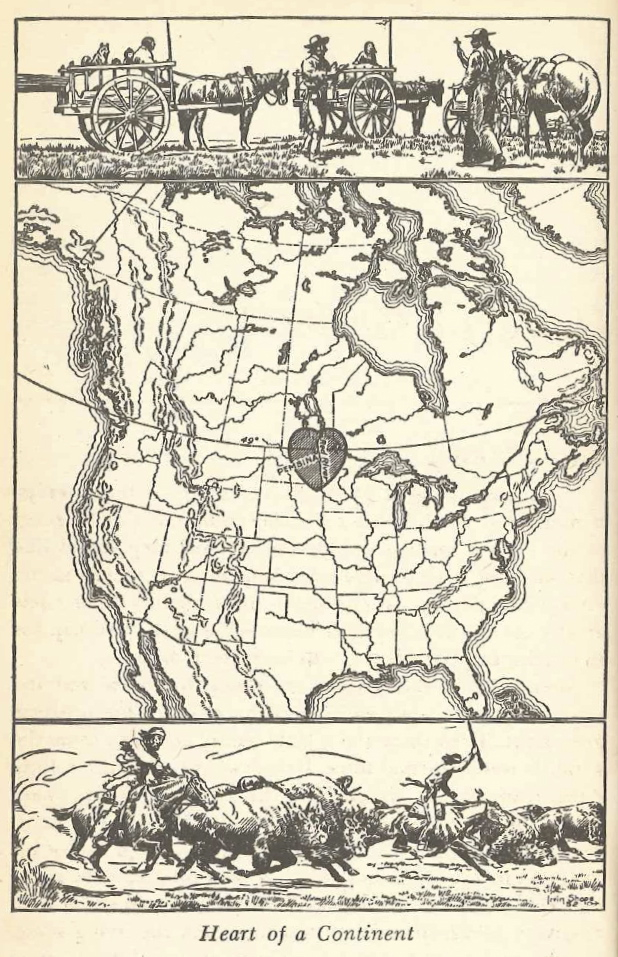
from Josephine Kinsey Howard's Strange Empire
Filed under: art, Canada, United States | Closed
Abstract
This essay argues that the new global regime of R2P bifurcates the international system between sovereign states whose citizens have political rights, and de facto trusteeship territories whose populations are seen as wards in need of external protection. Under the direction of the UN Security Council, the International Criminal Court has become an integral part of the international R2P regime by allowing for the legal normalization of certain types of violence (such as Western counterinsurgency efforts), while arbitrarily criminalizing the violence of other states as ‘genocide’. In place of this unequal global regime, the essay concludes by arguing for an internally-driven process of political reform and legal reconciliation, as pioneered in South Africa.
Keywords: Darfur; genocide; humanitarian intervention; International Criminal Court (ICC); sovereignty
Filed under: Africa, Genocide, law, Scholarship and insights | Closed
No abstract, so here is the intro:
The idioms and the methodologies of ‘Utopia’ have always been explicit and implicit in both projects of colonial acquisition and expansion, and in the differential projects of anti-colonial theory and practice. Yet there has never been an adequate commerce of ideas established between the respective contemporary fields of Utopian studies and postcolonial studies. However, in a recent essay in this journal, the postcolonial scholar, Bill Ashcroft, attempted to bridge the theoretical hiatus between the two fields. In ‘Critical Utopias’ Ashcroft essentially provides a literary critical mapping of how ‘the Utopian’ has figured in the literary art of Anglophone colonial, anti-colonial and postcolonial crucibles. Ashcroft’s summary Utopian/postcolonial survey takes its theoretical impetus, naturally enough, from a conversation between Ernst Bloch and Theodor Adorno in 1964, in which Adorno adumbrates the repressed knowledge that each individual harbours of a possible Utopia – we know that a better possible world exists, but we are ideologically persuaded that the possible is actually the impossible. In addition to foundational thinkers such as Bloch and Adorno, Ashcroft also enlists other theorists of the Utopian, including Herbert Marcuse and Fredric Jameson. The survey is not confined to theoretical utopias, however, as Ashcroft subsequently traverses a variety of historical times and spaces in divining traces of literary Utopian dynamism in colonial contexts. Invoked in this generous inventory are: Thomas More’s originary Utopia; Shakespeare’s The Tempest; and Defoe’s Robinson Crusoe – the latter two, of course, are representative of the Utopian colonial project, but are also read as texts that are capable of producing their own Utopian counter-narratives of anti-colonial resistance. In contemporary terms, Ashcroft straddles the Indian sub-continent; Africa and the Caribbean, specifically: Salman Rushdie; JM Coetzee; Edouard Glissant; Aime Cesaire; Derek Walcott; and Edward Kamau Brathwaite. Ashcroft’s intervention is distinguished by its concentration on what are, putatively, canonical texts of postcolonial literary studies. And while the species of utopia canvassed by Ashcroft is one that seeks to undermine the naturalised centrality of ‘History’ as discourse, there is an implicit assumption in such a parade of writers of a ‘postcolonial History’, or ‘postcolonial Tradition’ within its literary branch. Regardless of this initial point of contention, the virtue of Ashcroft’s essay is its dedication to the necessary relevance of Utopian literary critical; literary historical; and historiographical strategies to debates within postcolonial studies. Yet, as I have indicated, in this speculative initiative by Ashcroft these critical strategies seem to be predominantly confined to literary horizons and there is little engagement with neo-Marxist critiques within postcolonial studies itself. These features may be consequences of the fact that the range of Utopian theorists referred to may be foundational, but it is not extensive. While the employment of Bloch is naturally instructive and a contemporary Utopian critic such as Tom Moylan is summarily cited, there is no reference to seminal figures within the Utopian field such as: Lyman Tower Sargent; Ruth Levitas; Darko Suvin; Lucy Sargisson; Krishan Kumar; Barbara Goodwin; Gregory Claeys; Raffaella Baccolini and Vincent Geoghegan.
Finally, with respect to the postcolonial aspects of Ashcroft’s piece; the essay commits a familiar error of omission, one that seems to have been redressed in many publications on postcolonial studies but that does persist. The case of Ireland as either a Utopian, postcolonial or Utopian-postcolonial case-study is neither addressed nor alluded to at any stage. Such an oversight is disappointing given Ireland’s protracted colonial history and its exemplary role as an early twentieth century pioneer in anti-colonial theory and practice. Furthermore, Ireland has a distinguished history office Utopian writing, mythology and political philosophy, which would clearly enrich any discussion of the commonalities of the fields of Utopian studies and postcolonial studies. The purpose of the present essay is to respond to Ashcroft’s provocative critical alignment of the Utopian and the postcolonial, and to furnish necessary modifications and supplements to the argument developed therein. With this in mind, my argument will accent the inherently Utopian cast of much of the recent and ongoing literary historical; literary critical; historiographical; and theoretical writing within contemporary Irish postcolonial studies. In providing an effective metacritical survey of these Utopian-postcolonial vectors in Irish literary and cultural studies, this essay will address the implicated interdisciplinary projects that constitute the field of Irish postcolonial studies. The ensuing metacritique argues that not only are some of the major strands of Utopian postcolonial critique focused on interrogating the philosophical limits and lacunae of the contested legacies of ‘Enlightenment’ thought; British imperial discourses; and bourgeois Irish nationalism, but they are also involved in tracking the Utopian energies of subaltern Irish nationalisms and in retrieving the work and reputations of Irish anti-colonial thinkers, writers and activists in light of contemporary international postcolonial theory and activism. At root, the discussion displays the urgency with which postcolonial critics have approached, and attempted to appropriate, the Utopian dynamism of historical Irish anti-colonial thought and action in their own Utopian engagements with the prevailing political and economic conjuncture in Irish society. These projects are by no means homogenous and it is not to be concluded that they are easily woven together as fractions of a sanctioned critical consensus within Irish postcolonial studies. They are representative of a viable critical mass within Irish criticism that accepts the legitimacy of Utopian imagination, and that has gleaned valuable lessons from the historiographical, often subalternist, methodologies of international postcolonial studies. In sum, the present essay has a particular focus on matters that pertain to the utopic in terms of the literary historical and the historiographical within Irish postcolonial studies, and will, one hopes, catalyse future interventions that might engage with other facets of Irish colonial history and postcolonial criticism.
Filed under: Éire, postcolonialism, Scholarship and insights | Closed
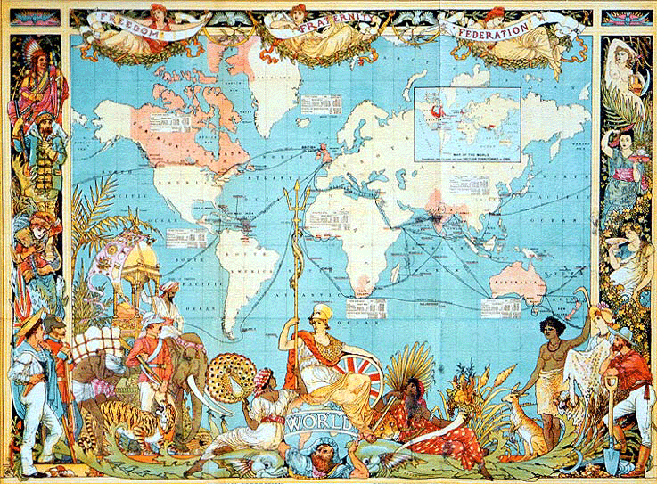
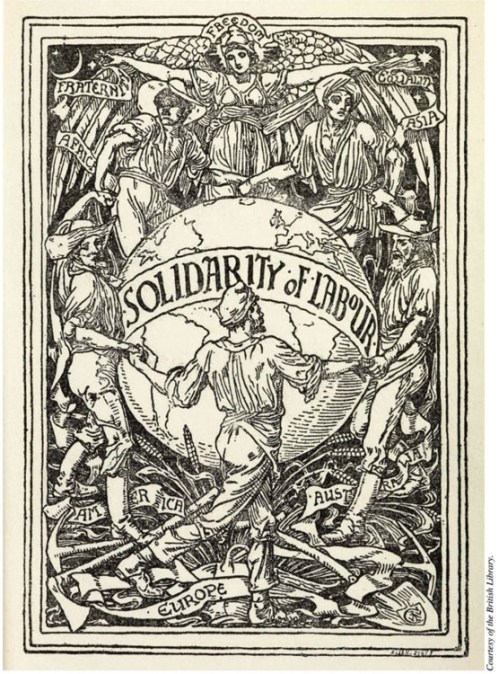
Crane’s commitment to a gendered, pastoral iconography of labour – epitomized by his celebrated May Day scenes – is clear in his design for the 1886 map. The vision of empire as a means of realizing the ambitions of socialism may fit awkwardly within our own histories of imperial and anti-imperial politics, but it does pose an important question about the extent to which intellectuals and workers in the English socialist tradition – especially in its arts and crafts manifestation – were able to connect a strongly pastoral vision of socialism with a sense of allegiance to the heroic values of labour in the settler colonies around the empire, at least before the 1890s. The significance of globalization in general, and white settler colonialism in particular, for the gendering of socialist iconography surely deserves more attention than it has been given in the pages of this journal. A Crane image used for the frontispiece of the American edition of News From Nowhere (1890), for example, clearly suggests an unacknowledged link between colonial and socialist iconography. Comparing this to the 1886 map is instructive. In the 1890 image dedicated to the solidarity of labour, the masculine brotherhood has triumphed, leaving only freedom represented by a woman, while Equality has – unsurprisingly – replaced Federation. However, Africa – like America and Australia – appears to be represented by a white male settler. On the other hand, we have already noted the unlikely appearance of the cap of liberty in the 1886 map, and Crane scholars have commented on his penchant for infiltrating such potent political emblems into his commercial work as an illustrator of children’s books. The figure of Atlas holding the globe on his shoulders in the 1886 map wears a band around his chest with the words ‘human labour’, providing another none-too-subtle pointer to Crane’s brand of socialism. If this is the labour theory of value, it is a theory in which empire is potentially a vehicle and not an obstacle to socialism. The banners to freedom and fraternity, the caps of liberty, the fruits and garlands, the sturdy male bodies and languid female forms all betray the fact of Crane’s authorship – though, remarkably, few if any Crane scholars or map historians recognized this until very recently.
Very interesting point, and a useful paper. Check it out.
Filed under: Empire, Scholarship and insights | Closed
Dorothy L. Hodgson, ‘Becoming Indigenous in Africa’, African Studies Review 52, 3 (2009).
Abstract:
This article traces the history of how and why certain African groups became involved in the transnational indigenous rights movement; how the concept of the indigenous has been imagined, understood, and employed by African activists, donors, advocates, and states; and the opportunities and obstacles it has posed for the ongoing struggles for recognition, resources, and the rights of historically marginalized people like Maasai.
Filed under: Africa, Scholarship and insights | Closed
Filed under: Call for papers | Closed
ulster freedom fighters
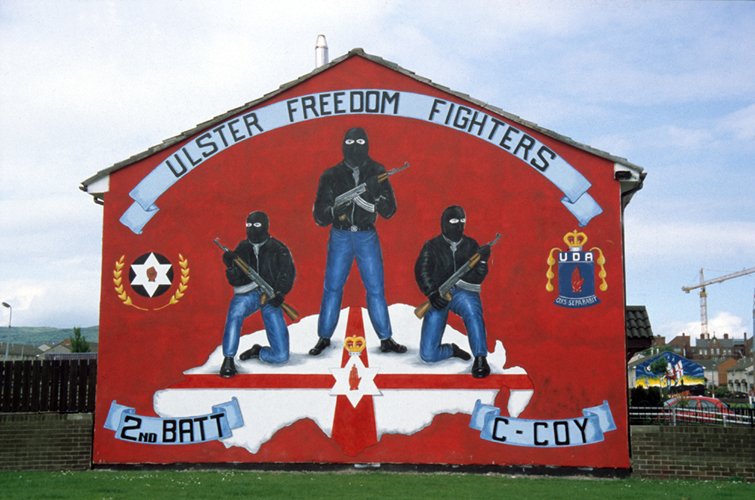
Johnny Adair's C-Company
Bill Rolston, Drawing Support: Murals in the North of Ireland (Beyond the Pale, 1992)
Like them or loathe them, they cannot be ignored. The political wall murals of the North of Ireland are an integral part of loyalist and republican communities. In its murals each group displays its hopes and fears, struggles and aspirations. Sometimes the murals are long-lived, more often their existence is fleeting. This unique collection of photographs captures a large selection of the murals in their original colour and grandeur. It provides a revealing glimpse into the ideologies of the communities which produce this lively political art.
Bill Rolston, Drawing Support 2: Murals in War and Peace (Beyond the Pale, 1998).
How can the political wall murals in the North of Ireland cope with the peace process and ceasefires? This second volume of unique photographs charts the changes in Loyalist and Republican mural painting between 1992 and 1995 and casts a tentative glance towards the future.
I came across Rolston’s work after reading an article of his in Tinteán. My thanks to him for digging this one up for the blog.
Filed under: art, Éire | Closed
oxford english dictionary
settler
1. a. One who or a thing which, settles, fixes, decides, etc.
b. colloq. Something that settles or ‘does for’ a person, a finisher; something that settles an antagonist in an encounter or argument; a crushing or finishing blow, shot, speech, etc.
c. A clerk in a betting shop who calculates the winnings.
2. a. One who settles in a new country; a colonist. old settler: see OLD a. D4. orig. Amer.
b. gen. One who settles in a place as a resident.
c. A worker at a social settlement (see SETTLEMENT 16).
3. Law. One who settles property: = SETTLOR.
4. A pan or vat into which a liquor is run off to ‘settle’ or deposit a sediment. In Metallurgy (see quot. 1881).
5. attrib. and Comb., as settler-folk,  slam (
SLAM n.3); settler’s or settlers’ clock Austral. (see quots.); settler’s effects Canad., goods brought into the country by an immigrant for his personal use that are exempt from import duty; also transf.; settler’s matches, twine Austral. (see quots.).
Filed under: Uncategorized | Closed
teeming perilous hordes of carp
The discourse of foreign species management, and all its bells and sparkles: wading through it is as fun as it is disturbingly eery.
SERENA DAI and JOHN FLESHER, ‘Single Asian carp found near Lake Mich’. ass. press.
CHICAGO — An Asian carp was found for the first time beyond electric barriers meant to keep the voracious invasive species out of the Great Lakes, state and federal officials said Wednesday, prompting renewed calls for swift action to block their advance.
[…]
“The threat to the Great Lakes depends on how many have access to the lakes, which depends on how many are in the Chicago waterway right now,” said John Rogner, assistant director of the Illinois Department of Natural Resources.
But environmental groups said the discovery leaves no doubt that other Asian carp have breached barriers designed to prevent them from migrating from the Mississippi River system to the Great Lakes and proves the government needs to act faster.
“If the capture of this live fish doesn’t confirm the urgency of this problem, nothing will,” said Andy Buchsbaum, director of the National Wildlife Federation’s Great Lakes office.
Scientists and fishermen fear that if the carp become established in the lakes, they could starve out popular sport species and ruin the region’s $7 billion fishing industry. Asian carp can grow to 4 feet and 100 pounds, and eat up to 40 percent of their body weight daily.
Rogner, from the Illinois Department of Natural Resources, estimated that the male carp was about 3 to 4 years old. It was caught live but has since been killed and will be sent to the University of Illinois to determine if it was raised artificially or naturally bred.
The fish was sexually mature, but Lake Calumet’s conditions aren’t conducive to reproduction because the water is too still, Rogner said.
Even so, the lake is the ideal living environment for the fish because it’s quiet and near a river system, he added.
“It fits the model to a T,” he said. “They may be concentrated in that area.”
Officials said they’ll use electrofishing and netting to remove any Asian carp from the lake.
They have been migrating up the Mississippi and Illinois rivers toward the Great Lakes for decades.
[..]
“Is it disturbing? Extraordinarily. Is it surprising? No,” Joel Brammeier, president of the Alliance for the Great Lakes, said of the carp’s discovery beyond the barriers.
He said the capture highlights the need to permanently sever the link between the Mississippi River and the Great Lakes. The Army Corps is studying alternatives, but says the analysis will take years.
“Invaders will stop at nothing short of bricks and mortar, and time is running short to get that protection in place,” Brammeier said.
Ian Johnston, ‘UK accused of ‘racism’ towards invaders from across the pond’, independent.
“Save the aliens!” is the cry – and an unusual one too. Safeguarding Britain’s flora and fauna from the ravages of mankind and “non-native invader” species has become the largely unquestioned cause célèbre of a generation.
In a new book, however, a leading historian argues this “culturally-determined” idea of native and non-native species is fundamentally flawed, and calls attempts to preserve the genetic identity of British wildlife “quasi-racist”. Professor Christopher Smout, Scotland’s Historiographer Royal and the founder of the Institute for Environmental History at St Andrews University, said species needing conservation should receive it regardless of “ethnicity”. Those which cause problems, such as native bracken or non-native giant hogweed, should be dealt with in the same way and classed as “pests”.
“The preoccupation with alien species is comparatively recent and not something which worried scientists and ecologists 50 years ago,” said Professor Smout, whose book, Exploring Environmental History, is published in May. “They were concerned with pests. In recent times, the emphasis has been on the fact these pests are aliens and it has tended to a blanket condemnation to all species not classed as natives.”
T. C. Smout, Exploring Environmental Histories, Edinburgh University Press, 2009.
Exploring Environmental History is a collection of essays and papers which distil the professor’s latter-day researches and reflections. They are characteristically acute and uncompromising. — Roger Hutchinson Scottish Review of Books The modest title of this book gives little idea of the excitements that lie within… This is a memorable book, rich in scholarship and full of argument, and elegantly written… the brilliance of the essays must make ‘Exploring Environmental History’ a thoroughly worthwhile purchase or gift. — Paul Ramsey Recorder News Christopher Smout is, in my opinion, the best environmental historian in Britain; indeed, he practically invented the term. He is worth being read by every conservationist, not just for his specialist knowledge, but also because he is extremely readable. It ought to be a commonplace view that, as he asserts, environmental problems can be understood properly only from a historical perspective. — Peter Marren British Wildlife Thant the book shoudl end with provoking thought in its readers cannot be anything but good and reinforces our sense of gratitude that these essays should exist and that the publishers should bring them all together. — Ian Simmons, Emeritus Professor, University of Durham Environment and History Exploring Environmental History is a collection of essays and papers which distil the professor’s latter-day researches and reflections. They are characteristically acute and uncompromising. The modest title of this book gives little idea of the excitements that lie within… This is a memorable book, rich in scholarship and full of argument, and elegantly written… the brilliance of the essays must make ‘Exploring Environmental History’ a thoroughly worthwhile purchase or gift. Christopher Smout is, in my opinion, the best environmental historian in Britain; indeed, he practically invented the term. He is worth being read by every conservationist, not just for his specialist knowledge, but also because he is extremely readable. It ought to be a commonplace view that, as he asserts, environmental problems can be understood properly only from a historical perspective. Thant the book shoudl end with provoking thought in its readers cannot be anything but good and reinforces our sense of gratitude that these essays should exist and that the publishers should bring them all together.
Filed under: Canada, media, Political developments, Quote, Scholarship and insights, United States | Closed

