The Australian referendum of 1967 approved amendments to the Australian Constitution which allowed the Federal Government to make special laws that applied to Aboriginal Australians. As a result, since 1967, Australian governments have put in place policies and programs with the aim of achieving positive social and economic outcomes for Aboriginal people. However, over four decades later, the gap between indigenous and non-indigenous Australians is still unacceptably wide. In fact, some studies suggest the gap is actually widening.Canada faces similar issues in closing the gap between their indigenous and non-indigenous citizens. While Canada and Australia both enjoy a high ranking on the United Nations Development Program’s (UNDP) Human Development Index (HDI)—8th and 4th respectively—their indigenous people are considerably worse off, comparatively sitting at 32nd and 103rd. This situation of Aboriginal people living in Third World conditions highlights the need for urgent action in both countries.An overview of the history of Aboriginal policy and relations in Australia in comparison to Canada provides a useful context for policymakers in both countries. Some of the negative experiences in Australia can also serve as a warning to governments in Canada, whereby if some of the problems faced in Canadian Aboriginal communities are not addressed soon, drastic interventions may be needed.
Filed under: Australia, Canada, Political developments, Scholarship and insights | Closed
arrival and possession
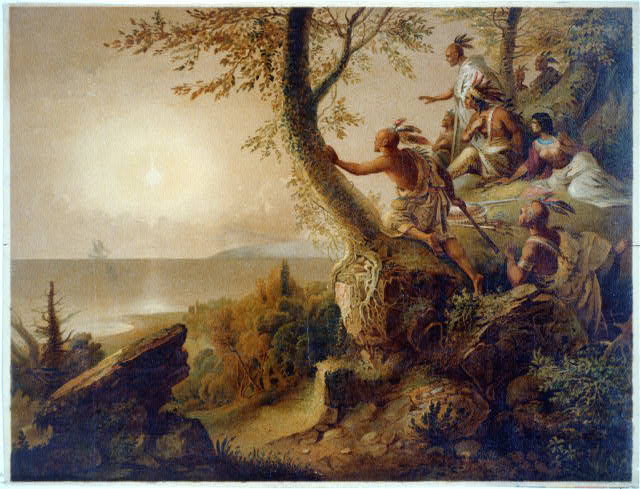
The arrival of Hendrick Hudson in the bay of New York, September 12, 1609
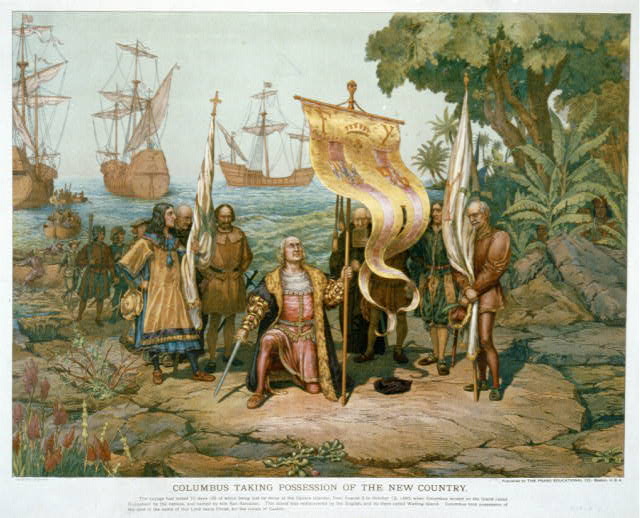
Columbus taking possession of the new country
From the Library of Congress Prints and Photographs Catalog.
Filed under: art | Closed
The white man systematically destroyed Indian culture where it existed, but separated blacks from his midst so that they were forced to attempt the creation of their own culture
Vine Deloria Jnr., Custer Died for your Sins (Norman: University of Oklahoma Press, 1988 [1969]).
Filed under: Quote, United States | Closed
out of what tree did i fall
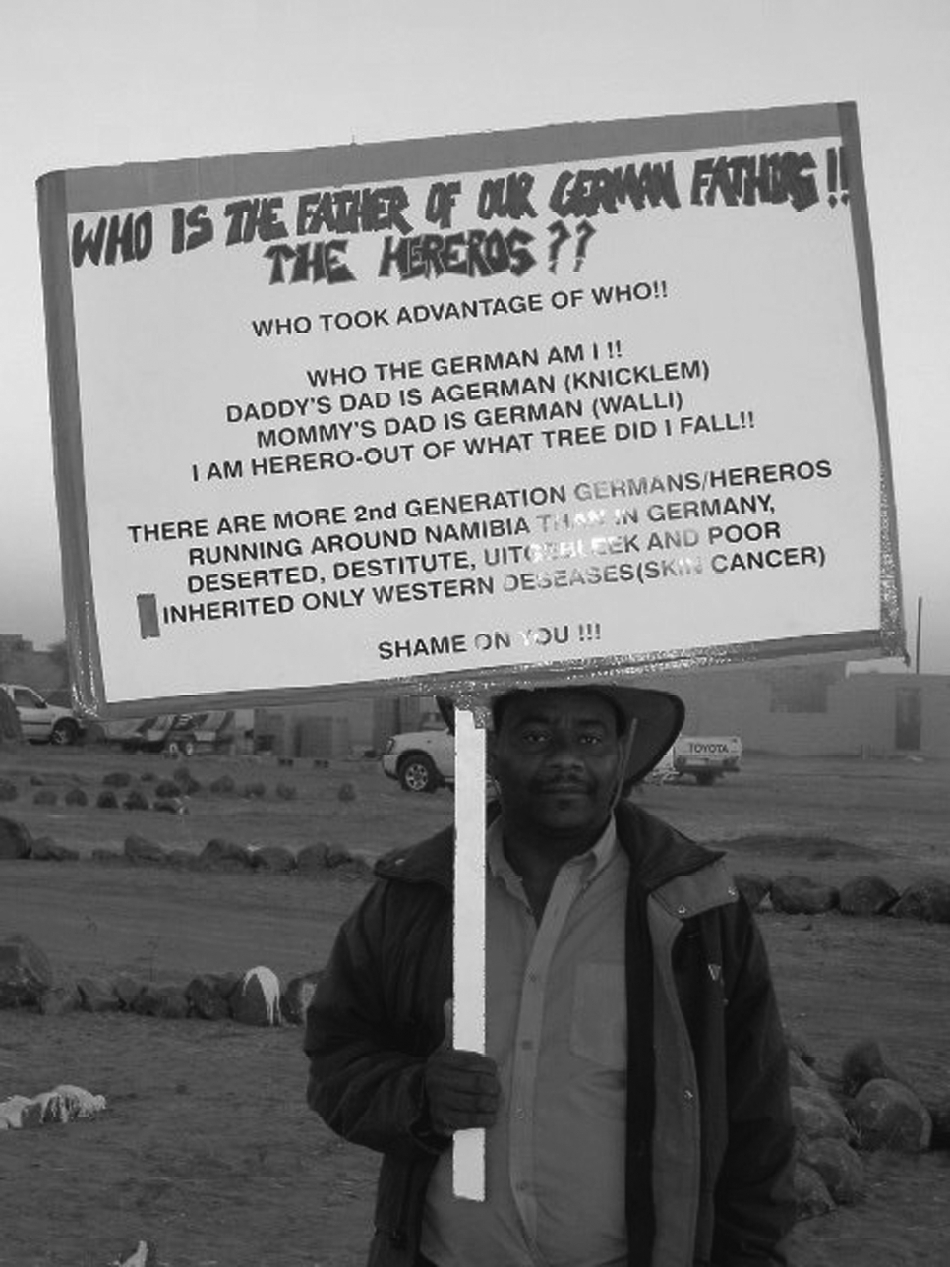
(Note: I got this from an article about a year ago, which I have unfortunately lost, so can not attribute for the moment. I am happy to reference if anyone remembers)
Filed under: Africa | Closed
Some highlights from the latest Urban History Review 38, 2 (2010), with the special topic of ‘Encounters, Contests and Communities’.
Franca Iacovetta and Jordan Stanger-Ross, ‘Intro: Encounters, Contests, Communities: New Histories of Race and Ethnicity in the Canadian City’.
Penelope Edmonds, ‘Unpacking Settler Colonialism’s Urban Strategies: Indigenous Peoples in Victoria, BC, and the Transition to a Settler Colonial City’.
Abstract:
This article uses settler colonialism as a specific analytic frame through which to understand the historical forces in the formation of settler cities as urbanizing polities. Arguing that we must pay attention to the intertwined histories of immigration and colonization, the author traces the symbolic and economic functions and origins of the settler-colonial city to reveal its political imperatives, the expropriation of Indigenous land, and the dispossession, removal, sequestration, and transformation of Indigenous peoples. Taking as a case study the city of Victoria, BC, and its Lekwungen people throughout the nineteenth century, the author charts the shift from a mixed and fluid mercantilist society to an increasingly racialized and segregated settler-colonial polity. This transition reveals how bodies and urbanizing spaces are reordered and remade, and how Indigenous peoples come to be produced and marked by political categories borne of the racialized practices of an urbanizing settler colonialism, which complement the powerful forces of settler ethnogenesis and colonial modernity.
Victoria Freeman, ‘Toronto has no History! Indigeneity, Settler Colonialism and Historical Memory in Canada’s Largest City’.
Abstract:
In 1884, during a week-long commemoration of the fiftieth anniversary of Toronto’s incorporation in 1834, tens of thousands celebrated Toronto’s history and its relation to British colonialism and imperialism. The author’s analysis of the historical tableaux in the first day’s parade and speeches by Daniel Wilson, president of University College, and Chief Samson Green of the Tyendinaga Mohawks reveals divergent approaches to commemoration as “politics by other means”: on one hand, the erasure of the area’s Indigenous past and the celebration of its European future, on the other, an idealized view of the past of Indigenous–settler partnership that ignores the role of local settlers in the dispossession of the Mississaugas. The 1884 commemoration marks the transition from the founding of the settlement in 1793 to its incorporation in 1834 as the city’s “ founding moment” and marker of the assumed “indigeneity” of settler-immigrants. The deed acquired from the Mississaugas in the Toronto Purchase of 1787 is deemed irrelevant, while the 1834 Act of Incorporation becomes the symbolic deed to Toronto’s modernity.
Filed under: Scholarship and insights | Closed
uncyclopedia
An alternative definition of settler colonialism from uncyclopedia:
Utilising the ‘Overstaying Your Welcome’ strategy, settlers enter a weaker nation’s borders, ask for a drink and begin scrutinising their CD collection.
Filed under: Quote, wacky | Closed
From maorinews:
The Government is on the verge of offering the Tūhoe tribe a treaty settlement that could be as groundbreaking as it is controversial. Tūhoe is hoping it will mean total control of the Urewera National Park, and start the tribe on the way to self-rule and becoming a separate nation. But the Government is sensitive about just how far it will go.
From nzherald:
A Treaty deal for Ngai Tuhoe could happen only if its land confiscation is recognised on a par with Tainui and Ngai Tahu’s $170 million settlements – the tribe couldn’t live with anything less.
[…]
A Waitangi Tribunal report last year said 24,147ha of land was confiscated during the 19th century – an act the Crown has accepted was unjust and excessive.
Money, then land, then autonomous government, then separate nation status. The Ngai Tuhoe plan resembles that of other Maori groups in recent decades, which is interesting; but what makes it more interesting is that it also resembles the process of founding collectives according to an age old settler colonial model, established centuries earlier. So in New Zealand, to a greater than any of the other settler states, treaty settlements resemble the process of European settlements.
Filed under: law, New Zealand, Political developments, Sovereignty | Closed
via indigenous peoples issues and resources
Abstract:
Este artículo examina la movilización popular y social en Oaxaca, México a través del ejemplo del movimiento de la Asamblea Popular de los Pueblos de Oaxaca (APPO). Estas páginas se centran en la manera en que el concepto de “indigeneidad” fue utilizado en representaciones e identificaciones de la APPO por diversos actores sociales. Un análisis más profunda de la actual movilización social en Oaxaca, ejemplificado por la APPO, sugiere que el uso de indigeneidad como etiqueta de identidad requiere una perspectivacrítica. Este trabajo argumenta que una dependencia aparente de modos de pensar dicotomizados (por ej., indígena/no-indígena) nos limita a la hora de revelar los diálogos de identidad dentro de la APPO y otras formas actuales de movilización colectiva a gran escala en Latinoamérica. También obstaculiza el reconocimiento de la extensión y medios con los que las identidades generadas por movilizaciones aquí y más allá son constituidas por una sociedad civil más global (y virtual).
This article examines popular social mobilization in Oaxaca, Mexico, through the example of the 2006 movement of the Asamblea Popular de los Pueblos de Oaxaca (APPO). It focuses on the way the concept of “indigeneity” came to be used in representations and identifications of the APPO by various social actors. A deeper examination of current social mobilization in Oaxaca as exemplified by the APPO suggests that the use of indigeneity as an identity label should be approached with a more sharply ground critical lens. This work argues that an apparent continued analytical reliance on modes of dichotomized thinking (e.g., indigenous/non-indigenous) is limiting in terms of revealing the complicated interpellations of identity at play in the APPO and other current forms of large-scale collective action in Latin America. It also prevents recognition of the extent and ways in which movement identities here and elsewhere are being constituted by an increasingly global (and virtual) civil society.
Filed under: Latin America, Scholarship and insights | Closed
Swedish Resistance Movement, Stockholm, this week:

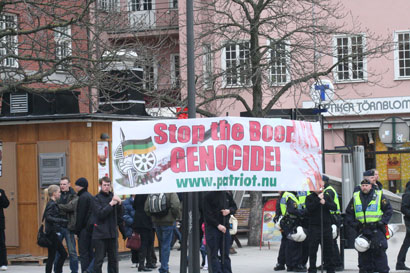
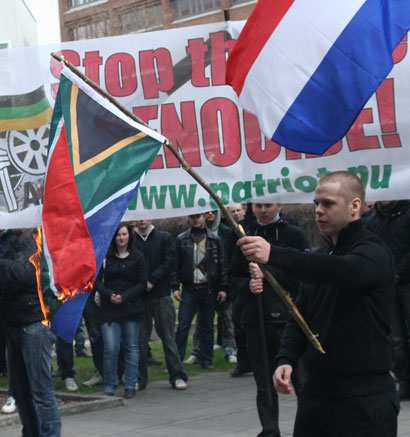
Excuse my ridiculous title for this post. I frame it partly to poke fun at academic jargon, but partly to highlight some uncertainty. What are the words for this European, and therefore extra-settler, rights discourse? Is it new? Is it likely to stick around? Can we compare it to, say, civil rights discourse, or later, anti-apartheid discourse, as they arose in places far removed from places of conflict? Can settler colonial decolonisation therefore never be a fait accompli?
Filed under: Political developments, Southern Africa | Closed
freshly ground black people
The publishing company was forced to pulp and reprint 7000 copies of Pasta Bible last week after a recipe called for “salt and freshly ground black people” – instead of pepper – to be added to the spelt tagliatelle with sardines and prosciutto.
[…]
“In one particular recipe [a] misprint occurs which obviously came from a spell checker. When it comes to the proofreader, of course they should have picked it up, but proofreading a cookbook is an extremely difficult task. I find that quite forgivable.
Perhaps the headline should have read: ‘Proofreading cookbook an extremely difficult task’.
Thanks to Rob A.
Filed under: Australia, Political developments, wacky | Closed

