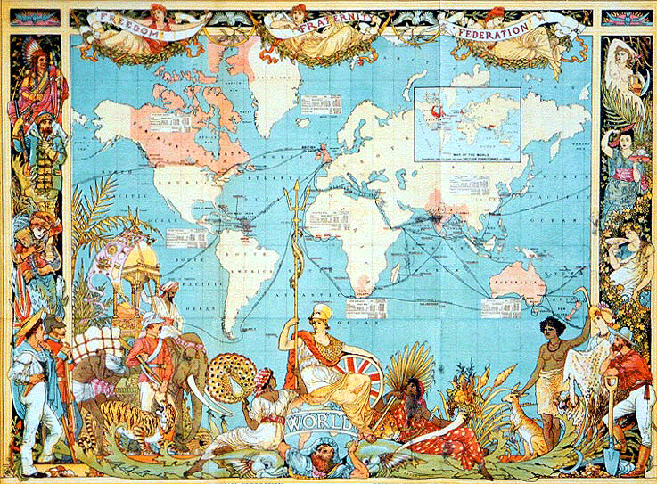
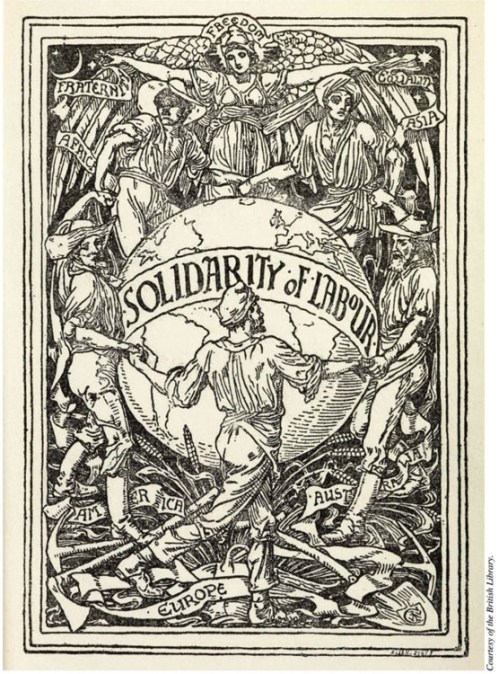
Crane’s commitment to a gendered, pastoral iconography of labour – epitomized by his celebrated May Day scenes – is clear in his design for the 1886 map. The vision of empire as a means of realizing the ambitions of socialism may fit awkwardly within our own histories of imperial and anti-imperial politics, but it does pose an important question about the extent to which intellectuals and workers in the English socialist tradition – especially in its arts and crafts manifestation – were able to connect a strongly pastoral vision of socialism with a sense of allegiance to the heroic values of labour in the settler colonies around the empire, at least before the 1890s. The significance of globalization in general, and white settler colonialism in particular, for the gendering of socialist iconography surely deserves more attention than it has been given in the pages of this journal. A Crane image used for the frontispiece of the American edition of News From Nowhere (1890), for example, clearly suggests an unacknowledged link between colonial and socialist iconography. Comparing this to the 1886 map is instructive. In the 1890 image dedicated to the solidarity of labour, the masculine brotherhood has triumphed, leaving only freedom represented by a woman, while Equality has – unsurprisingly – replaced Federation. However, Africa – like America and Australia – appears to be represented by a white male settler. On the other hand, we have already noted the unlikely appearance of the cap of liberty in the 1886 map, and Crane scholars have commented on his penchant for infiltrating such potent political emblems into his commercial work as an illustrator of children’s books. The figure of Atlas holding the globe on his shoulders in the 1886 map wears a band around his chest with the words ‘human labour’, providing another none-too-subtle pointer to Crane’s brand of socialism. If this is the labour theory of value, it is a theory in which empire is potentially a vehicle and not an obstacle to socialism. The banners to freedom and fraternity, the caps of liberty, the fruits and garlands, the sturdy male bodies and languid female forms all betray the fact of Crane’s authorship – though, remarkably, few if any Crane scholars or map historians recognized this until very recently.
Very interesting point, and a useful paper. Check it out.
Filed under: Empire, Scholarship and insights | Closed
Dorothy L. Hodgson, ‘Becoming Indigenous in Africa’, African Studies Review 52, 3 (2009).
Abstract:
This article traces the history of how and why certain African groups became involved in the transnational indigenous rights movement; how the concept of the indigenous has been imagined, understood, and employed by African activists, donors, advocates, and states; and the opportunities and obstacles it has posed for the ongoing struggles for recognition, resources, and the rights of historically marginalized people like Maasai.
Filed under: Africa, Scholarship and insights | Closed
Filed under: Call for papers | Closed
ulster freedom fighters

Johnny Adair's C-Company
Bill Rolston, Drawing Support: Murals in the North of Ireland (Beyond the Pale, 1992)
Like them or loathe them, they cannot be ignored. The political wall murals of the North of Ireland are an integral part of loyalist and republican communities. In its murals each group displays its hopes and fears, struggles and aspirations. Sometimes the murals are long-lived, more often their existence is fleeting. This unique collection of photographs captures a large selection of the murals in their original colour and grandeur. It provides a revealing glimpse into the ideologies of the communities which produce this lively political art.
Bill Rolston, Drawing Support 2: Murals in War and Peace (Beyond the Pale, 1998).
How can the political wall murals in the North of Ireland cope with the peace process and ceasefires? This second volume of unique photographs charts the changes in Loyalist and Republican mural painting between 1992 and 1995 and casts a tentative glance towards the future.
I came across Rolston’s work after reading an article of his in Tinteán. My thanks to him for digging this one up for the blog.
Filed under: art, Éire | Closed
oxford english dictionary
settler
1. a. One who or a thing which, settles, fixes, decides, etc.
b. colloq. Something that settles or ‘does for’ a person, a finisher; something that settles an antagonist in an encounter or argument; a crushing or finishing blow, shot, speech, etc.
c. A clerk in a betting shop who calculates the winnings.
2. a. One who settles in a new country; a colonist. old settler: see OLD a. D4. orig. Amer.
b. gen. One who settles in a place as a resident.
c. A worker at a social settlement (see SETTLEMENT 16).
3. Law. One who settles property: = SETTLOR.
4. A pan or vat into which a liquor is run off to ‘settle’ or deposit a sediment. In Metallurgy (see quot. 1881).
5. attrib. and Comb., as settler-folk,  slam (
SLAM n.3); settler’s or settlers’ clock Austral. (see quots.); settler’s effects Canad., goods brought into the country by an immigrant for his personal use that are exempt from import duty; also transf.; settler’s matches, twine Austral. (see quots.).
Filed under: Uncategorized | Closed
teeming perilous hordes of carp
The discourse of foreign species management, and all its bells and sparkles: wading through it is as fun as it is disturbingly eery.
SERENA DAI and JOHN FLESHER, ‘Single Asian carp found near Lake Mich’. ass. press.
CHICAGO — An Asian carp was found for the first time beyond electric barriers meant to keep the voracious invasive species out of the Great Lakes, state and federal officials said Wednesday, prompting renewed calls for swift action to block their advance.
[…]
“The threat to the Great Lakes depends on how many have access to the lakes, which depends on how many are in the Chicago waterway right now,” said John Rogner, assistant director of the Illinois Department of Natural Resources.
But environmental groups said the discovery leaves no doubt that other Asian carp have breached barriers designed to prevent them from migrating from the Mississippi River system to the Great Lakes and proves the government needs to act faster.
“If the capture of this live fish doesn’t confirm the urgency of this problem, nothing will,” said Andy Buchsbaum, director of the National Wildlife Federation’s Great Lakes office.
Scientists and fishermen fear that if the carp become established in the lakes, they could starve out popular sport species and ruin the region’s $7 billion fishing industry. Asian carp can grow to 4 feet and 100 pounds, and eat up to 40 percent of their body weight daily.
Rogner, from the Illinois Department of Natural Resources, estimated that the male carp was about 3 to 4 years old. It was caught live but has since been killed and will be sent to the University of Illinois to determine if it was raised artificially or naturally bred.
The fish was sexually mature, but Lake Calumet’s conditions aren’t conducive to reproduction because the water is too still, Rogner said.
Even so, the lake is the ideal living environment for the fish because it’s quiet and near a river system, he added.
“It fits the model to a T,” he said. “They may be concentrated in that area.”
Officials said they’ll use electrofishing and netting to remove any Asian carp from the lake.
They have been migrating up the Mississippi and Illinois rivers toward the Great Lakes for decades.
[..]
“Is it disturbing? Extraordinarily. Is it surprising? No,” Joel Brammeier, president of the Alliance for the Great Lakes, said of the carp’s discovery beyond the barriers.
He said the capture highlights the need to permanently sever the link between the Mississippi River and the Great Lakes. The Army Corps is studying alternatives, but says the analysis will take years.
“Invaders will stop at nothing short of bricks and mortar, and time is running short to get that protection in place,” Brammeier said.
Ian Johnston, ‘UK accused of ‘racism’ towards invaders from across the pond’, independent.
“Save the aliens!” is the cry – and an unusual one too. Safeguarding Britain’s flora and fauna from the ravages of mankind and “non-native invader” species has become the largely unquestioned cause célèbre of a generation.
In a new book, however, a leading historian argues this “culturally-determined” idea of native and non-native species is fundamentally flawed, and calls attempts to preserve the genetic identity of British wildlife “quasi-racist”. Professor Christopher Smout, Scotland’s Historiographer Royal and the founder of the Institute for Environmental History at St Andrews University, said species needing conservation should receive it regardless of “ethnicity”. Those which cause problems, such as native bracken or non-native giant hogweed, should be dealt with in the same way and classed as “pests”.
“The preoccupation with alien species is comparatively recent and not something which worried scientists and ecologists 50 years ago,” said Professor Smout, whose book, Exploring Environmental History, is published in May. “They were concerned with pests. In recent times, the emphasis has been on the fact these pests are aliens and it has tended to a blanket condemnation to all species not classed as natives.”
T. C. Smout, Exploring Environmental Histories, Edinburgh University Press, 2009.
Exploring Environmental History is a collection of essays and papers which distil the professor’s latter-day researches and reflections. They are characteristically acute and uncompromising. — Roger Hutchinson Scottish Review of Books The modest title of this book gives little idea of the excitements that lie within… This is a memorable book, rich in scholarship and full of argument, and elegantly written… the brilliance of the essays must make ‘Exploring Environmental History’ a thoroughly worthwhile purchase or gift. — Paul Ramsey Recorder News Christopher Smout is, in my opinion, the best environmental historian in Britain; indeed, he practically invented the term. He is worth being read by every conservationist, not just for his specialist knowledge, but also because he is extremely readable. It ought to be a commonplace view that, as he asserts, environmental problems can be understood properly only from a historical perspective. — Peter Marren British Wildlife Thant the book shoudl end with provoking thought in its readers cannot be anything but good and reinforces our sense of gratitude that these essays should exist and that the publishers should bring them all together. — Ian Simmons, Emeritus Professor, University of Durham Environment and History Exploring Environmental History is a collection of essays and papers which distil the professor’s latter-day researches and reflections. They are characteristically acute and uncompromising. The modest title of this book gives little idea of the excitements that lie within… This is a memorable book, rich in scholarship and full of argument, and elegantly written… the brilliance of the essays must make ‘Exploring Environmental History’ a thoroughly worthwhile purchase or gift. Christopher Smout is, in my opinion, the best environmental historian in Britain; indeed, he practically invented the term. He is worth being read by every conservationist, not just for his specialist knowledge, but also because he is extremely readable. It ought to be a commonplace view that, as he asserts, environmental problems can be understood properly only from a historical perspective. Thant the book shoudl end with provoking thought in its readers cannot be anything but good and reinforces our sense of gratitude that these essays should exist and that the publishers should bring them all together.
Filed under: Canada, media, Political developments, Quote, Scholarship and insights, United States | Closed
Sovereignty for Indigenous nations!
Smash the state!
We are anti-colonial.
Filed under: Canada, Political developments | Closed
Terence Ranger, ‘Constructions of Zimbabwe’, Journal of Southern African Studies 36, 2 (2010).
Some selections:
Yet the absence of a scholarly history of Zimbabwe has been sorely felt by all sort of people – by diplomats, for example; by teachers and students; by intelligent tourists; by the ‘general reader’; and by all those who find the relentless proclamation of public history and its lists of heroes and villains implausible and even repulsive. Of course, it is not as though there is nothing to read about aspects of Zimbabwe’s history. As readers of JSAS know, there is a superabundance of published Zimbabwean historiography written by Zimbabweanists and increasingly by Zimbabweans. Much of it is of high quality. A lot of it is exciting. But much of it takes the form of district case studies, of histories of individual towns or histories of great events, like the 1948 general strike or the guerrilla war; of biographies; of denominations. Anyone who wants a book that seeks to put everything together has had until now to depend on L.H. Gann’s A History of Southern Rhodesia (London, Chatto and Windus, 1965) or Ian Phimister’s An Economic and Social History of Zimbabwe (London, Longman, 1988). But the first only goes up to 1934 and the second to 1948; neither is now available in Zimbabwe.
[…]
‘[A] generation whose time has come to take the reins of the state cannot be stopped by anyone’. Sabelo writes this from Johannesburg. He was offered a place in the Prime Minister’s office in Harare but he chose to go on being an academic. Change will come if the academics get it right. It would be nice to think so.
Filed under: Scholarship and insights, Southern Africa | Closed
The central question of this book is when and how does indigeneity in its various iterations – cultural, social, political, economic, even genetic – matter in a legal sense? Indigeneity in the Courtroom focuses on the legal deployment of indigenous difference in US and Canadian courts in the late 20th and early 21st centuries. Through ethnographic and historical research, Hamilton traces dimensions of indigeneity through close readings of four legal cases, each of which raises important questions about law, culture, and the production of difference. She looks at the realm of law, seeking to understand how indigeneity is legally produced and to apprehend its broader political and economic implications.
Filed under: law, Scholarship and insights, United States | Closed
Renisa Mawani, Colonial Proximities: Crossracial Encounters and Juridical Truths in British Columbia, 1871–1921 (Vancouver: UBC Press, 2009).
Contemporary discussions of multiculturalism and pluralism remain politically charged in former settler societies. Colonial Proximities historicizes these contestations by illustrating how crossracial encounters in one colonial contact zone — late-nineteenth- and early-twentieth-century British Columbia — inspired juridical racial truths and forms of governance that continue to inform contemporary politics, albeit in different ways.
Drawing from a wide range of legal cases, archival materials, and commissions of inquiry, this book charts the racial encounters between aboriginal peoples, European colonists, Chinese migrants, and mixed-race populations. By exploring the real and imagined anxieties that informed contact in salmon canneries, the illicit liquor trade, and the (white) slavery scare, this book reveals the legal and spatial strategies of rule deployed by Indian agents, missionaries, and legal authorities who, in the interests of racial purity and European resettlement, aspired to restrict, and ultimately prevent, crossracial interactions. Linking histories of aboriginal-European contact and Chinese migration, this book demonstrates that the dispossession of aboriginal peoples and Chinese exclusion were never distinct projects, but part of the same colonial processes of racialization that underwrote the formation of the settler regime.
Colonial Proximities shows us that British Columbia’s contact zone was marked by a racial heterogeneity that not only produced anxieties about crossracial contacts but also distinct modes of exclusion including the territorial dispossession of aboriginal peoples and legal restrictions on Chinese immigration. It is essential reading for students and scholars of history, anthropology, sociology, colonial/ postcolonial studies, and critical race and legal studies.
And Eve-Darian Smith gives an insightful review of the book in the recent edition of Canadian Journal of Law and Society.
Filed under: Canada, law, Scholarship and insights | Closed

