homelands
Homelands represent the intersection of specific areas of country… That is, they do not represent random settlements ‘where people go for a better lifestyle’ away from the larger communities created by non-Indigenous agents.
In contrast, homelands represent particular living areas in which each Indigenous individual and group is based in order to fulfil their own cultural obligations to their inherited country and its underlying traditional Law.
No, they’re not talking about apartheid-vintage Bantustans, but Aboriginal settlements across remote Northern Territory. An eerily similar description though, and you’re forgiven for being confused.
Though they sound the same, they aren’t the same: the NT homeland initiative is very much an Aboriginal-led one; the government supports it with funding (although a finite amount); and mining capitalists aren’t constantly sending their touts (labour recruiters) in there with contracts.
The quote is from a report entitled Our home, our homeland, quoted by Graham Ring, which I found via Fieldnotes and Footnotes.
Filed under: Australia, Political developments, Southern Africa | Closed
ngapuhi case begins
A while ago I got whisper of an excitingly unique Maori claim launched by the Ngapuhi.
Today I learn the case is getting under way today, via NZHerald:
The Te Paparahi o te Raki inquiry is unique in that iwi members will argue that their ancestors did not cede sovereignty when the Treaty was signed in 1840. Most historical tribunal claims deal with land loss.
Filed under: law, New Zealand, Political developments, Sovereignty | Closed
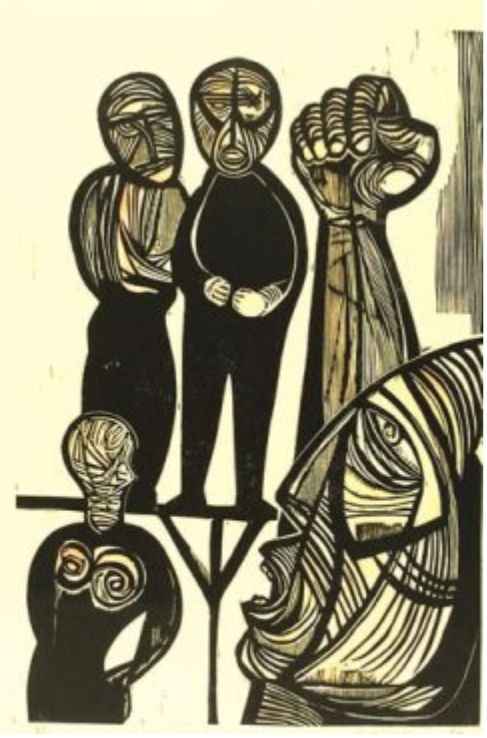
A snippet from John and Jean Comaroff’s — as always, gripping — opening essay of their edited collection, Law and Disorder in the Postcolony (Chicago 2006):
…there has certainly been an explosion of law-oriented nongovernmental organizations in the postcolonial world: lawyers for human rights, both within and without frontiers; legal resourcecenters and aid clinics; voluntary associations dedicated to litigating against historical injury, for social and jural recognition, for human dignity, and for material entitlements of one kind or another. Situated at the intersection of the public and the private, nongovernmental organizations of this sort are now commonly regarded as the civilizing missions of the twenty-first century. They are asserting their presence over ever wider horizons, encouraging citizens to deal with their problems by legal means. The upshot, it seems, is that people, even those who break the law, appear to be ever more litigious, sometimes with unforeseen consequences for states and ruling regimes. In South Africa, as we write, a plumber convicted of drunk driving is demanding $167,000 in damages from three cabinet ministers and the commissioner of Correctional Services for holding him in custody when, he says, by rights they should have had him in rehabilitation. And two well-known alumni of the liberation struggle, the national chair and the secretary of the Umkhonto weSizwe Military Veterans Association (MKMVA), announced in 2005 that they would seek a high-court interdict against two others who had claimed to be elected officials of the organization and had entered financial deals, fraudulently, in its name. In times past, this kind of conflict among the African National Congress elect would have been fought out by more conventional political means, less by using the law and its breach as their weapons of combat. But then, in times past, the MKMVA would not have been a thoroughly neoliberal organization, as much an investment holding company for its members as a commons for ex-guerilla heroes.
The global impact of legal nongovermental organizations on postcolonial consciousness is such that it is not uncommon nowadays to hear the language of jurisprudence in the Amazon or Aboriginal Australia, in the Kalahari or the New Guinea highlands, or among the homeless of Mumbai, Mexico City, Cape Town, and Trench Town. […] Postcolonies, in sum, are saturated with selfimaginings and identities grounded in the jural, even in places in which trafficking outside it is as common as trafficking within it—presuming, of course, that the distinction can be made at all.
[…]
It is not just the politics of the present that is being judicialized. The past, too, is increasingly caught up in the dialectic of law and disorder: hence the mobilization of legalities to fight anti-imperialist battles anew, which has compelled the British government to answer under oath for having committed acts of unspeakable atrocity in its African “possessions”, for having killed local leaders at whim, and for having unlawfully alienated territory from one African people to another. By these means is colonialism, tout court, rendered criminal. Hauled before a judge, history is made to break its silences, to speak in tongues hitherto unheard and untranslated, to submit itself to the scales of justice at the behest of those who suffered it, of its most abject subjects— and to be reduced to a cash equivalent, payable as the official tender of damage, dispossession, loss, trauma. In the process, too, it becomes clear that what imperialism is being indicted for, above all, is its commission of lawfare: its use of its own rules—of its duly enacted penal codes, its administrative law, its states of emergency, its charters and mandates and warrants, its norms of engagement—to impose a sense of order upon its subordinates by means of violence rendered legible, legal, and legitimate by its own sovereign word. And also to commit its own ever-socivilized, patronizing, high-minded forms of kleptocracy.
pp. 25-6, 28-9.
Flicking back through this book today, I was particularly struck by this comment.
Filed under: Africa, law, Political developments, postcolonialism, Quote, Scholarship and insights | Closed
council rock
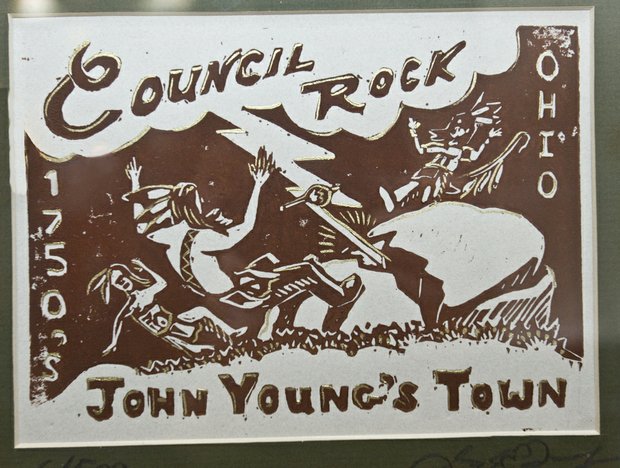
A block print by Joseph Donnelly, photographed recently by Lisa Ann-Ishihara, via Youngstown News.
Filed under: art, United States | Closed
Please enjoy these mp3 recordings of the papers delivered at the recent round table, ‘Settler Colonialism and the Colour Line’. Individual abstracts can be found here.
- Gaia Giuliani, Matching Colours
- Lorenzo Veracini, Decolonising Settler Colonialism
- Maria Giannacopoulos, Xenos, Nomos, Bia (temporarily unavailable)
- Kiran Grewal, The Native versus the Alien: Discourses of Belonging and the Reinforcement of White Hegemony
- Dinesh Joseph Wadiwel, The Right to Discriminate: Settler Colonialism, Solidarity, Sovereignty
Filed under: Australia, law, media, Political developments, postcolonialism, public lecture, Scholarship and insights, Sovereignty, Website | Closed
zunguzungu
It took me a long time to realize that the difference between settler colonialism and franchise/metropolitan/regular-old colonialism was the hinge for what I’m trying to do with the relationship between the United States and Kenya in my dissertation. In a very complicated way, of course; the problem with Kenya settlers is that they thought they were a settler colony when they actually weren‘t and couldn’t be, a problem they had in common with South African settlers, for whom the problem was not as grave but just as unsolvable. There just weren’t enough settlers, such that the colonial economy — and thus, the keys to the kingdom — always rested, in the final analysis, on African labor. The white settler community wanted Kenya to be a “white man’s country,” like the United States and Australia, and they failed because they lost the demographic war they often didn’t even realize they were fighting.
The reason it took me so long to find that piece of the conceptual puzzle, I think, was because “post-colonialism,” to the extent one can generalize, had quite programmatically taught me not to observe the distinction. Theorists of colonialism and postcolonialism tend to treat “it” like it’s one thing, tend to act as if it had a definite historical form and anatomy about which a variety of generalizations can be made and from which all sorts of statements about culture can be derived. This is not surprising; the pantheon of postcolonialist thinkers who rose to prominence in the 80′s traded on that notion quite successfully — and wrote a lot of important work whose foundational statusis is more or less proven by the extent to which we’ve moved beyond it — yet to the extent that “postcolonialism” became a subject of knowledge, it tended to turn “empire” and “colonialism” into an increasingly singular thing.
Without attributing intention to the founders of that canon, it’s not surprising that it happened that way. In part, making “the colonial” into a very specific thing allowed us to enjoy a triumphalist sense of post-colonialism in the present, insulating us in time from the sins of the past, and in this way making postcolonialism a safe discourse for us now. And it is also insulated us in political space; since empire was a thing that Britain and France did, the American postcolonialists — which was most of them — could safely excoriate the sins of an empire with whose legacy their audience had almost nothing to do with. The more specifically you defined “the postcolonial,” after all, the fewer people you alienated.
More here: ‘Postsettlerism is not a good thing’
Filed under: Africa, postcolonialism, United States | Closed
Cultural Studies Review, vol. 15 no. 2 September 2009.
Line-up:
Editorial—JOHN FROW & KATRINA SCHLUNKE
Critical Indigenous Theory
—Co-editor AILEEN MORETON-ROBINSON
Introduction—AILEEN MORETON-ROBINSON
‘In the City of Blinding Lights’: Indigeneity, Cultural Studies and the Errants of Colonial Nostalgia—JODI A. BYRD
‘There is Nothing that Identifies Me to that Place’: Indigenous Women’s Perceptions of Health Spaces and Places—BRONWYN FREDERICKS
In the Northern Territory Intervention What is Saved or Rescued and at What Cost?— IRENE WATSON
Imagining the Good Indigenous Citizen: Race War and the Pathology of Patriarchal White Sovereignty—AILEEN MORETON-ROBINSON
Critical Indigenous Studies: From Difference to Density—CHRIS ANDERSEN
Indigenous Existentialism and the Body—BRENDAN HOKOWHITU
Native American Scholarship and the Transnational Turn—ROBERT WARRIOR
Filed under: Scholarship and insights | Closed
Selections:
The aim of The Returns of Zionism is clear, and Piterberg does not hide it: the total de-legitimization of the Jewish nation-state founded in Palestine. A quarter of a century ago, this idea had a certain novelty; it aroused curiosity, especially as Zionist historiography was characterized by conformism, not to say an antiquated and dusty quality; but since then the anti-Zionists have established their own conformism and become stuck in its mire. At the same time, Israeli historiography has liberated itself from many of its traditional weaknesses, very comparable to those of the French or German historiographies of the 19th and 20th centuries. Moreover, the extreme politicization of anti-Zionist discourse and its considerable exposure in the media have not benefited research. One could say that, like post-modernism, anti-Zionism has aged badly. But if works whose aim is the de-legitimization of the Jewish national movement and the State of Israel are legion, Piterberg’s is distinguished by its high intellectual standard and the general culture of the author. This does not mean that he succeeds in avoiding the usual faults of the genre; but if he does not discover America, his book has sufficient merit to deserve an in-depth critical reading.
[…]
For Piterberg, there can be no solution except for the end of the Jewish state. Any other nationalism can transform itself, but the only future for ‘settler colonialism’ must be the total disappearance of the state it produced. […] First of all, a colonization that is not comparable to any other colonial society in its social and economic structures cannot be called a colonization. If Mandate-era Jewish Palestine was not based on any of the characteristic features of a colonial society—the exploitation of a native work-force; the confiscation of the natural riches of the country; a monopoly of political power that created two different classes of inhabitants, citizens and others who had no rights—it could not have been a colonial society. The truth was rather the opposite: in order to build a nation, the Jews of Palestine formed themselves into a self-sufficient and closed society. The cult of manual labour and the necessity of creating an infrastructure for the reception of new immigrants helped to prevent the emergence of exploitative relationships.
[…]
The founders of Israel, the young people who came to Palestine a few years before and after the First World War, never hid their intentions. The aim of Zionism was the conquest of Palestine and the creation of a Jewish state. Berl Katznelson, the labour-movement ideologist, never thought there could be any doubt about it: ‘The Zionist enterprise is an enterprise of conquest’, he said in 1929. And in the same breath: ‘It is not by chance that I use military terms when speaking of settlement.’ In 1922 Ben-Gurion had already said the same: ‘We are conquerors of the land facing an iron wall, and we have to break through it.’ That is why the Jewish Labour Movement was never a socialist movement like the others, nor was the Histadrut ever a trade-union organization like the rest. The Labour Movement was mobilized to build the nation; for the sake of national unity it abandoned any real intention of changing society. Equality was not an aim as such. The social services—at that time perhaps the most advanced in the world outside the Soviet Union—were those required by the worker, conceived as a soldier in the great army of conquerors of the land, for a people that needed a home more than any other national community in Europe.
The conquest of the land was thus an existential necessity. Zionism was a stringent nationalism, a radical nationalism; but to claim that the arrivals were white settlers driven by a colonialist mind-set does not correspond to historical reality.
Gabriel Piterberg, ‘Settlers and their States’ (His response), New Left Review 62 March 2010.
Selections:
Politically, the most consequential theme is the thorny C-word, colonialism. I am frankly baffled by Sternhell’s misrepresentation, or misunderstanding, of my arguments for situating the Zionist project in Palestine and the state of Israel within the framework of comparative settler-colonialism. He attempts to refute them by stating that the Zionist venture in Palestine was not based on the exploitation of native Arab labour and that it did not have ‘monopoly of political power’. But the fundamental point about a white-settler colony—New England, Virginia, Australia, New Zealand, Argentina—is that it is predicated on white labour, on complete closure vis-à-vis the natives, on gradual territorial expansion, under the bayonets of a metropole colonial power for as long as necessary; and on the creation of a self-sufficient economy that can attract more settler immigration. Contrary to Sternhell’s allegation that this notion is ‘dated’, a buoyant field of comparative settler colonialism has produced some of the most penetrating new studies of these societies over the past decades. Their starting-point is the recognition that, from the 16th century on, European expansion and conquest produced two related but clearly distinguishable forms of colonialism. One was metropole colonialism, in which the European powers conquered and ruled vast territories, but without the emigration there of Europeans seeking to make these territories their national home: British India is a good example. The other type was settler colonialism, in which conquest brought with it substantial waves of European settlers who, with the passage of time, sought to make the colony their national patrimony. This process entailed a relationship with the indigenous people that could range from dispossession to elimination, or from slavery—which for the most part did not use the native population—to cheap labour, depending on the economic and social formation of the given settler society.
The achievements of the comparative study of settler colonialisms have been at once scholarly and political. Several of these colonies gave birth to powerful nation-states which have asserted their own hegemonic narratives, nationally and internationally. The comparative field not only questions these narratives, through countervailing evidence and interpretation; it also offers an alternative account of the social formations themselves. In the process, three fundamental features common to these hegemonic settler myths are undermined. The first of these is the putative uniqueness of each settler nation; the second, their privileging of the settlers’ intentions, as sovereign subjects, at the expense of the natives’ consciousness. Third, the supposed inconsequence of the natives to the form each settler society takes; in other words, the conflict with the natives is not denied, but the fundamental role that this conflict has played in shaping the identity of the settler nation is written out. It is within the typology of settler colonialisms that I place the Zionist colonization of Palestine and the state of Israel—a move which surely should have put to rest the tedious contention that Zionism could not be termed a colonial venture because it lacked the features of metropole colonialism; as if anyone were suggesting otherwise. What its apologists fail to confront is the settler-colonial paradigm.
I am by no means the first to suggest it.
Pointing to the groundbreaking works of Gershon Shafir and Patrick Wolfe, Piterberg then goes on to illustrate in greater depth the value of applying the settler colonialism paradigm to the Zionist designs of Israel. In doing so he makes an exquisite defence of his recent book, The Returns of Zionism: Myths, Politics and Scholarship in Israel (Verso 2008) – a watershed for settler colonial studies and critical revisionism on Israel/Palestine.
Filed under: Israel/Palestine, Scholarship and insights | Closed
Maria Giannacopoulos, ‘The Nomos of Apologia’, Griffith Law Review, Vol. 18, No. 2, 2009.
Abstract:
On 13 February 2008, the newly elected Prime Minister of Australia, Kevin Rudd, offered an apology to the Stolen Generations of Indigenous peoples – an apology he said he offered ‘without qualification’. His ‘unqualified’ apology, however, was crafted for the purpose of bringing ‘the first two centuries of our settled history to a close’. In this article, I not only contend that Rudd’s apology comes with qualifications but also that it is unqualified. Rudd says: ‘but my proposal is this: If the apology we extend today is accepted in the spirit of reconciliation, in which it is offered, we can today resolve together that there be a new beginning for Australia’. This is precisely a moment of ‘qualification’, since Rudd attempts to delineate the boundaries through which the recipients are to ‘accept’ his terms. But further, the delineation of the boundaries for the comprehension of this apology also draw our attention to the ways in which the apology is ‘unqualified’ – that is to say, it silences and denies the more complete context of colonial violence for which Rudd should be apologizing, or at least acknowledging, but instead is silent. This contradiction in the text of Rudd’s apology is not accidental: it reproduces the violent and productive contradictions that are constitutive of Australian law and sovereignty. Rudd’s apology is for specific laws of the past but not for the system of law itself, which in the Australian context is an effect and perpetuation of colonial violence. By remaining silent on the larger questions of the place of white law in a still-colonial Australian context, Rudd can seemingly logically call a period of history ‘settled’, ‘resolved’ and, alarmingly, ‘closed’.
Filed under: Australia, law, Political developments, Scholarship and insights | Closed

