Corinn Columpar, Unsettling Sights: The Fourth World on Film (Southern Illinois University Press, 2010):
Unsettling Sights: The Fourth World on Film examines the politics of representing Aboriginality, in the process bringing frequently marginalized voices and visions, issues and debates into the limelight. Corinn Columpar uses film theory, postcolonial theory, and Indigenous theory to frame her discussion of the cinematic construction and transnational circulation of Aboriginality. The result is a broad interdisciplinary analysis of how Indigeneity is represented in cinema, supported by more than twenty rigorous and theoretically informed case studies of contemporary feature films by both First- and Fourth-World filmmakers in the United States, Canada, New Zealand, and Australia. Columpar relies heavily on textual analysis of the films but also explores contextual issues in filmmaking such as funding, personnel, modes of production, and means of distribution.
Part one of Unsettling Sights focuses on contact narratives in which the Aboriginal subject is constructed in reactive response to a colonizing or invading presence. Films such as The Piano and The Proposition, wherein a white man “goes native,” and The New World and Map of the Human Heart, which approach contact from the perspective of an Aboriginal character, serve as occasions to examine the ways in which Aboriginal identities are negotiated within dominant cinema. Part two shifts the focus from contact narratives to films that seek to define Aboriginality on its own terms, with reference to a (lost) homeland and/or Indigenous practices of (hi)story-telling: while texts such as Once Were Warriors and Smoke Signals foster an engagement with issues of deterritorialization, relocation, and urbanization, discussion of beDevil, Atanarjuat, and The Business of Fancydancing, among others, bring questions of voice, translation, and the relationship between cinema and oral tradition to the forefront.
Unsettling Sights is the first significant, scholarly examination of Aboriginality and cinema in an international context and will be invaluable to scholars and students in many fields including cinema studies, anthropology, critical race studies, cultural studies, and postcolonial studies.
Filed under: Australia, Canada, New Zealand, Scholarship and insights, United States | Closed
bastard

Adam Kok III
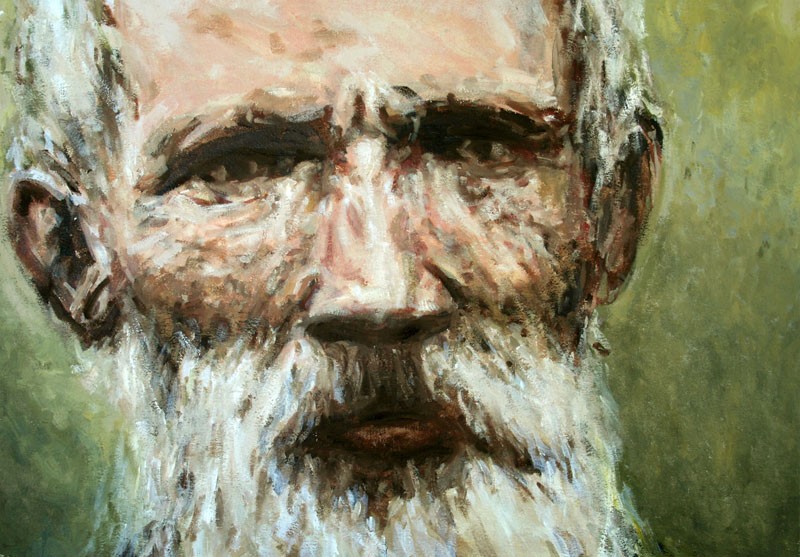
Nicholaas Waterboer
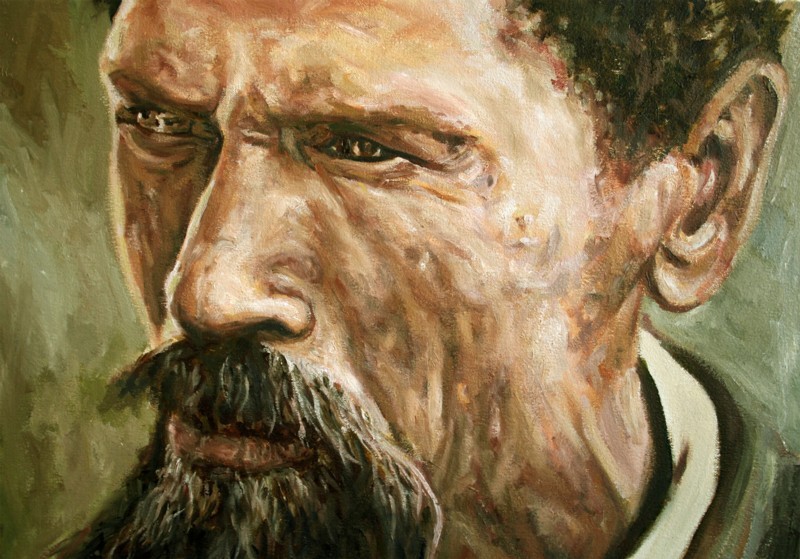
Hermanus van Wyk
You’re looking at some amazing South African leaders: first, Adam Kok III, the man who led the Griquas from Philippolis across the Drakensberg into Kokstad; Nicholaas Waterboer, the man who held the fort at Griquatown while Free State and colonial administrations (and their lawyers) squabbled over the diamond fields that fell within his inherited jurisdiction; and finally Hermanus van Wyk, the man who established Rehoboth as a city-state for his Baster polity.
These amazing (oil on canvas) portraits come from the 2010 series of the artist Cobus van Bosch, entitled Bastard.
which I found via Africasacountry
What a collection.
Filed under: art, Southern Africa | Closed
The Production of Colonial Historiography, Frankfurt University, Germany, October 4-5 2010.
What Postcolonial Theory Doesn’t Say, University of York, UK, July 3-5 2010.
Emerging Paradigms in Critical Mixed Race Studies, De Paul University, Chicago, November 5-6 2010.
Exploring the Red Atlantic, University of Georgia, Nov 12-13 2010.
Reconceptualising Migrations: Movements and Struggles, University of Bologna, Italy, 20-21 May 2010.
AlterNative: An International Journal of Indigenous Peoples, call for papers.
Postcolonial Intimacies, edited collection, call for papers.
(With thanks again to those who sent in their details. Keep it coming.)
Filed under: Call for papers, Scholarship and insights | Closed
Abstract:
Nearly six months after the horrific episodes of racist violence at Cronulla beach in Australia, Israeli artillery fire killed seven Palestinians on a northern Gaza beach. This article examines how, in both sites, the beach is constructed as the legitimate preserve of an aggressive majority that maintains its fragile sense of cartographic hegemony through an excessively violent mapping of the racialised Arab Other’s body. The trans-national mapping of the somatic violence of whiteness will be analysed through a reading of Arab embodiment in the Australian and Israeli contexts of racial oppression and territorial aggression.
Keywords: white cartographic anxiety; colonial settler cartography; Arab bodies; Cronulla beach, Australia; Beit Lahiya beach, Gaza; Palestine/Israel
more:
The present article discusses the current contexts of Australian and Israeli acts of colonial-settler territorial aggression on the beach. It traces how Arab bodies on beaches in Cronulla and Gaza have been occupied somatically and mentally by white centres of discursive, military and political hegemony. These centres comprise not only governments and their militaries but also their media and citizens who appropriate volatile yet sacrosanct imaginaries of self-definition through an anxious cartography of being. I argue that Australian and Israeli self-constitution as ‘‘sovereign’’ nation-states of a Eurocentric history have been made in a spatial geometry of oppression. The physical annexation of foundational violence against indigenous populations still informs the cultural behaviour of these states in dealing with threatening minoritised bodies evoking spectres of national guilt and of drowning otherness. Maps graphically lineate the borders that mark their porosity and solidity with bodies that inhabit, populate, roam and (un)settle the designated area. It is, however, often left unclear what the social construction of territory really implies and what it explains. As several meanings can be attached to territory, the key question is not whether territory is socially constructed but how it is constructed within a series of racialising and disciplining circumstances where such violent instantiations of power affect the bodies of those entangled in such cartographic distributions. This article tries then to sharpen facile constructivist claims regarding territory when faced with physical human loss and anguish. I proceed to do this by tracing the encompassing reach of colonial-settler oppression that treads over any racialised territory, even on the beach as a space of unmitigated enjoyment. Engendered in this textual corpus are the spectral corpses and wounds that haunt the generative violence of such a deconstructive project. I contextualise this project with the ability of suffering Arab bodies to disrupt and repudiate their reduction merely into aesthetic victims by explaining the political relationality and inextricability of these events from operations of sovereign power.
Filed under: Australia, Israel/Palestine, Scholarship and insights | Closed
The media frenzy over Eugene Terre’Blanche’s death has been a great source of interest over the past few weeks. It turned out to be remarkable for this blog, as I wrote a little piece on Mr. TB and the AWB over a month before his death. Sadly, no journalist (to my knowledge) thought it fit to reprint my inkling, that the AWB were on their way to formulating a (very indigenous-esque) land rights-based discourse, based on the historical exposition of property law as it developed in South Africa.
Rather, in the white popular media, emanating strongly from England and America, most journalists were motivated to show off their amazing rhetoric and hyperbole to (re-)prove just how repugnant that old chestnut (the racist white South Africa) still is. Violence in South Africa (read: the ‘poor, angry black’), in these accounts, was the exceptional but natural consequence of post-apartheid reconfigurations (read: the ‘evil whites’). What would have been more refreshing is if the authors contextualised the murder within a number of historical patterns of rural unrest, mistrust, reconciliation and compensation that feature not only in Southern Africa, but all settler sites.
Rather disconcertingly, parts of academic discourse reproduced a classic black/white binary just as good as the media. In the H-net discussion server – which is a brilliant resource, btw – two discussions on Violence in South Africa slowly transformed into a mudslinging debate centred around the ‘race’ of the writers and the meaning of a particular turn of phrase. As the discussion wore on, it became embarrassing to participate and even to read.
A recent article in a Kenyan newspaper has been published, that brings – albeit selectively and a little curiously in places – a number of conjunctures and ironies into focus with an appraisal of Eugene Terre’Blanche’s death and recent violence in South Africa. It is the most refreshing thing I have read on the whole furore. Jenerali Ulimwengu, ‘Terre’blanche the white supremacist is dead, the ironies of oppression live on’, The East African (via AllAfricaNews):
That he should die in a pay dispute is an anticlimax. One other irony is that he should get himself killed at a time when his antics had become so irrelevant to the politics of South Africa that the only interest he was drawing was from those in the business of studying curious insects.
Sadly, the ironies surrounding Terre’blanche and people of his ilk do not end there. His name — meaning ‘white land’ — suggests French ancestry. My guess is his people were among the French Huguenots who fled France to escape persecution at the hands of rabid Catholic inquisitors who were hunting down and burning at the stake all followers of the doctrine taught by a “heretic” named Martin Luther.
Some of those who ran away went to Holland, and some among these later moved again to Southern Africa with the “Boer” influx in the 17th and 18th centuries, which eventually led to the founding of a state based on extreme forms of exclusionism, racism and xenophobia.
Thus those who had run away from repression became master repressors themselves.
The irony of erstwhile victims becoming perpetrators of the injustices they themselves once suffered is one of those realities of life that beggars belief, even though here a crooked argument may be discerned: We were oppressed because we are special; we shall not allow ourselves to go through what we went through again, and to effect this resolve we are prepared for anything, including oppressing others.
It is the pattern that also emerges from the Middle East, where a Jewish state, basing its claims on land titles embedded in arcane scrolls that only the initiated can understand, is lording it over the Palestinians and Israeli Arabs whose only transgression is to want to live in a country that they have always called home. Apparently, the sufferings of the Jews during the Holocaust — which were truly horrific — justify any exactions that the state of Israel feels like imposing on its non-Jewish citizens and neighbours.
Just like the Huguenots who became “Boer” colonisers in South Africa, the Jewish state couches its philosophy in a doctrine of divine selection that bestows powers on Israel that no temporal arrangements can vary, literally dragging God into a land dispute.
Filed under: Africa, media, Political developments, Scholarship and insights, Southern Africa | Closed
Libby Porter, Unlearning the Colonial Cultures of Planning (Farnham/Burlington: Ashgate, 2010).
Colonialization has never failed to provoke discussion and debate over its territorial, economic and political projects, and their ongoing consequences. This work argues that the state-based activity of planning was integral to these projects in conceptualizing, shaping and managing place in settler societies. Planning was used to appropriate and then produce territory for management by the state and in doing so, became central to the colonial invasion of settler states. Moreover, the book demonstrates how the colonial roots of planning endure in complex (post)colonial societies and how such roots, manifest in everyday planning practice, continue to shape land use contests between indigenous people and planning systems in contemporary (post)colonial states.
Filed under: Australia, Canada, New Zealand, Scholarship and insights, United States | Closed
The Australian referendum of 1967 approved amendments to the Australian Constitution which allowed the Federal Government to make special laws that applied to Aboriginal Australians. As a result, since 1967, Australian governments have put in place policies and programs with the aim of achieving positive social and economic outcomes for Aboriginal people. However, over four decades later, the gap between indigenous and non-indigenous Australians is still unacceptably wide. In fact, some studies suggest the gap is actually widening.Canada faces similar issues in closing the gap between their indigenous and non-indigenous citizens. While Canada and Australia both enjoy a high ranking on the United Nations Development Program’s (UNDP) Human Development Index (HDI)—8th and 4th respectively—their indigenous people are considerably worse off, comparatively sitting at 32nd and 103rd. This situation of Aboriginal people living in Third World conditions highlights the need for urgent action in both countries.An overview of the history of Aboriginal policy and relations in Australia in comparison to Canada provides a useful context for policymakers in both countries. Some of the negative experiences in Australia can also serve as a warning to governments in Canada, whereby if some of the problems faced in Canadian Aboriginal communities are not addressed soon, drastic interventions may be needed.
Filed under: Australia, Canada, Political developments, Scholarship and insights | Closed
arrival and possession
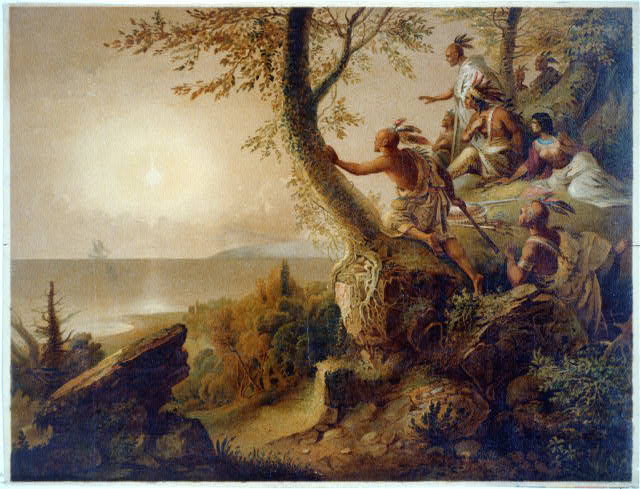
The arrival of Hendrick Hudson in the bay of New York, September 12, 1609
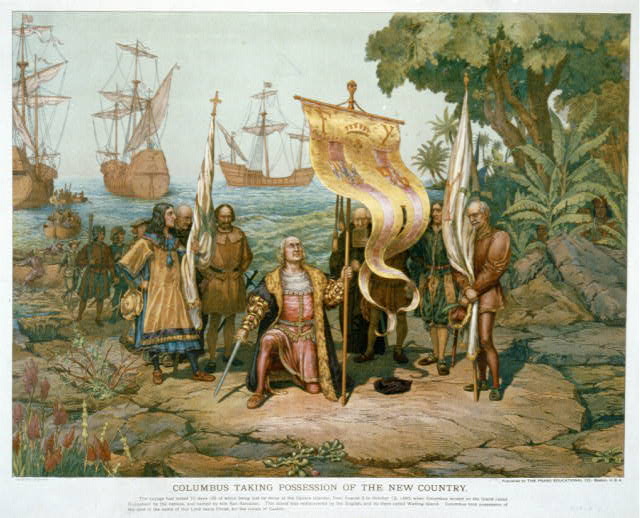
Columbus taking possession of the new country
From the Library of Congress Prints and Photographs Catalog.
Filed under: art | Closed
The white man systematically destroyed Indian culture where it existed, but separated blacks from his midst so that they were forced to attempt the creation of their own culture
Vine Deloria Jnr., Custer Died for your Sins (Norman: University of Oklahoma Press, 1988 [1969]).
Filed under: Quote, United States | Closed
out of what tree did i fall
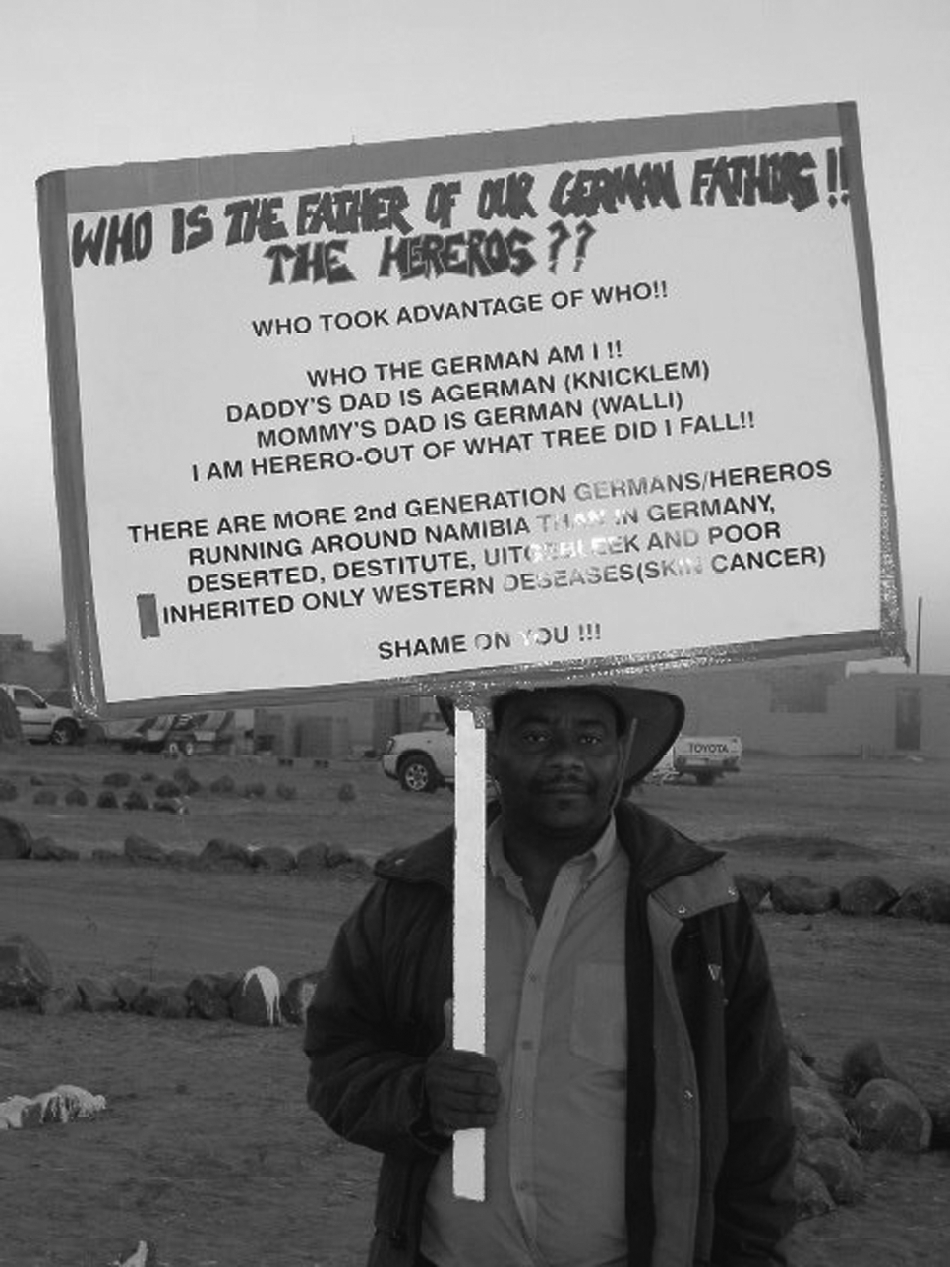
(Note: I got this from an article about a year ago, which I have unfortunately lost, so can not attribute for the moment. I am happy to reference if anyone remembers)
Filed under: Africa | Closed

