bell on j. s. mill and colonies
Duncan Bell, “John Stuart Mill on Colonies”, Political Theory, 38, 1 (2010), pp. 34-64.
Abstract:
Recent scholarship on John Stuart Mill has illuminated his arguments about the normative legitimacy of imperial rule. However, it has tended to ignore or downplay his extensive writings on settler colonialism: the attempt to create permanent “civilized” communities, mainly in North America and the South Pacific. Mill defended colonization throughout his life, although his arguments about its character and justification shifted over time. While initially he regarded it as a solution to the “social problem” in Britain, he increasingly came to argue that its legitimacy resided in the universal benefits—civilization, peace, and prosperity—it generated for humanity. In the final years of his life Mill seemed to lose faith in the project. Finally recognizing the prevalence of colonial violence and the difficulty of realizing his grand ambitions, yet refusing to give up on colonization altogether, his colonial romance gave way to a form of melancholia.
Filed under: Empire, Scholarship and insights | Closed
Outline:
Focusing on the great population movement of British emigrants before 1914, this book provides a new perspective on the relationship between empire and globalisation. It shows how distinct structures of economic opportunity developed around the people who settled across a wider British World through the co-ethnic networks they created. Yet these networks could also limit and distort economic growth. The powerful appeal of ethnic identification often made trade and investment with racial ‘outsiders’ less appealing, thereby skewing economic activities towards communities perceived to be ‘British’. By highlighting the importance of these networks to migration, finance and trade, this book contributes to debates about globalisation in the past and present. It reveals how the networks upon which the era of modern globalisation was built quickly turned in on themselves after 1914, converting racial, ethnic and class tensions into protectionism, nationalism and xenophobia. Avoiding such an outcome is a challenge faced today.
Filed under: Empire, Scholarship and insights | Closed
The Zimbabwean phenomenon briefly touched upon in the post “Second Thoughts on Land Seizures in Southern Africa” is certainly a complex issue. Two important recent studies on the topic have surfaced in recent months.
Abstract
‘Viability’ is a key term in debates about land redistribution in southern African and beyond. It is often used to connote ‘successful’ and ‘sustainable’- but what is meant by viability in relation to land reform, and how have particular conceptions of viability informed state policies and planning approaches over time? How have such notions influenced the contested politics of land and agriculture? In southern Africa policy debates have tended to focus narrowly on farm productivity and economic returns, and an implicit normative model is the large-scale commercial farm. Through a review of land reform experiences in South Africa, Namibia and Zimbabwe, this paper critically interrogates this influential but under-examined notion. It examines contrasting framings of viability derived from neo-classical economics, new institutional economics, livelihoods approaches (both developmentalist and welfarist), radical political economy and Marxism, and their influence in southern Africa. Through a discussion of alternative framings of viability, the paper aims to help shift policy debates away from a narrow, technocratic economism, a perspective often backed by powerful interests, towards a more plural view, one more compatible with small-scale, farming-based livelihoods.
In lieu of an abstract, I will give a brief outline of this monograph: Fisher sets out to understand the process of decolonisation in Zimbabwe, and uncovers evidence of a widening conflict between white and black Zimbabweans. She explains some of the policies applied by the new government in postcolonial Zimbabwe, and focuses on their impact on the white cultural experience. The idea that a shared Zimbabwe would emerge in the 1990s turned out to be little more than a dream: ‘coloniser’ and ‘colonised’ were resilient constructions that did not dissipate at the moment of settler decolonisation; on the contrary, by the invocation of past memory and the fact of ongoing public disharmony, they continue to inform and influence the ways that each component operates and sees each other in the new Zimbabwe.
Fisher’s thesis is strongly grounded in theoretical and comparative studies relating to colonial and postcolonial phenomenon. It is an important work which I strongly recommend, and I congratulate her for choosing to publish it as a free e-book.
Filed under: Africa, law, Political developments, Scholarship and insights, Southern Africa | Closed
One small, Cape Town property, once owned by whites but later transferred to the Zimbabwean state in a compensatory transaction, was yesterday returned to white ownership. The ruling is pretty important, not just for the touchy matter of postcolonial ethics, but also for the jurisdictional dilemmas now facing Zimbabwe and South Africa. The ruling emanates from the Southern African Development Community’s High Court in North Gauteng, and recommends more stringent and transparent protocol regarding ‘land grabs’, potentially enforceable by the South African government. Zimbabwe admits it falls within the gambit of the SADC, but argues that their precedent has no meaning in Zimbabwe. From Business Day:
Zimbabwe does not recognise the Sadc ruling. It has argued that the ruling has yet to be ratified by the regional body’s summit. Government spokesman George Charamba previously told Business Day there was therefore no question of Zimbabwean assets being attached in SA. He could not be reached for comment yesterday.
[…]
The Sadc Tribunal previously declared Zimbabwe’s 2005 constitutional amendment that allowed the government to redistribute white-owned farms without compensation as racially discriminatory and illegal. It ordered the government to pay dispossessed farmers fair compensation, and protect the property rights of those still on their farms.
Zimbabwe’s High Court rejected an application to enforce the Sadc judgment in Zimbabwe. Judge Bharat Patel said this would be “fundamentally contrary to public policy” by forcing Zimbabwe to reverse its land reforms since 2000.
But last month , the North Gauteng High Court ruled the Sadc judgements, including the costs award, were enforceable in SA.
Reluctant to trump the sovereignty of Mugabe’s Zimbabwe, the SADC are only willing at this stage to enforce the ruling in South Africa – and that’s where this tiny, little property in Cape Town comes into the picture.
This is a touchy issue. There is no question that all racially discriminatory legislation should be abolished, but to a reformist post-settlercolonial dictatorship, there is no other way to transform a white state into a black one. The solution is – and South Africa have led the way in this respect – to reach a postcolonial equilibrium by making law and policy adjustments that are only subtly racially discriminatory. But that seems a lot of tip-toeing about the place for a region that was never subtle about its dichotomous legal architecture (white/black; us/them; citizen/subject), doesn’t it?
For more info, check out the Business Day article, and see BBC.
Update 7/5: This issue is not over. Tbe SA government looks set to launch an appeal against the process.
Filed under: Africa, law, Political developments | Closed
From the University of Queensland:
The long-lost works of one of Australia’s leading early anthropologists have been discovered in the shed of a northern New South Wales cattleman.
The groundbreaking works of Caroline Tennant-Kelly, close friend of the famed American anthropologist Margaret Mead, were believed destroyed until uncovered by the detective work of a dogged team of two University of Queensland researchers — Mr Kim de Rijke and Mr Tony Jefferies.
[…]
“We’ve worked in native title in Central Queensland and are acutely aware of the lack of historical Australian Aboriginal ethnographic material for the region. We could hardly contain our excitement at the quantum leap this material represents,” Mr de Rijke said.
Mrs Tennant-Kelly’s work as an anthropologist spans from 1932 to 1970.
The collection details daily Aboriginal life at Cherbourg Aboriginal Settlement in Queensland in 1934. In the late 1930s she also worked at Aboriginal settlements in New South Wales. She recorded kinship practices, traditional ceremonies, language, territorial knowledge and genealogies. Her research fills large holes for today’s anthropological study.
The collection will be valuable for indigenous communities in Queensland and New South Wales as Tennant-Kelly makes numerous references to families and individuals and their links to land.
The discovery also includes private letters and photographs from her famous friend, the American anthropologist Margaret Mead, correspondence likely to add to the knowledge of Mead’s groundbreaking work.
Filed under: Australia, Scholarship and insights | Closed
diderot on savage europeans
SAVAGE EUROPEANS! Ye doubted at first whether the inhabitants of the regions you had just discovered were not animals which you might slay without remorse, because they were black, and you were white. You almost envied them the knowledge of God, your common Father. Most horrid thought! But when you had permitted them also to raise their hands and eyes to heaven; when you had initiated them in your ceremonies and mysteries; made them join in their prayers and offerings, and in the hopes of a future slate, afforded by one common religion; when you had acknowledged them to be your brethren; was not the general horror redoubled, at seeing you trample under foot the ties of this sacred consanguinity? You have put them more upon an equality with yourselves; and yet you go to distant parts in order to buy and sell them! You sell them, too, as you would a base herd of cattle! In order to repeople one part of the globe, which you have laid waste, you corrupt and depopulate another…. English, French, Spaniards, Dutch, or Portuguese, let me suppose I am conversing with one of you about a treaty concluded between two civilised nations; and that I should ask him, what kind of compensation he imagines may have been agreed upon in the exchange you have made? He will think it to consist in gold, provisions, privileges, a town, or a province; while, on the contrary, it consists in a greater or less number of your fellow creatures, which the one gives up to the other to dispose of at pleasure. But such is the infamy of this unnatural contract, that it doth not even present itself to the ideas of the contracting parties.
An anonymous Diderot, on the history of settlements and trade, found in Abbe Raynal’s Philosophical and Political History, 1770.
Filed under: Quote | Closed
cleveland indians

No race, creed or religion should endure the ridicule faced by Native Americans today.
– National Congress of American Indians.
Another hat tip to Mat A.
Filed under: art, Political developments, United States | Closed
Borders, State University of New York, October 16 2010.
Women and Gender in Colonial Contexts, Université Paris-1, 19-21 January 2012.
A big thanks to those who sent me their link.
Filed under: Call for papers | Closed
cher
In 1973, Cher released a track called “Half Breed” – which is certainly news to me. Check out the album art for the Japanese version:
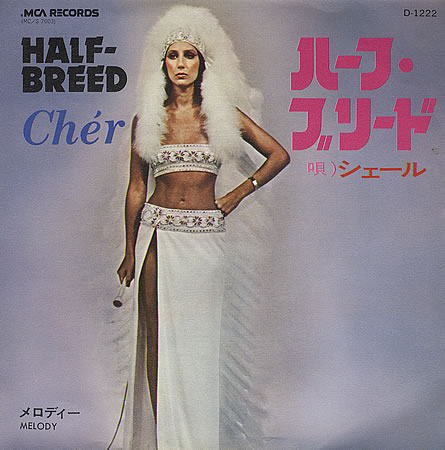
What’s interesting is that this American song – about living with mixed white and Cherokee heritage – made number 1 in Canada and New Zealand (but only made number 3 in Australia). You may scoff, but this represents a fairly significant – and transnational – triumph of miscegenation discourse into the realm 70s pop-culture. It also one of the few early tracks she released in Germany, where it made 29. (Statistics come from Wikipedia, btw.)
For her surreal and uncomfortable film-clip, complete with symbolic Cherokee window-dressing, head over to Youtube. Thanks to Rob A. for pointing this one out to me.
Filed under: wacky | Closed
The Agreements, Treaties and Negotiated Settlements (ATNS) project is an ARC Linkage project examining treaty and agreement-making with Indigenous Australians and the nature of the cultural, social and legal rights encompassed by past, present and potential agreements and treaties. The project also examines the process of implementation and the wider factors that promote long term sustainability of agreement outcomes.
Check it out here.
Filed under: Australia | Closed

