the course of empire
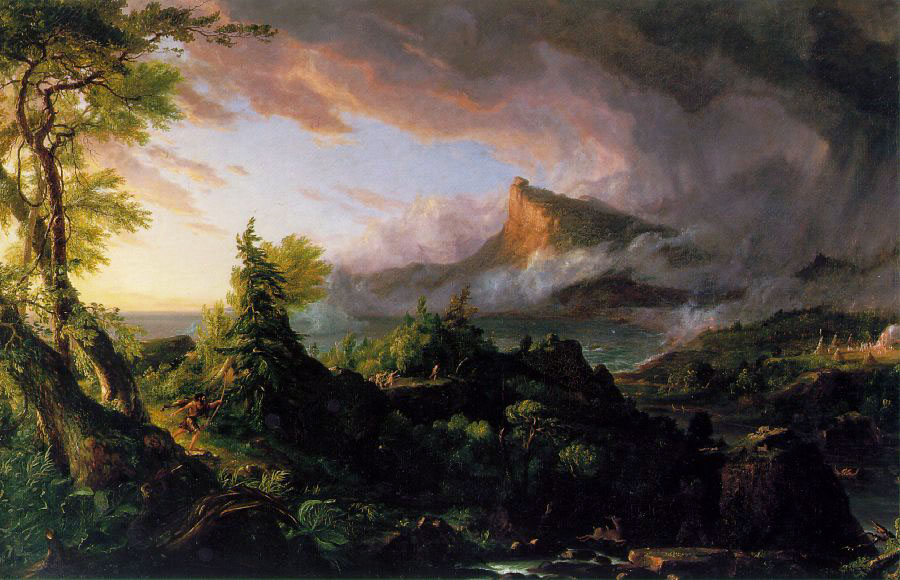
The Savage State

The Arcadian or Pastoral State
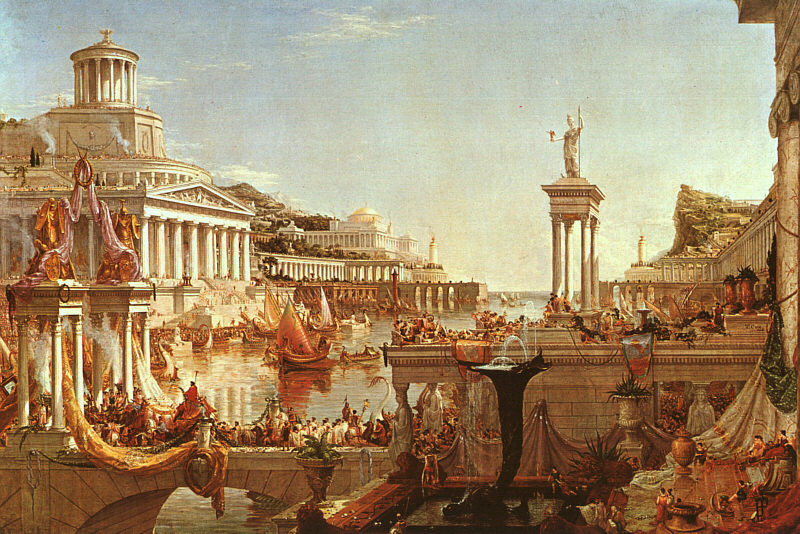
The Consummation
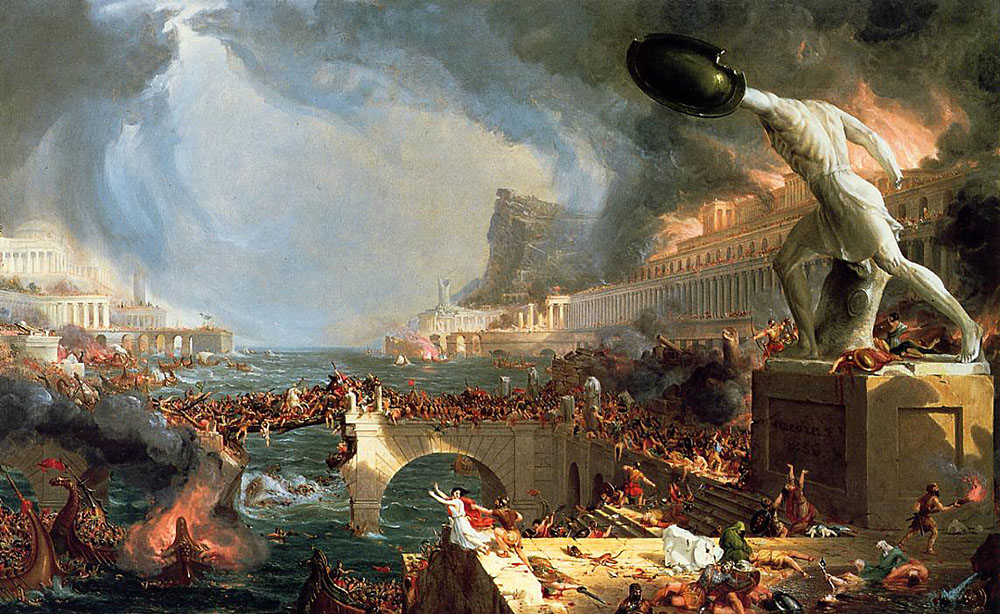
Destruction
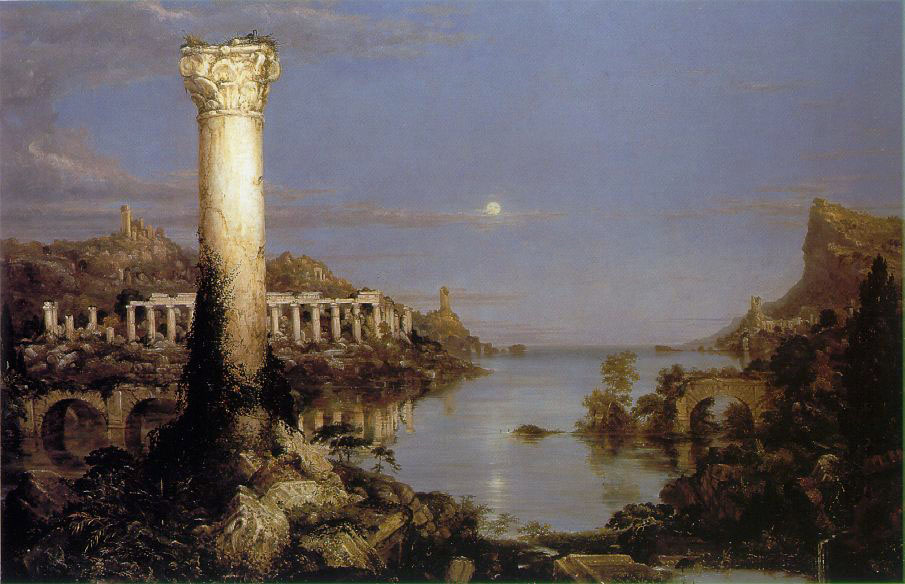
Desolation
Cole Thomas, The Course of Empire (series), 1836. Oil on canvas.
Filed under: art | Closed
In lieu of an abstract, here is part of the introduction:
Each Native American culture and nation has differing beliefs as to the treatment of human remains. Some are adamantly opposed to any kind of study of human remains, some are open to all types of study, and others fall somewhere in between, allowing scientific investigations that do not include invasive procedures such as DNA analysis.
[…]
This case study brings to the forefront a continual problem of miscommunication between tribal and scientific communities and allows for a discussion on the usefulness of osteological analysis for settling such disputes. Additionally, the case study presents evidence of physical characteristics often considered quintessential Native American traits and evidence of their presence in human remains in the Americas almost ten thousand years before the present. This critical fact would have been unknown if analysis of the remains had not been done. When the invitation to carry out the analysis of the University House remains was accepted by the bioarchaeologist at San Diego State University, it was understood that the goal was to document biological evidence, by noninvasive procedures, of population relationships. This analysis was based on collecting nonmetric data on dental and skeletal traits as well as skeletal morphology; metric data would be collected where possible. Any additional information that would be indicative of a population’s biological history, such as disease patterns and occupational health, would also be documented. A surprising development during this process was the realization that, unlike in the past, where the charge was to determine if the remains were related to a specific group of Native Americans, the new challenge was to determine if they were Native American, an issue critically related to the current political controversy surrounding the subject of culturally unidentifiable human remains (CUHR).
The recently proposed changes to NAGPRA (Native American Graves Protection and Repatriation Act) continue to polarize the anthropological and Native American communities as well as some within the scientific community. The current law dealing with the repatriation of Native American human remains and objects of cultural patrimony includes the phrase “of or relating to a tribe, people or culture that is indigenous to the United States” (NAGPRA PL 101-601). In 2004 a change was suggested that would alter the definition by adding in “or was” (“that is ‘or was’ indigenous”). The proposed wording change as to the determination of when a group is deemed to be Native American is, of course, related to the continuing debate over who were the first Americans and what pre-European contact populations may have contributed to the genetic and cultural diversity we see in the indigenous populations of the Americas today.
Participating in the science, or at least defining the questions at hand, would allow Native American communities the chance to level the playing field and answer for themselves inquiries regarding these early peoples. What makes us human? What makes us Native American? The Australian Aborigines can trace their lineage back almost fifty thousand years. Why let them have all the fun? As an evolutionary approach to the peopling of the New World continues, biological evidence may also lend further support to the many archaeological sites of greater antiquity in the New World. The dental, DNA, and craniometric studies point to Pacific coastal regions of both North and South American populations as the locations we should be investigating for answers to the earliest migrations. Not surprisingly, the archaeology has begun to point in that direction as well.
Filed under: law, Political developments, Scholarship and insights, United States | Closed
Christopher Churchill, ‘Camus and the Theatre of Terror: Artaudian Dramaturgy and Settler Society in the Works of Albert Camus’, Modern Intellectual History 7 (2010), pp. 93-121.
Abstract
This essay examines Albert Camus’s considerable debt to Antonin Artaud. Camus was not only a dramatist, but he also employed dramaturgical techniques in his more famous fiction and essays. In this regard, Artaud’s ideas on social reconstitution through aesthetic terror were crucial to the development of many of Camus’s most famous works, written both in Algeria and in France before and after World War II. This article considers the ways in which aesthetic–political techniques adapted from Artaud’s Theatre of Cruelty were employed to challenge fascism in Algeria and France, by simultaneously summoning Algerian settler myths of exile, destitution and regeneration. Camus’s considerable sophistication in the use of these techniques, and the colonial context in which they were initially applied, have often been missed by scholars and critics who have sought to unproblematically situate his works within debates about the Cold War and more recently the “War against Terror”.
Filed under: Africa, Scholarship and insights | Closed
Many non-Indigenous activists recognize that as visitors on this land, we have an obligation to fight colonial institutions and work towards building relationships that contest and seek to transcend colonial power relations. What does it mean to challenge systems of domination and oppression in a neo-colonial context if, as a settler, one’s very presence on stolen land is a result of colonialism? We have a responsibility to undermine colonialism, including the little colonizer in our heads. How do we keep this awareness in the forefront of our minds in a way that empowers anti-colonial activism?
In order to create a space where we can begin to tackle these issues through dialogue and critical engagement, Indigenous and non-indigenous scholars and activists are invited to share their experiences of anti-colonial activism and decolonizing Indigenous-settler relations on Monday April 12th at 10:00 am at the University of Victoria, on Coast Salish Territory. Speakers Include Dr. Taiaiake Alfred, and Dr. Marc Pinkoski.
Thanks to Adam B. for the tip off!
Filed under: Canada, Political developments | Closed
Leader of the Afrikaner Weerstandbeweging Eugene Terre’blanche has been murdered.
According to the official newsreel of the AWB:
It is with shock, dismay, frustration and the greatest of emotional pain that we were informed that our leader, Eugene Terre’Blanche was murdered on his farm Villanna (meaning “Home of Anna”) just outside Ventersdorp called around 17:00 this afternoon.
Details are sketchy, but from reports by people at the scene there was an argument with one of his black farm workers this afternoon. Later, while he was taking an afternoon nap, the farm worker, incited by others, entered his house and hacked him to death with a panga (chopping knife used for clearing bushes).
Just last month I noted with interest that the AWB had revamped their old campaign. With die Leier gone, where to now for the AWB? Watch this space.
Filed under: Political developments, Southern Africa | Closed
mate helps
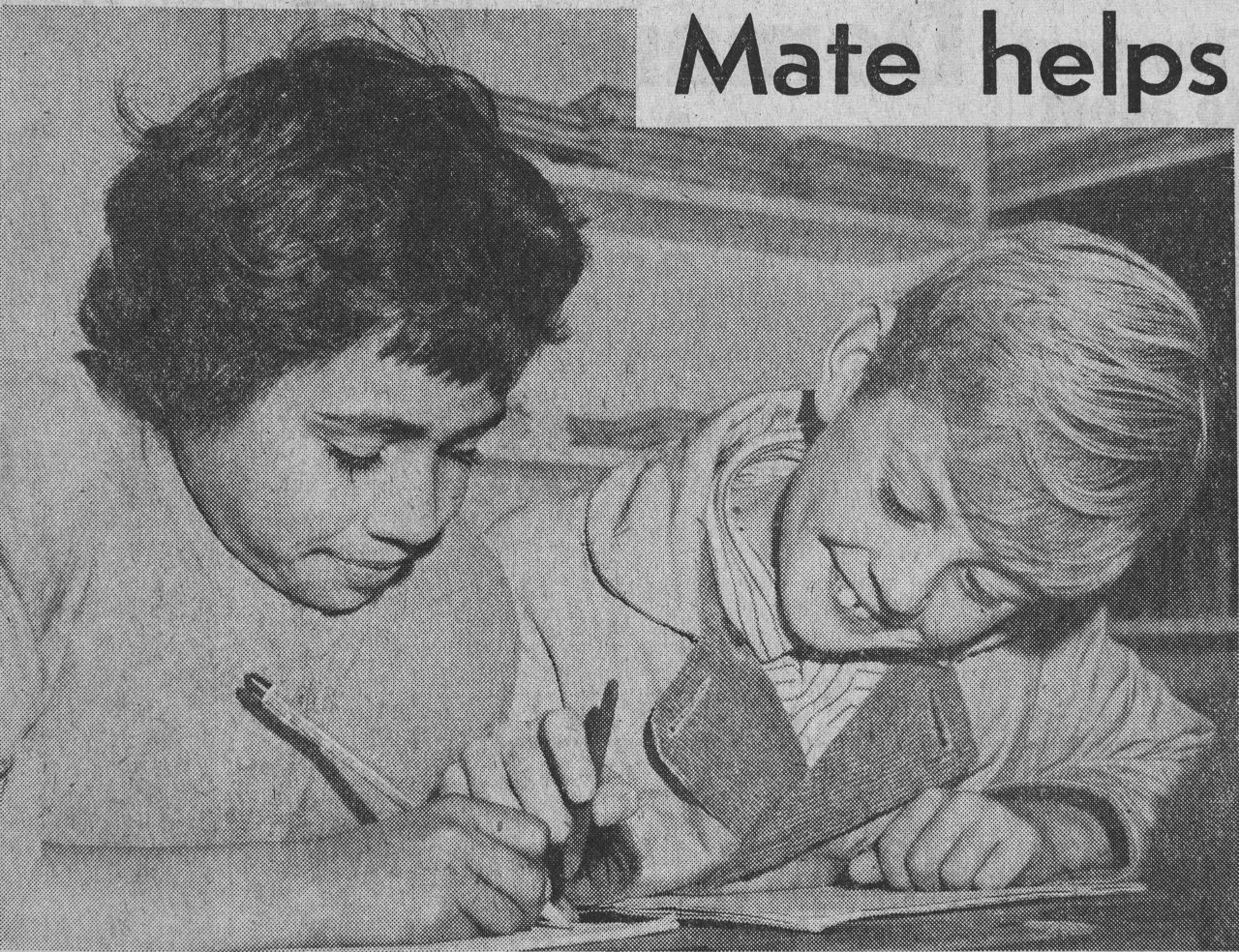
‘Mate Helps’, Herald, 1961.
This came up in a presentation delivered by Jane Lydon last fortnight at the Gender and Settler Colonialism symposium. It is discussed and contextualised in her recent book, Fantastic Dreaming: The Archaeology of and Aboriginal Mission, Altamira Press, 2009. Many thanks to Jane for letting me share it on the blog.
Filed under: art, Australia, Scholarship and insights | Closed
contested terrain
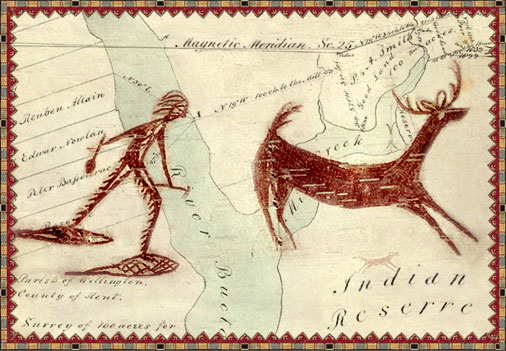
From Contested Terrain: Aboriginal Land Petitions in New Brunswick.
This website features a digital collection of petitions, written between 1786 and 1878, relating to land grants in colonial New Brunswick, in which either Aboriginal people are the petitioners or their land is the subject of attention.
Little documentation exists in New Brunswick surrounding the early period of Aboriginal-settler interaction in the province. The 90 petitions in this collection, located in RS108 at the Provincial Archives of New Brunswick, offer valuable primary evidence about the experience of First Nations after the arrival of the Loyalists and the founding of New Brunswick in 1784.
The petitions are presented as archival-quality images with full-text transcriptions and are fully searchable.
Filed under: art, Canada, Website | Closed
Some highlights from the awesome blog zunguzungu, which among other things includes snippets of his research on Kenyan history, framed within a transnational perspective.
Putting Africans to work — breaking and training them to use the tools of agriculture — is almost literally the same process as domesticating African oxen; note the wonderful ambiguity, for instance, by which “they” refers to both the rough tools of oxen, pickaxes, and Africans with which a pioneer “break(s) the land” to bring forth crop from his seed. Since the African’s natural proclivity is violence — and even his agricultural tool gets described as a sword — putting him to work is synonymous with the process of pacification, the bending of his panga into plowshares. And, perhaps most importantly, while the actual process of “pacification” had proceeded by means of large-scale co-optation of African military labor, something the earliest imperialist had clearly and publicly understood and articulated as they incorporated Masai, Nandi, and Kikuyu tribes into the colonial state by means of military alliances, the act of putting Africans to work has, here, become the process of de-tribalizing them, a process of rendering natural life into domestic labor which is explicitly aligned with breaking oxen to the plow. In the official settler consciousness, good Africans were as rootless and dis-organized as wild oxen, while bad Africans — those who didn’t take easily to the harness and had therefore to be broken — were the tribal societies with respect to which violent subjugation was the same process as replacing the spear in their hands with the plow-handle.
That British East Africa [BEA] was already full of native Africans, place names, and history, of course, almost goes without saying. Or, rather, while franchise colonialists like Churchill were often quite quick to say it, the white settlers whose existence as such depended on the emptiness of the land had a literal investment in un-saying the existence of its native inhabitants. Although it wasn’t until 1903 that Charles Eliot — the commissioner who oversaw the beginnings of the settler project – began leasing “crown” land to white settlers on a large scale, it had been official policy since 1899 that “wastelands and other unoccupied land and that occupied by savage tribes” were to be made available for settler use. And while the Crown Lands Ordinance of 1902 specified that “the Commissioner shall not sell or lease any land in the actual occupation of the natives,” the forced logic of the first phrase nicely illustrates the elisions by which the process would go forward in practice: since it was — by implication — alienable land’s categorical status as empty that made it appropriate to be leased to settlers, alienating native lands served as a sort of tautological assertion that they were empty. Yet while it was the emptiness of the land that, in theory, justified white settlers in occupying it in the first place, the process of emptying it — if only by legal fiat — had actually to precede that process of occupation, making settlement something that could only be justified retroactively by its result, a foundation that could only be built after the house itself was underway.
In this sense, the work of the settler state was, to a significant extent, the dream-work of imagining a wilderness: Eliot would apportion out massive tracts of lands to white settlers as if they were already empty — rendering their native occupants into “squatters” by the flick of a pen — and he would write in his 1905 memoir, The East African Protectorate, that “We have in East Africa the rare experience of dealing with a tabula rasa, an almost untouched and sparsely inhabited country, where we can do as we will, regulate immigration, and open or close the door as seems best.” Eliot’s metaphor is revealingly apt in a way he does not intend; like the literal “blank slate” to which he refers, BEA’s emptiness was a man-made artifact meant to signify a state of natural “untouchedness,” an emptiness that had to be inscribed with blankness so that it could be written upon. And the settler community’s desire for a blank space on which to write was vexed by exactly this problem in a more concrete sense: while the real African presence had to be “erased” before the land could be occupied, that process of occupation could only be retroactively justified by imagining the land to have been already empty. Qualifiers like Eliot’s “almost” and “sparsely” illustrate precisely the extent to which BEA was less a tabula rasa than a palimpsest, and as his pro-settlement memoir blithely turns from describing the territory as empty to describing the ethnographic characteristics of its native occupants, the closest he gets to acknowledging the contradiction is his reference to the native population as “scanty.”
In practice, of course, the settler community had little difficulty living and acting according to this theoretical contradiction, working practically to empty land which was theoretically already empty. And the existence of native Africans — the existential repudiation of the “empty space” narrative of Kenya — could be and were managed by a literal violence that was matched by a figurative violence to the historical record. They accompanied the application of violent force to create a particular kind of absence with a kind of “violence” to historical, ethnographic, and journalistic reality, imagining that this absence had already existed. Eliot’s fantastical vision of a “sparsely inhabited country, where we can do as we will” is broadly representative: while he argued that the country’s emptiness gave settlers the right to “do as we will” (in a theoretical sense), it was also precisely the fact that, in practice, the metropole allowed the settlers to do as they willed that made it possible for them to take concrete steps to render the country sparsely inhabited in the first place.
However, when there was resistance (from both within and without), this contradiction would shape the form which that resistance would take, as well as the settler response. When there was pushback from BEA’s native population — whose very existence was a repudiation of the white settlers’ project — Kenyan settlers were faced with a form of resistance which was quite literally unthinkable in the terms by which they justified their occupation: if the land was already empty, after all, how could the threat of its inhabitants’ existence even be named? “Natives” were the problem, in part, because their nativity was an existential threat, a threat not of action but of being. As such, natives were problematic even to represent.
The idea of the African native therefore haunted the settler imagination. As in the American south, perhaps, the African presence was imagined through an impossible simultaneity of both hopeless harmless impotence and unstoppably virile danger lurking behind and underneath every nook and cranny of white society. And as with 19th century American plantation society, Kenyan settlers combined deep political and military security with the most profound of social paranoias; black resistance which was, in practice, quite limited in its scope and potential came to be magnified in the settler imagination into a structuring principle of societal culture, the bedrock faith out of which everything else flowed.
Keep it comin’.
Filed under: Africa, Empire, Scholarship and insights, United States, Website | Closed
Haaretz, the Israeli newspaper, is a fascinating place to publish a feature article on Afrikanerdom. Here’s some of what Benjamin Pogrund wrote up today:
The establishment of the State of Israel only a few days before the 1948 election also affected Afrikaner attitudes: Despite their anti-Semitism, their intense Calvinism meant that they venerated the People of the Book. They identified with Israel. To them, these were two “white” peoples at the head and foot of the African continent, each fighting for survival against black hordes and godless Communism.
[…]
The fact that increasing numbers of dark-skinned Israelis, like those from North Africa and India, would have been classified as inferior “non-whites” under South Africa’s apartheid laws never seemed to penetrate the Afrikaner racial view. Most Afrikaners are probably as comfortable or uncomfortable with black majority rule as other whites are. However, among younger Afrikaners, there is a discernible sense that freedom for blacks has also brought them their own freedom: They have discarded the shackles of oppressing another people. Afrikaner business, which flourished under apartheid rule, has proved flexible. It has embraced the economic empowerment on which the African National Congress insists, has brought blacks into shared ownership arrangements and hired them to senior positions. It is even said that blacks prefer dealing with Afrikaners as opposed to English-speaking whites. During the apartheid era, blacks commonly said that although Afrikaners were the oppressors, their stand was open and blunt, whereas English speakers would say they opposed apartheid when they actually supported it.
[…]
Will Afrikaners survive as a small, priveleged people in a black-majority country and continent? The question cannot be answered, but some point to the mixed-race coloreds – who are offspring of the original white settlers – as proof that at least the Afrikaans language will be carried on. For the moment, pragmatism wins. As an Afrikaner hotel owner in a village says with a laugh: “Before, we ran the country and the English-speaking made money. Now the blacks are running the country and we are concentrating on making money. That’s okay.”
I found this article and some of its arguments fairly curious for a number of reasons.
Filed under: Southern Africa | Closed
Introduction:
What was the indigénat, that obscure core of the French colonial state? In approaching this deceptively simple question, this article will make three intertwined arguments. First, a study of the indigénat – the regime of administrative sanctions applied to colonial subjects – disrupts the argument that French West Africa was part of an ‘empire of law’, as historians of French colonialism in Africa and Southeast Asia have argued. Particularly in the absence of European settlers and the accompanying anxieties around race and ‘dignity’ that they provoked among colonial administrators, law as such was neither the heart of the imperial project nor the cornerstone of colonial authority in French West Africa. Second, until its abolition in 1946, an ever-expanding and contracting spectrum of political statuses, exemptions, and privileged categories developed around the indigénat in both meanings of that term – the regime of sanctions and the status of the native (indigène). This spectrum is potentially more revealing and surely no less significant than one of its poles taken alone, namely the narrow category of colonial citizens on which a rich literature exists. Indeed, susceptibility to or exemption from the indigénat represented both marker and motive for the proliferation of political statuses in French colonial Africa. Third, attention to the workings of the indigénat allows a reassessment of the role of violence in the practice of colonial authority. In contrast, studies focusing on colonial law tend to diminish the role of such violence – whether enacted or potential – and to privilege legal institutions and procedures over day-to-day practices revealed, however imperfectly, via other sources. Rather than traversing an analytical terrain of which agency and structure mark the coordinates and law the terra firma, or invoking the indigénat as anti-structure, I place it at the center of an analysis of the ‘colonial situation’, not as the luminous essence of colonial ideology but as its inverse, a kind of black hole that represents a center of gravity into which it is difficult to peer but which defines the space around it.
Filed under: Africa | Closed

