via Turtletalk
An anthropologist and a legal scholar combine expertise in this innovative book, deploying the history of one California tribe—the Tule River Tribe—in a definitive study of indigenous sovereignty from earliest contact through the current Indian gaming era.
Filed under: law, Scholarship and insights, Sovereignty, United States | Closed
After doing the same for the JCCH, I thought I’d do have a look at the feature articles published in the Journal of Imperialism and Commonwealth History as well. Interesting results (some unexpected).
Comparative or transnational topics (total: 15)
Comparative or transnational topics relating to ‘British world’ (total: 5)
Comparative or transnational topics relating to settler colonialism (total: 1)
Literature or biography (total: 1)
Politics of imperialism (total: 11)
Britain 6
United States 2
Greece 1
Australia 1
Canada 1
Middle East (total: 8 )
Israel/Palestine 2
Arabia 1
Kutch 1
Ottoman empire 1
Iraq 1
Persia 1
Afghanistan 1
South Asia (total: 4)
India 3
Region 1
South East Asia (total: 3)
Burma 2
Malaysia 1
East Asia (total: 8 )
China 6
Hong Kong 1
Region 1
Latin and South America (total: 1)
Argentina 1
North America (total: 2)
United States 1
Canada 1
Caribbean (total: 2)
Bahamas 1
Barbados 1
Oceania and the Pacific (total: 6)
New Zealand 4
Australia 2
North and Central Africa (total: 18 )
Region 3
Sudan 3
West Africa 3
Kenya 2
Central Africa 2
Morocco 1
Mauritius 1
Gold Coast / Ghana 1
North Africa 1
Nigeria 1
Southern Africa (total: 7)
South Africa 6
Zimbabwe 1
Other (total: 4)
Malta 3
Ireland 1
Gibraltar 1
(Any mistakes in the tabling of the data are my own)
Filed under: Call for papers, Scholarship and insights | Closed
Today I tabled up the topics covered in feature articles published by the Journal of Colonialism and Colonial History since the start of 2007. There’s surprisingly little content relating to settler colonial histories, along with a number of other regional gaps as well. See for yourself:
Comparative or transnational topics (total: 3)
Comparative or transnational topics relating to settler colonialism (none)
Literature or biography (total: 4)
Politics of imperialism (total: 6)
Britain 4
United States 1
Germany 1
Middle East (total: 0)
South East Asia (total: 0 )
South Asia (total: 8 )
India 6
Andaman Islands 1
Ceylon 1
East Asia (total: 3)
China 2
Wider region 1
Latin and South America (total: 2)
Mexico City 1
Mexico 1
North America (total: 2)
United States 2
Caribbean (total: 2)
Jamaica 1
Wider Region 1
Oceania and the Pacific (total: 2)
Australia 2
Israel/Palestine (total:0 )
North and Central Africa (total: 11)
Sierra Leone 5
Congo 1
Gabon 1
Sudan and Eritreya 1
Algeria 1
Kenya 1
Tanzania 1
Southern Africa (total: 1)
Zimbabwe 1
(Any mistakes in the tabling of the data are my own.)
See also my similar post on the Journal of Imperialism and Commonwealth History.
Filed under: Call for papers, Scholarship and insights | Closed
the colonizability of africa
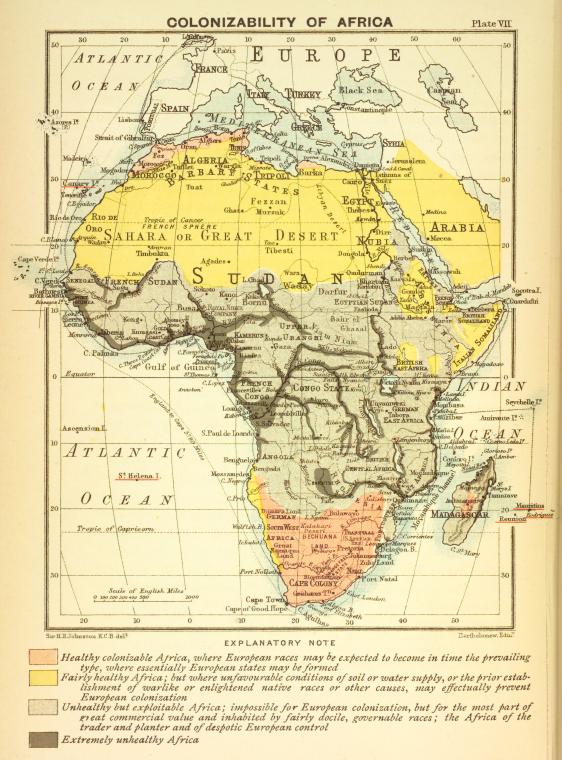
Bartholomew, J. G. (John George), 1860-1920, Colonizability of Africa, Map from Johnson, A history of the colonization of Africa by alien races, 1899. Also held at the New York Picture Library.
via
Filed under: Africa, art | Closed
The expansion of the U.S. in the antebellum period relied on the claim that the nation’s boundaries were both self-evident and dependent on the consent of those enclosed within them. While the removal of American Indians and racism toward former Mexicans has been well-documented, little attention has been paid to the legal rhetorics through which the incorporation of these peoples and their territories was justified, portraying them as actively agreeing to come under the authority of the U.S. Yet even as the creation and extension of U.S. jurisdiction functioned as an imperial system, it did not go unchallenged by dominated populations. In Manifesting America , Mark Rifkin explores how writings by Native Americans and former Mexicans protested the legal narratives that would normalize their absorption into U.S. national space.
Focusing on Indian removal in the southeast and western Great Lakes regions as well as the annexation of Texas and California, the monograph tracks the confrontation between U.S. law and the self-representations of once-alien peoples newly subjected to it. Institutions in the U.S. legitimized conquest by creating forms of official recognition for dominated groups that reinforced the logic and justice of U.S. mappings. But the imposed mappings continued to be haunted by the persistence of earlier political geographies. Examining a variety of nonfictional writings (including memorials, autobiographies, and histories) produced by imperially displaced populations, Rifkin illustrates how these texts contest the terms and dynamics of U.S. policy by highlighting specific forms of collectivity and placemaking disavowed in official accounts. Persuasively argued and anchored with judicious research, Manifesting America provides an overdue chapter in the history of resistance to U.S. imperialism.
Filed under: Scholarship and insights, United States | Closed
Among the thousands who cross the Plains, there are many who have never been refined by either mental or moral culture. The sum total of their religious and political faith consists in Squatter Sovereignty – the right to do as they choose, regardless of all but selfish interests. When such as these get beyond the range of Law and Civilization, a slight cause often makes them reckless and abusive; and many are the cases of violence and murder, of which the world never hears; and as the Authorities at the Forts exercise neither civil nor military jurisdiction over the Emigrants, any outrage may be committed with comparative impunity. But it is the Indians who are generally their most numerous victims. At first they find more excitement in shooting bears and buffaloes, than they did in the States killing rabbits and deer. They grow ambitious and begin to think it would be a great achievement to kill an Indian; and, as most of them are armed with rifles and revolvers, the desire becomes strong to slay one of those whom their own savageness has converted into an enemy […] Thus the poor Indian, by being spoken of as a brute, is cast beyond the pale of a common humanity – where the killing of him ceases to be murder, and no atrocity is considered cruel or unjust.
John Beeson, A Plea for the Indians, 1857.
Filed under: Quote, Sovereignty | Closed
via TurtleTalk
Abstract:
First possession is said to be the root of title but the first possession theory suffers from two major defects. First, land titles in the United States originate in acts of conquest, and because conquest denies the rights of first possessors, land titles in the U.S. do not have a just origin. We should recognize the unjust origins of our land titles and recognize that the democratic way to deal with the legacies of conquest is to refuse to engage in further acts of conquest. This requires recognizing the pre-existing sovereignty and persisting property rights of Indian nations. Second, first possession is justified only if others have equal opportunities to acquire property. The equal opportunity principle is not only one that is crucial to justifying and limiting the historical rights of first possessors but constitutes a core moral principle that must be satisfied in each generation. Property rights are therefore justified today only if they are defined and regulated in a manner consistent with the norms that define a free and democratic society which treats each person with equal concern and respect. Property has legitimate origins not in first possession or conquest but in the practice of democracy and the ideal of equal opportunity. This does not mean that possession is irrelevant; it means that its moral significance must be judged in light of the democratic ideal of equal opportunity.
Filed under: law, Scholarship and insights, United States | Closed
via indigenouspeoplesissues.com
Abstract:
The core argument of this opinion is that in museums focused on Native Americans, staff members must abandon colonial and stereotypic views about Native Americans. They also must challenge notions commonly held by Indians and non-Indians that only Indians can provide authentic information about Indians. Museums can accomplish this by presenting cultural realities that are multithreaded, multivocal, and complicated.
Filed under: Scholarship and insights, United States | Closed
Katherine Ellinghaus, ‘Biological Absorption and Genocide: A Comparison of Indigenous Assimilation Policies in the United States and Australia’, Genocide Studies and Prevention 4, 1 (April 2009): 59–79.
Abstract:
This article examines biological absorption (the imagined process by which indigenous identity would disappear through interracial sexual liaisons) and its relationship to the assimilation policies of the United States and Australia. In the debates about whether or not indigenous assimilation policies constituted genocide, biological absorption has often been pointed to as a particularly salient example of genocidal thinking. US and Australian historians, however, have mostly seen biological absorption as only a minor aspect of assimilation. This article argues that biological absorption should be recognized as a pervasive construct underlying many aspects of Australia’s and the United States’ dealings with Aborigines and Native Americans, respectively. Acknowledging its pervasiveness blurs the boundaries between ethnocide and genocide, demonstrating that strict definitions are not always useful for historians attempting to understand the actions of settler societies.
Filed under: Australia, Genocide, Scholarship and insights, United States | Closed
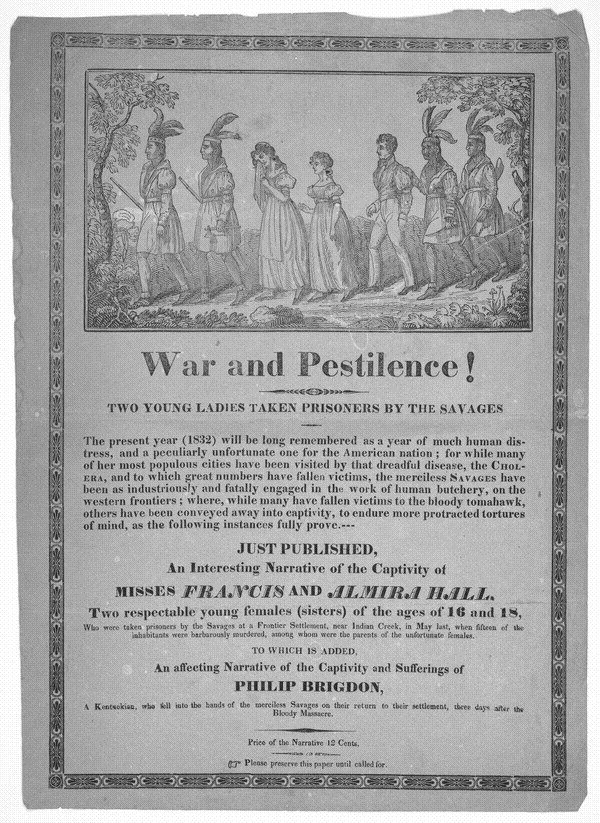 War and pestilence! Two young ladies taken prisoners by the savages, 1833 woodcut, Library of Congress Rare Book and Special Collections Division Washington, D.C.
Filed under: art | Closed

