Upon the recommendation of Mat A., I was today directed towards a memoir by Edward Said from 2001, of a meeting with Jean Paul Sartre in 1979. Sartre, by then an old man, had lost much of the anti-colonial vigour of his earlier days (evident, for instance, in his 1961 preface to Fanon’s Wretched of the Earth), appearing decrepit and derelict in none other than Michel Foucault’s apartment.
Wrote Said of the Arab-Israeli colloquium at which he was in attendance:
[Sartre] said absolutely nothing for hours on end. At lunch he sat across from me, looking disconsolate and remaining totally uncommunicative, egg and mayonnaise streaming haplessly down his face. I tried to make conversation with him, but got nowhere. He may have been deaf, but I’m not sure. In any case, he seemed to me like a haunted version of his earlier self, his proverbial ugliness, his pipe and his nondescript clothing hanging about him like so many props on a deserted stage.
[…]As the turgid and unrewarding discussions wore on, I found that I was too often reminding myself that I had come to France to listen to what Sartre had to say, not to people whose opinions I already knew and didn’t find specially gripping. I therefore brazenly interrupted the discussion early in the evening and insisted that we hear from Sartre forthwith. This caused consternation in the retinue. The seminar was adjourned while urgent consultations between them were held. I found the whole thing comic and pathetic at the same time, especially since Sartre himself had no apparent part in these deliberations. At last we were summoned back to the table by the visibly irritated Pierre Victor, who announced with the portentousness of a Roman senator: ‘Demain Sartre parlera.’ And so we retired in keen anticipation of the following morning’s proceedings.
Sure enough Sartre did have something for us: a prepared text of about two typed pages that – I write entirely on the basis of a twenty-year-old memory of the moment – praised the courage of Anwar Sadat in the most banal platitudes imaginable. I cannot recall that many words were said about the Palestinians, or about territory, or about the tragic past. Certainly no reference was made to Israeli settler-colonialism, similar in many ways to French practice in Algeria. It was about as informative as a Reuters dispatch, obviously written by the egregious Victor to get Sartre, whom he seemed completely to command, off the hook. I was quite shattered to discover that this intellectual hero had succumbed in his later years to such a reactionary mentor, and that on the subject of Palestine the former warrior on behalf of the oppressed had nothing to offer beyond the most conventional, journalistic praise for an already well-celebrated Egyptian leader. For the rest of that day Sartre resumed his silence, and the proceedings continued as before. I recalled an apocryphal story in which twenty years earlier Sartre had travelled to Rome to meet Fanon (then dying of leukemia) and harangued him about the dramas of Algeria for (it was claimed) 16 non-stop hours, until Simone made him desist. Gone for ever was that Sartre.
Filed under: Quote | Closed
me-no-quet
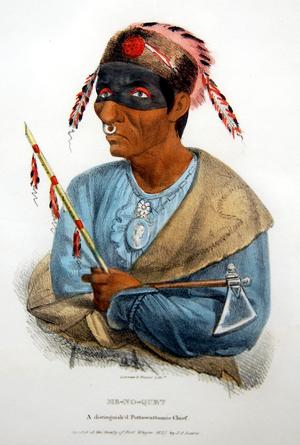
The wickedlocal reports of Early Lithographs of Native American leaders currently on loan from Fruitlands Gallery to Littleton, MA.
Filed under: art | Closed
Daniel M. Anderson, “Sexual Threat and Settler Society: ‘Black Perils’ in Kenya, 1907-30”, Journal of Imperial and Commonwealth History, 38, 1, 2010.
Abstract:
This essay deals with ‘black peril’ scares in colonial Kenya, reviewing the evidence of reported cases of sexual assaults to provide a detailed account of their social and cultural resonance for settler society. Reported cases of assault were few in number and the outbreaks of ‘peril’ more sporadic in Kenya than in other settler societies in Africa, yet the exceptional nature of individual reported incidents of sexual assault was highly significant in shaping public perceptions of the real (or imagined) threat to ‘white purity’. Sexual assault of the innocent and helpless—children and the elderly—sparked the most vociferous of Kenya’s ‘black peril’ debates, culminating in 1926 in the introduction of legislation making the rape or attempted rape of a white woman by a black man a capital offence in Kenya. Fears and anxieties about the threat of African sexuality were incubated in the hothouse of Kenya’s small and insular settler community, but were also informed by a wider discourse on social morality and miscegenation that looked to other parts of the British Empire, especially Rhodesia and South Africa, and to Britain itself. Kenya’s three ‘black peril’ episodes—1907, 1920-22, and 1924-26—are examined in turn. The concluding discussion then returns to broader questions of the explanation for and timing of the ‘black peril’ scares, setting the Kenyan experience in comparison with the other African cases.
Filed under: Africa, gender, Scholarship and insights | Closed
dear bono
Out-of-date rock star receives Santa Claus-style wishlist, reports the Aboriginal News Group:
Dear Bono,
We call on you now not to grant legitimacy to a state that practices the most pernicious form of colonialism and apartheid.
[…]
Rather than shifting the blame from the violence of the colonial oppressor to the resistance of the indigenous oppressed and characterizing the Palestinians as a population filled with “rage and despair,” it is more apt to consider them among the “aroused citizenry” responding to tyranny – Israel‘s regime of occupation and apartheid.
The Palestinian Campaign for the Academic and Cultural Boycott of Israel.
Filed under: Quote | Closed
Berghahn Books has recently re-published the edited collected, A. Dirk Moses, ed., Empire, Colony, Genocide: Conquest, Occupation, and Subaltern Resistance in World History. This collection of essays is rich in critical insight, and boasts of vast historical coverage. Its original appearance in 2008, I think, proved that the experimental fusion of genocide studies and colonial studies in the early 2000s was more than some academic mariage de convenance; and, for settler colonial studies more generally, it yielded considerable insight into the patterns of destruction and ‘logics of elimination’ implicit in settler projects, past and present. The decision to re-release the book as an affordable paperback is a good one.
Contents
Preface
A. Dirk Moses
SECTION I: INTELLECTUAL HISTORY AND CONCEPTUAL QUESTIONS
Chapter 1. Empire, Colony, Genocide: Keywords and the Philosophy of History
A. Dirk Moses
Chapter 2. Anti-colonialism in Western Political Thought: The Colonial Origins of the Concept of Genocide
Andrew Fitzmaurice
Chapter 3. Are Settler-Colonies Inherently Genocidal? Re-reading Lemkin
John Docker
Chapter 4. Structure and Event: Settler Colonialism, Time, and the Question of Genocide
Patrick Wolfe
Chapter 5. “Crime without a Name”: The Case for “Indigenocide”
Raymond Evans
Chapter 6. Colonialism and Genocides: Towards an Analysis of the Settler Archive of the European Imagination
Lorenzo Veracini
Chapter 7. Biopower and Modern Genocide
Dan Stone
SECTION II: EMPIRE, COLONIZATION AND GENOCIDE
Chapter 8. Empires, Native Peoples, and Genocide
Mark Levene
Chapter 9. Colonialism, History, and Genocide in Cambodia, 1747–2005
Ben Kiernan
Chapter 10. Genocide in Tasmania: The History of an Idea
Ann Curthoys
Chapter 11. “The aborigines… were never annihilated, and still they are becoming extinct”: Settler Imperialism and Genocide in 19th-century America and Australia
Norbert Finzsch
Chapter 12. Navigating the Cultural Encounter: Blackfoot Religious Resistance in Canada (c. 1870-1930)
Blanca Tovías
Chapter 13. Genocide in German Southwest Africa and German East Africa
Dominik J. Schaller
Chapter 14. Inner Colonization and Inter-imperial Conflict: The Destruction of the Armenians and the End of the Ottoman Empire
Donald Bloxham
Chapter 15. Inner Colonialism and the Question of Genocide in Imperial Russia and the Soviet Union
Robert Geraci
Chapter 16. Colonialism and Genocide in Nazi-occupied Poland and Ukraine
David Furber and Wendy Lower
SECTION III: SUBALTERN GENOCIDE
Chapter 17. Genocide from Below: The Great Inca Rebellion of 1780–82 in the Southern Andes
David Cahill
Chapter 18. Political Loyalties and the Genocide of a Settler Community: The Eurasians in Indonesia, 1945-46
Robert Cribb
Chapter 19. Savages, Subjects, and Sovereigns: Conjunctions of Modernity, Genocide, and Colonialism
Alexander L. Hinton
Filed under: Genocide, Scholarship and insights | Closed
The Northern Territory intervention has allowed the Australian government to experiment with ‘quarantined’ welfare provision – by rolling out ‘Basics cards’ – in the region. Today the ABC has published an interview in which the system is called ‘apartheid-like’ – although this type of rhetoric has been around since 2008 (see rollbacktheintervention). The comparison of separate shopping lanes in 2010 NT and post-1948 South Africa is apt and evocative, but perhaps overdrawn: apartheid had nothing to do with natives’ welfare; it functioned to allow the settler community to manage only its own people, to allow them, in fact, to clean their hands of any such responsibility.
Filed under: Australia, media, Political developments, Southern Africa | Closed

Just last week, I posted on the topic of Noel Pearson and native title. Unfortunately, I had to rely on the ABC’s sources for the speech contents. Today I have discovered that the Cape York Institute has published a transcript of the speech online, and can be found here. I will post some clippings below here, but interested individuals are encouraged to download the paper from the CYI.
The first principle of the Mabo case was to confirm white land rights. Challenging the many titles enjoyed by the settlers and their descendants was not made justicible in the courts and the relentless reality in the High Court’s decision was to confirm that colonial dispossession could not now be disturbed. The second principle of Mabo was to say that, of course, the remnant lands under the period advanced by the Court should now be forthwith accorded to its traditional owners. The remnant lands where extinguishment had not occurred and the people had not been annihilated should forthwith be determined in favour of its traditional owners. So the structure of the compromise was that the original peoples were to get what was left over. And the third principle articulated by the High Court in the Wik decision was to say that there are various categories of land such as pastoral leases and national parks where there was a possibility of co-existence, co-existence of the crown grants with the original titles held by the traditional owners. That should have been the structure of the compromise. The colonists keep what’s theirs, the Indigenous keep everything that’s left over and there should be honour in relation to the determinations that should result in the wake of the decision and there are categories of land where titles can co-exist and the formula in the Wik case gave that co-existence, gave superiority in that co-existence to the holder of the crown rights. So wherever there was an inconsistency between the native title and the crown grant, the rights under the crown grants superseded the native title. I felt that given the reality of history and the possibilities for the future and the fact that the ongoing process of dispossession would continue as long as there was not a settlement of remnant rights, I felt that the compromise was one that the country ought to seize upon. It was the only compromise available without resort to anything but the courts of law. It was a compromise proffered by our highest institution as a means of resolving the two centuries’ grievance; and all of our febrile hopes rested on the idea that the country might accept the basis of that compromise, after all, we argued in the wake of the Mabo decision. After all, the basis of this compromise had its foundation in the law of the colonists. It was the law of England which respected Indigenous title to land. It was the law of England that apprehended the Aboriginal peoples as following the acquisition of sovereignty now subjects of the British Crown but then also entitled to the protections offered by British law and that principle protection being that those in occupation of land should be presumed to be in possession. And we thought the people of Australia would draw upon their own legal traditions to say that at this juncture Mabo ought to be a cornerstone for reconciliation and a new relationship between the Aboriginal peoples and the rest of the country. Mabo provided to this country what I described at the time as a once in a lifetimes opportunity for a nation. Nations only get one chance like this to get it right. And we squibbed it. Over the past 18 years we have seen a grudging determination on the part of the Australian people to put to absolute proof every native title claim launched by traditional owners in relation to their remnant lands. There have been court cases that have cost far in excess of the value of the land in the market place. A pastoral lease costing $2 million cost $12 million worth of case law.
[…]
[Mabo revealed that] No peoples, whatever their cultures and social organisation and religions and beliefs and relationships to country, occupy land without possessing it. All peoples are to be accorded respect by the common law in respect of the occupation. There is no justification for a racial discrimination that gave priority in recognition to certain cultures in societies and not to others. But then having made that breakthrough, the Australian law immediately descended into an estimation of discriminatory exercise in relation to the nature of the title that could be enjoyed pursuant to that occupation. So in the Australian law that has accumulated over the last 18 years, there is a bizarre jurisprudence that posits the idea that native title in this country is the sum total of whatever berry picking rights Indigenous claimants must be able to prove by reference to their traditional laws and customs as they existed in 1788. So, in the Australia law, the Indigenous hardly own the economic property on the lands they successfully claim. And they are left in this bizarre historical zoo by virtue of the mistaken idea that native title is to be determined by reference to traditional laws and customs. You see, the key question that has been misunderstood in the academic and judicial discussion of native title in this country is this: even as we have accepted that traditional rights survive the acquisitional sovereignty by the crown, even as we all accept that, that the rights survive the acquisition of sovereignty under what is known in the Canadian law and in some of the Australian discussion as the doctrine of continuity, even as we accept that, the mistake arises in relation to the question of what continues? Is it those rights and interests that are established as a matter of proof by reference to the traditional laws and customs of the group? Or is the right to continue the occupation of the land pursuant to the authority of one’s traditional laws. Is it the occupation that founds the right to possession that survives the acquisition of sovereignty?
[…]
[Regarding social welfare, over-representation in jails, and the ‘gap’], These are problems that are not going to be turned around in short order but what we must first realise before we pursue the policies that have some hope of working is that we have made many efforts in the past. We have come to many similar conclusions about the immorality of this situation in the past. We have come to many sincere junctures where we’ve said things have got to change, things have got to get better and our policies and programs and budgetary commitments have got to be renewed. And yet like groundhog day we come to that juncture again five years later when a whole range of new indicators illuminate a deteriorating situation. We have long argued from our part of the country that we have got to get our thinking straight first and our critique of welfarism has been central to our re- thinking, it was obvious that we needed welfare reform but the problem of relegating the country’s original peoples to a position of mendicancy was not just a symptom of the problem, it was the cause of many of our problems and if it wasn’t causal of many of our problems, it certainly exacerbated any existing problems we had and certainly frustrated and prevented any of the solutions that we proposed so we had to get on top of welfarism, substance abuse and the social breakdown that was occasioned, particularly in the past three to four decades. It was my analysis, and it still is my analysis, that through 200 years of mean history in the teeth of inhumane racism, aboriginal people had as the slogan said they “survived”. They had mustered together some strength that had seen them survive in the teeth of a heartless society. We had some strengths in the ‘50s and the ‘60s and those strengths were largely social and family-based strengths where people would continue to fulfil their responsibilities to their children and had taken responsibility because at the end of the day responsibility was all that they had, even if their rights were not fully accorded to them. I was struck by an analysis by the conservative African American intellectual, Shelby Steele, that struck a chord with me in relation to what might have happened at the moment of our citizenship in 1967. I think a grievous mistake was made when the doors of citizenship finally opened. Instead of holding on to our responsibility and enjoying our newly guaranteed rights we ushered in an era where a combination of white guilt and black victimhood made a bad situation worse and deferred the day when we would take our rightful place in the country because no salvation at the end of the day was to be found in white guilt and black victimhood. We keenly understood that victimhood was ultimately not a posture that would benefit our people, it was not a mentality for continued survival. If our ancestors had adopted a mentality of victim hood we would never have survived colonisation but the tragic deal struck in the argument of Shelby Steele in the wake of the 1965 Civil Rights Act and with a parallel in the wake of the ‘67 referendum in this country was this Faustian pact we made about white people were going to redeem their history through guilt and the aboriginal peoples and black Americans would cultivate an outlook unfortunately that had too many strains of victim hood within it. So we have been pursuing a responsibility agenda.
[…] [The] great dialectical struggle between W.E.D. Debois and Booker T. Washington… that great struggle between those two ideas in the history of African Americans and the United States, [has] consumed my thinking. […] We needed strong recognition of our rights and a strong affirmation of our responsibility and in that struggle, between those two ideas. I suppose I personally fall on the Booker T. Washington side of that, that debate. I fall on that side of the debate because it’s the uncool side. I fall on that side of the debate for this argument, so let me propose this argument: It is because at the end of the day it is taking responsibility for yourself that is your most guaranteed defence, it is your most guaranteed position and if we, and people of our ancestors, can draw upon our history for confirmation that people can survive provided that they have the strength of their own responsibility, even in the teeth of oppression. I think that one of the causes of social unravelling in our communities has been the idea that somehow it was the Australian welfare state that was going to save the indigenes and once we internalise the idea that somebody else was going to save us, we had internalised a fatal conceit.
In its entirety, the speech considers issues with greater complexity than the ABC – and by consequence, SettlerColonialStudies.org – reported.
The coverage that Noel Pearson receives in the media, when he even gets any at all, is consistently brief and to scandalising effect (extracts of this particular speech, for example, were flashed around cyberspace mostly because of the strange and slight parallel drawn in the speech between Aborigines and the world’s Jewish people). This has transformed Pearson into somewhat of a target for intellectuals and commentators, white and black, radical and conservative. See, for example, the most recent example of this, in Arena Magazine: in his short article, Geoff Sharp sees Pearson’s ‘liberal’ concern with individual Aboriginal achievement as one ‘[in]consider[ate] [of] the conditions for continuity of Indigenous social forms’. Pearson’s doctrine, Sharp goes further, ‘contribute[s] to a massive shift in public opinion towards a neo-assimilationist trajectory’.
This blog will not get into either side of the debate: Pearson’s speech is of interest to this blog only because it engages with matters of land rights and the conditions of indigenous suffering – and moreover, it includes comparisons to other settler contexts. This blog will, however, issue a warning to general readers and those in the media: be careful, the picture of Aboriginal Australia we get is so seldom complete, and it is cause for massive concern.
Filed under: Australia, law, media, public lecture | Closed
This from the latest edition of Native South, courtesy of IndigenousPeoplesIssues.com:
Malinda Maynor Lowery, ‘Indians, Southerns, and Americans: Race, Tribe and Nation during “Jim Crow”‘:
After the Civil War, Southerners of all races struggled to resolve questions of citizenship, opportunity, political autonomy, and freedom in a drastically changed economic environment. The story of Southern African Americans in this period is well known, while that of Native Americans centers on conflicts over the United States’ imperial expansion in the West. But Native Americans in the South contended with an imperial force as well: the mounting wave of white supremacy. By 1910 white supremacy dictated the separation of racial groups in public facilities—schools, churches, movie theaters, streetcars, and other places.
In Robeson County, North Carolina, home of the largest Indian community east of the Mississippi, that separation was threefold in the county seat of Lumberton. There were different facilities for whites, blacks, and Indians. In the county courthouse each group had its own water fountains and restrooms, while the Lumberton movie theater boasted a balcony divided by chicken wire for the Indian and black patrons. What were the contours and boundaries of racial segregation for Native American Southerners? How did their identities function and how did the concept of race become institutionalized out of identities based on different markers, of kinship and place? Furthermore, how did Indians negotiate identities as both Indians and American citizens? Why do Indians seek recognition, when other American citizens have devoted so much energy to dispossessing them?
I want to introduce the topic of Indian citizenship and federal recognition with a personal story. I am Lumbee, from Robeson County, North Carolina, and the people you see in this photograph are all Lumbees.
Filed under: Scholarship and insights, United States | Closed
From Interventions: The Journal of the Institute of Postcolonial Studies, 11, 3, 2009:
Rebecca L. Stein, ‘Travelling Zion: Hiking and Settler Nationalism in pre-1948 Palestine’:
This essay considers the political import of the hike or walk (ha-tiyul; plural, tiyulim) among Jewish settlers in Palestine during the first decades of the twentieth century. Situating this travelling practice within the broader Zionist discourse of which it was a part, I will suggest that the tiyulim conducted by Jewish settlers were important technologies of settler nation-making which helped to rewrite Arab Palestine as a Jewish geography. Drawing on postcolonial arguments about imperial travel, this essay presents both a condensed history of such travelling practices and a close reading of some of the travelogues they spawned. I focus on two divergent itineraries: (a) accounts of travel within the borders of the Land of Israel (Eretz Yisrael) replete with classic colonial tropes of conquest, the empty landscape, and Palestinian-Arab culture qua ethnographic object; and (b) accounts of Jewish travel to neighbouring Arab countries (Syria, Egypt, Jordan, Lebanon) from which colonial tropes are frequently absent. I suggest that these postcolonial readings of Zionist travel and travelogues advance the scholarship on Zionist coloniality by suggesting the role of everyday culture within the settler-national project.
Filed under: Scholarship and insights | Closed

