a heartfelt dedication
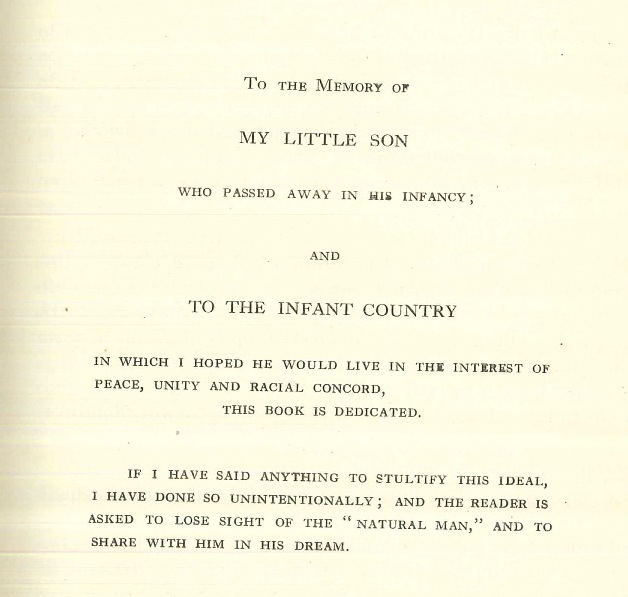
From the opening pages of C. J. Uys, In the Era of Shepstone: Being a Study of British Expansion in South Africa (1842-1877) (Lovedale: Lovedale Press, South Africa, 1933).
Filed under: Quote, Southern Africa | Closed
Settlers are made by conquest, not just by immigration. Settlers are kept settlers by a form of the state that makes a distinction – particularly juridical – between conquerers and conquered, settlers and natives, and makes it the basis of other distinctions that tend to buttress the conquerers and isolate the conquered, politically. However fictitious these distinctions may appear historically, they become real political facts for they are embodied in real political institutions.
The settler-native question is a political question. It is also a historical question. Settler and natives belong together. You cannot have one without the other, for it is the realtionship between them that makes one a settler and the other a native. To do away withone, you have to do away with the other.
Mahmood Mamdani, ‘When does a settler become a native? Reflections on the colonial roots of citizenship in Equatorial and South Africa’, Inaugural Lecture as A. C. Jordan Professor of African Studies, UCT, 1998.
Filed under: Africa, Quote, Southern Africa | Closed
coinage
Settler specie is typically littered with imagery of animals: the exotic ones unseen before in Europe.
Occasionally, they display ‘the native’.




with help from Newspaper Rock
Filed under: Australia, United States, wacky | Closed
ryan irwin on the place of south africa in transnational conceptualisations of the ‘colour line’
Abstract
This study examines scholarship about the global color-line. It unfolds in two sections. The first traces how understandings of race and racism were encoded within university environments in the mid-twentieth century. The second shows how this epistemology influenced early academic comparisons of the United States and South Africa in the 1980s and why the literature diversified in the post-apartheid era.
My effort here is fairly focused. Rather than examine the infinitely large body of work on transnational discrimination and resistance, this study looks tightly at a singular topic: scholarship on South Africa’s place in the world. The conceptual lodestar of work on global racism, South Africa – and the apartheid question more specifically – has guided a particular research agenda for nearly half a century, pushing historians in different fields toward a similar set of inquiries, assumptions, and intellectual imperatives. The result has not only been a uniquely specific map of South Africa’s ‘proper’ place abroad, but also a surprisingly unified vision of what racism is, where it came from, and how it transformed world history in the twentieth century. This map remains influential in our modern era, attaching meaning to international resolutions and weight to public discourse, even as the reference points that gave it life erode slowly in the face of the ‘New’ South Africa and the ‘post-Cold War’ world. Decoding the scholarship on South Africa in the world – uncovering its fault lines and support beams and how it evolved – offers an excellent pathway for better understanding the origins, complexities, and contradictions of the color-line narrative.
We are in a unique moment of intellectual upheaval. The reference points and narratives that largely shaped scholarly understandings of human interaction through most of the twentieth century have buckled in recent decades – questioned, subverted, and reformulated by academics and laypeople alike, all eager to adjust staid explanations of the political present and historical past. This tumult has transformed the historical discipline in palpable and ethereal ways. Regardless of subfield, historians are being asked today to rethink categories of nationalism, culture, and territoriality, and reconsider how such frameworks helped institutionalize assumptions that made the messiness and interconnectivity of the past less discernable to those tasked with its preservation. The nation, once treated as an omnipotent organizing principle of historical inquiry, has emerged from this milieu on the defensive, pursued by cosmopolitans who, although respectful of its power, are eagerly shining light on the crevices, connections, and contradictions of the global past.
This historiographical study looks at the effects of these upheavals from a particular vantage point. It explicates the epistemological evolution and the imaginative geography of a transnational narrative both bigger and less discrete than the nation: the story of the color-line. Open nearly any textbook today and W. E. B. Du Bois’s famous dictum that ‘the problem of the twentieth century is the problem of the color-line’ invariably frames and animates discussions of racial discrimination and nonwhite activism. What was this color-line and how have historians studied it? It has been treated, more often than not, as a metaphor for those left behind and excluded in the nation’s unyielding march toward modernity – the line of conflict where nonwhites fought back against the linearity of the European mind and the discriminatory blind spots of national development. Like any other narrative, this story has developed its own self-referential terminologies and updated itself with time, and provided historians with essential guideposts to understand world affairs.
A compelling and thorough lit. review/discussion piece, this.
Filed under: Southern Africa, United States | Closed
Catherine Agbo, ‘My Mission is to Liberate FCT Natives’: Dara, Leadership (Abuja)
Immediate past Chairman of Bwari Area Council in the Federal Capital Territory, Hon. Isah Dara Bwari has disclosed that the major reason for his aspiration to the House of Representatives is to correct the injustices not only against the original Abuja indigenes, but for the generality of all Nigerians living in the FCT.
Hon. Bwari who is aspiring to be elected into the AMAC/Bwari federal constituency of the FCT stressed that it is only a true son of the territory that can truly make a case, with sincerity for the indigenes and residents alike.
////
“Government in the past has made it optional that anybody, who wants to remain in the FCT as an indigene, can remain and that is why many of us have remained. However, there are many things which the federal government was supposed to have done for the original indigenes that have not been done.
Filed under: Africa, Political developments | Closed
Abstract
‘Archaeologists make up stories about the past, but not just any stories.’ Archaeological stories are written principally from the interpretation of material remains. Increasingly we also use evidence from a variety of other sources, such as genetics and linguistics. In Australia, as in other countries colonised from Europe, the stories are about the past of Indigenous peoples and so are generally believed to have an important relationship with the ethnographic description of traditional behaviour. But the relationship is not straightforward. Ethnographic accounts show that there are oral and other histories that account for the way those people are. For this reason, archaeological histories are not always easily adopted by Aboriginal Australians, particularly as they are, in almost all cases, written by non-Aboriginal people. I suggest that an alternative approach is to look at the record of ethnographies and historical material culture around Australia as indicating what is to be explained through the analysis of archaeological materials, just as geneticists and linguists begin from the analysis of the variation in modern samples. An archaeological approach to the diversity of peoples in Australia requires an understanding of the symbolic construction of identity in the past. But symbols, because of their very nature, are difficult to interpret, so special care is needed to work out how the diversity was constructed, and attention needs to be paid to different scales of analysis. Archaeology has proceeded rather as other sciences proceed, by putting up hypotheses, testing them, and moving on to the next hypothesis once the test is satisfactorily conducted. The conclusions must be understood as historical though the methods of arriving at them are like the process of science. In this regard, just as an unchanging Dreaming is said to be successively revealed as new claims are established, so archaeological history, too, is successively revealed.Keywords: Australian archaeology; historical narrative; hypothesis testing; science; demography
Filed under: Australia, Scholarship and insights | Closed
Salvatore Engel-Di Mauro, ‘Capitalist Expansionism, Imperialism, and the European Union’, State of Nature (2006)
With so much attention by activists worldwide on current US imperialism, few have questioned the recent expansionism of the European Union (EU) and its continued neo-colonialist policies. What is worse, the EU has been treated as if it were a more humane alternative to the latest version of US capitalism, so that the present prevailing strategy among most mainstream “left” circles is to support the EU project as a counterbalance to US hegemony. This strategy fails to consider the capitalist underpinnings of the EU, its consequent imperialistic tendencies and practices, and its complicity with and active support for American military aggression worldwide. The eastward “enlargement” of the EU on 1st May 2004 (and the usurpation of Labour Day) is part of an expansionistic strategy of major segments of both the Western and Eastern European bourgeoisie for retaining, if not increasing their core status in the capitalist world-system. The majority of Eastern Europe and its relatively low-waged, largely precarious workforce will, according to the Lisbon Strategy, be largely sacrificed, eventually along with their Western European counterparts, to bring about a “competitive, dynamic, and knowledge-based economy”.
So what do you reckon: is Mauro in this article describing settler colonialism or simply the migration of wealth and privilege into existing political orders? Are the two mutually exclusive?
Filed under: Europe, Scholarship and insights | Closed
Abstract
This article addresses the vexed question of settler massacres of Aboriginal Victorians on the Port Phillip frontier 1836-1851. It argues for a new approach to the question by combining the models of Aboriginal resistance and settler activism within a framework that considers colonialism as a dynamic, contested and ongoing process. It then applies the methods of massacre investigation devised by historical sociologist Jacques Semelin to analyse a range of printed sources from the period to identify the scale, pre-conditions, types, prevalence and evidence of settler massacres across the three major pastoral regions in Port Phillip. In analysing the data, the article finds that settler massacres were widespread and responsible for the deaths of more than 11 per cent of the known Aboriginal population in Port Phillip in 1836. The data also identifies three pre-conditions and four types of massacre and that most were perpetrated by settlers but that the various mounted police units also played a key role. The article concludes that settler massacres have played a more significant role in the dramatic Aboriginal population decline in Port Phillip than historians of the Aboriginal resistance school have estimated.Keywords: massacres; settlers; Aborigines; colonialism; Port Phillip frontier
Filed under: Australia, Scholarship and insights | Closed
Seth Korman, ‘Indigenous Ancestral Lands and Customary International Law’, University of Hawai ‘i Law Review 32 (2009-2010), pp. 391-463.
In lieu of an abstract, here’s part of the introduction:
The debate over the existence of customary law protecting the land rights of indigenous peoples is relatively new. While there is commentary and scholarship on the emergence of indigenous land rights in various countries and in international law, arguments supporting an international right tend to look mostly at treaties and some accumulated state practice, and not to the deeper underpinnings of customary law.’ This is understandable, as the absence of a universally signed treaty or a definitive International Court of Justice (ICJ) ruling on the issue of indigenous property rights forces observers to dive into the murky field of customary international law, a body of law derided by outspoken critics like Justice Scalia as a “20th-century invention of internationalist law professors and human rights advocates,”‘ yet recognized as real law by the United States Supreme Court,’ the ICJ, and most nations throughout the world.
This article looks at the existence of a customary norm protecting indigenous ancestral territory by applying contemporary understandings of customary international law to the current state of indigenous real property protections in various parts of the world. By looking at the many domestic, international, and supranational developments in the campaign for increased protection for native property rights through a lens of state action and international legal obligation, this article seeks to demonstrate that the framework for the establishment of such a norm is in fact already in place, especially amongst post-colonial nations with large indigenous populations. Part I of this article provides a contemporary assessment of the relevant aspects of customary international law, and looks at the existing requirements for proving its existence. Parts II and III then examine the various domestic and international developments protecting indigenous ancestral lands that might demonstrate—or at least provide evidence towards-the potential existence of custom: Part II surveys both state action and legal obligations of various nations, while Part III looks at secondary indicators, including treaties, international instruments, and additional international law that bears on theissue of indigenous land rights. Parts II and III simply present evidence, following the rule of thumb that, when trying to prove custom-a job the International Law Commission (ILC) admits to be “a herculean task”–the volume of evidence is of utmost importance. Part IV then applies this evidence to the framework for proving customary international law, and demonstrates that the current body of law relating to customary land rights may reveal an emerging custom in international law, albeit one that remains vague and ill- defined.
Filed under: law, Scholarship and insights | Closed
Indigenous Law Journal 8, 1 (2010)
Table of Contents:
Bessie Mainville ‘Traditional Native Culture and Spirituality: A Way of Life That Governs Us Community Voices’, pp. 1-6.
Kent McNeil, ‘Reconciliation and Third-Party Interests: Tsilhqot’in Nation v. British Columbia’, pp. 7-26.
Emily Luther, ‘Whose Distinctive Culture – Aboriginal Feminism and R. v. Van der Peet’, pp. 27-54.
Eric H. Reiter, ‘Fact, Narrative, and the Judicial Uses of History: Delgamuukw and Beyond’, pp. 55-80.
Dominique Nouvet, ‘R. v. Kapp: A Case of Unfulfilled Potential Case Comment’, pp. 81-94.
Simon Young, ‘Tides of History and Jurisprudential Gulfs: Native Title Proof and the Noongar Western Australia Claim’, pp. 95-120.
Filed under: Australia, Canada, law, Scholarship and insights, United States | Closed

