sydney gazette
Does the mere effecting a settlement by no other right but that of the strongest, and retaining possession owing to the physical weakness of the owners of the soil, for a period of forty years, does that divest them of their natural right to resist and expel the invaders, whenever they were in a situation to do so? We think not.
Sydney Gazette, 20 April 1827.
Filed under: Quote | Closed
the irish famine was genocide?
Here’s an interesting little snippet from international lawyer Francis A. Boyle, found on AboriginalNewsGroup:
While there are many legitimate subjects of debate surrounding the Famine, there is no doubt that the British Government committed genocide against the Irish People.
Filed under: Genocide | Closed
Abstract:
Since the advent of the African Union, confidence in Africa’s renaissance has been high, but a number of state-civil society anxieties continue to challenge stable social relations. One area of anxiety concerns post-colonial African governments’ attempts to incorporate traditional authorities into largely secular, constitutional democracies. Indigenous authorities have been a significant part of South Africa’s colonial and apartheid history – in resistance and collaboration – and are widely imagined to be part of the country’s political culture for the foreseeable future. The post-1994 African nationalist government sought to deal with the indigenous through the formal regulation of indigenous authorities and the integration of indigenous institutions into the fledgling democracy, without adjusting the provisions of South Africa’s culture of secular constitutionalism. In this article, I explore the possibility that the post-apartheid state’s promotion of religious, linguistic and cultural rights, and its protection of indigenous authorities through legislation serve to domesticate and exclude such organic, indigenous institutions and social movements from matters of state making. I argue that while such domestication is a feature of the contemporary situation, it is made more complicated by the sources of sacred power, which ideas of tradition and indigeneity offer African nationalism.
Filed under: Africa, law, postcolonialism, Scholarship and insights, Southern Africa | Closed
The symposium “Gender and Settler Colonialism” was held last friday at the Institute of Postcolonial Studies, North Melbourne. To get an idea of the areas covered, have a look at the program.
Keynote: Angela Wanhalla, ‘Intimate Moments, Racial Pasts, Colonial Histories’
Chair: Kat Ellinghaus‘Intimacy, Space and Types/Representations of Indigenous Women’
Chair: Lynette RussellPenelope Edmonds, ‘Settlement and Gendered Territorialism: First Nations Women and Mixed Relations in Victoria, British Columbia, 1850s-1880s’
Jane Lydon, ‘Photographing “native slums”: Assimilation, Domesticity, and Aboriginal Camps’
Liz Conor, ‘The “Lubra” Type: Colonial Mobility and Typology’
Roundtable: Thinking through Methodologies
Chair: Lachlan PatersonJane Carey, ‘Reproducing Empire, Nation, Race: Transnationalism vs the New Imperial History’
Victoria Haskins, ‘Transnationalism in the Archives: Comparing state intervention in Indigenous domestic service, Australia and the US’
Shurlee Swain, ‘Child Rescue and Settler Colonialism: Gendering the Discourse’
Ben Silverstein, ‘Gendering Native Divisions of Labour: Efficiency, Exploitation and (Dis)Order’
Ann McGrath, ‘Writing Gender, Courtship and the Transnational across the Middle Ground’
Discussion Panel
Chair: Jane Carey
Panelists: Ann Curthoys, Patricia Grimshaw, Angela Wanhalla, Angela Woollacott.Booklaunch
Penelope Edmonds, Urbanizing Frontiers Indigenous Peoples and Settlers in 19th-Century Pacific Rim Cities, UBC Press.
Overall, the symposium was a great success, and featured some great scholarship accompanied with lively discussion. The speakers I found especially provocative were Penny Edmonds, whose investigation into the urban pockets of settler regimes was thorough and timely; Liz Conor, whose meticulous exploration of racial stereotypes yielded fascinating histories of expanding words; and Ben Silverstein, whose deconstruction of the gendered division of labour as it appeared in settler discourse in northerly Australia, South Africa and Kenya, was really something. Congratulations to Jane Carey for organising the event, and let’s hope there’s room for more of this 2010.
Filed under: gender, Scholarship and insights, Seminar | Closed
goldblatt in boksburg
Michael Stevenson is exhibiting David Goldblatt’s awesome selection of apartheid photography at the moment, which you can see on his gallery website. This is my favourite:
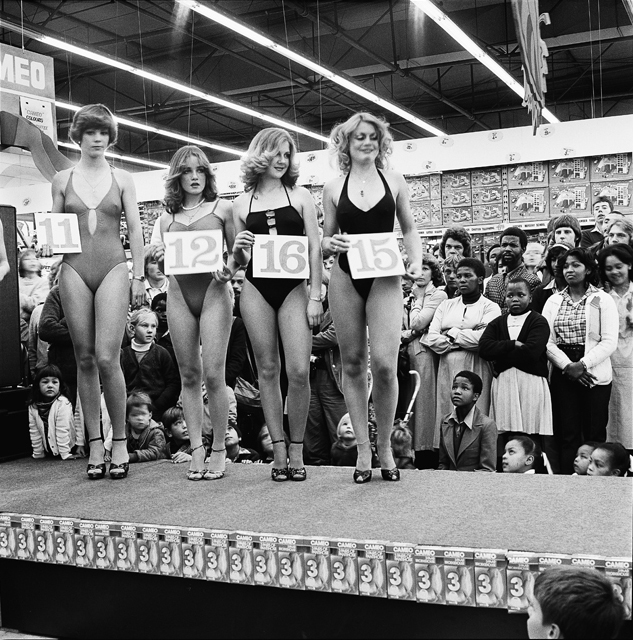
David Goldblatt, “Saturday morning at the Hypermarket: Miss Lovely Legs Competition”. Silver gelatin print, 1979.
Filed under: art, Southern Africa | Closed
From Douglas H. Johnson, “Mamdani’s ‘Settlers’, ‘Natives’, and the War on Terror”, African Affairs 108, 433 (2009):
Mamdani extends his South African paradigm, first proposed in his award-winning Citizen and Subject and further elaborated in When Victims Become Killers, to Sudan, whereby the colonial power is said to have imposed a divide between ‘settlers’ and ‘natives’ on the indigenous people, and identified the people of Sudan ‘as members of different races, termed “Arab” and “Zurga” (“black”) earlier and “Arab” and “African” more recently’. This rather assumes that the peoples of Sudan are a tabula rasa on which external powers can inscribe their own vision. The reality of the colonial encounter in the Nile valley suggests otherwise, that the colonial power adopted indigenous categories and terms to describe the peoples it governed.
The Nile valley has a long history of indigenous state building, going back to pharaonic times, and those states have left a legacy not only of social stratification, but of perceptions of race, ethnicity, and social status, and idioms for expressing them. […] Certainly in the northern Nile valley the terms ‘Nubi’ (Nubian), ‘Nubawi’ (Nuba) and ‘Sudani’ (Sudanese) entered colloquial Arabic as synonymous with ‘slave’, and have a very old, pre-nineteenth-century pedigree; while being wholly free was increasingly linked to professing Islam in addition to claiming Arab descent.
These terms were in use when the British occupied Sudan; they were not invented or imposed by the imperial power. They are still in use, with varying degrees of pejorative overtones. If the northern Sudanese intellectuals Mamdani consulted for his introduction to the country have ‘bought into’ these colonial stereotypes, it is because the colonial power ‘bought into’ indigenous classifications. […] Racial categories in Sudan are more a state of mind than of skin colour, and never a clear-cut distinction between black and white (or black and red). While Anglo-American perceptions of race might be misleading when applied to Sudan, perceptions of race and descent still do matter, still do influence how individuals and groups deal with each other, and are still used in the political mobilization of segments of the population. Mamdani’s attempt to dismiss this does not help us understand the continuing complexity of Sudan’s civil conflicts.
Filed under: Africa, Genocide, Political developments, Scholarship and insights | Closed
Provocative scholar of government and race in colonial and postcolonial Africa, Mahmood Mamdani, has recently published a new book, entitled Saviours and Survivors: Darfur, Politics and the War on Terror. Writes Verso Press:
Saviours and Survivors is the first account of the Darfur crisis to consider recent events within the broad context of Sudan’s history, and to examine the efficacy of the world’s response to the crisis. Illuminating the deeply rooted causes of the current conflict, Mamdani works from its colonial and Cold War origins to the war’s intensification from the 1990s to the present day. Examining how the conflict has drawn in national, regional, and global forces, Mamdani deconstructs the powerful Western lobby’s persistent calls for a military intervention dressed up as a “humanitarian intervention.” Incisive and authoritative, Saviours and Survivors will radically alter our understanding of the crisis in Darfur.
Mamdani’s views on British imperialism and settler colonialism are worth producing here too. In a recent interview for Socialist Review, Mamdani said:
Colonialism laid a foundation through history-writing, conducting a census and implementing a system of laws. It wrote a history of Sudan as one of Arab settlers conquering native tribes. As early as the 1920s, the British began to prepare a census for Sudan, which was ultimately carried out in the mid-1950s. The census was driven by three categories: tribe, groups of tribes (really language groups) and race. Arab and Negroid were defined as separate races in the census.
It is legislation that gave teeth to the categories in the census. Though racialisation was important at an ideological level, it was tribalisation – not racialisation – that drove administrative practice. Both land and administration were tribalised. To have “customary” access to land and to be appointed to “customary” positions like that of “chief”, you needed to belong to a “native” tribe. The result was systematic discrimination against non-native tribes on a tribal basis. Tribe became the basis of discrimination in colonial Sudan. This is why the civil war of 1987-89 was waged as a tribal, and not a racial, war.
At the same time, it is with the civil war of 1987-89 that we hear of “Arab” and “African” tribes, rather than the Masariyya or the Rizeigat (“Arab”) or the Fur, the Masalit and the Zaghawa (“African”), joining “tribe” to “race”. This process is accelerated after 2003 as the international media and Save Darfur not only buy into this language but turn into its main purveyors.
This is the big difference between Rwanda and Darfur. In Rwanda race was an administrative – and not just an ideological – reality in the colonial period. In Darfur the administrative reality was tribe. In Darfur race is a relatively new concept in which the international community is heavily implicated.
Filed under: Africa, Genocide, Political developments, Scholarship and insights | Closed
Abstract
Has Australian colonisation tended to ‘eliminate’ the Indigenous presence? The Australian government did not enact the logic of elimination—by ceasing to enumerate people as Indigenous Australians—when the referendum in 1967 showed popular support for the ‘inclusion’ of ‘Aborigines’. No longer distinguishing ‘Aborigines’ in the results of the census, thus ending the ‘Aboriginal population’, was a possible road to inclusion, but it was not taken. Rather, census policy 1961-1971 effectively enlarged the ‘Aboriginal population’. We argue that ‘the logic of elimination’ was resisted by a combination of Indigenous demand (for recognition), technical considerations (the unreliability of self-reported ‘caste’), and social scientists’ and bureaucrats’ demand for better knowledge of Indigenous Australians.
Filed under: Australia, Scholarship and insights | Closed
zizek on avatar
Slavoj Zizek, “Return of the Natives”, From New Statesman:
Avatar’s fidelity to the old formula of creating a couple, its full trust in fantasy, and its story of a white man marrying the aboriginal princess and becoming king, make it ideologically a rather conservative, old-fashioned film. Its technical brilliance serves to cover up this basic conservatism. It is easy to discover, beneath the politically correct themes (an honest white guy siding with ecologically sound aborigines against the “military-industrial complex” of the imperialist invaders), an array of brutal racist motifs: a paraplegic outcast from earth is good enough to get the hand of a beautiful local princess, and to help the natives win the decisive battle. The film teaches us that the only choice the aborigines have is to be saved by the human beings or to be destroyed by them. In other words, they can choose either to be the victim of imperialist reality, or to play their allotted role in the white man’s fantasy.
[…]
The film enables us to practise a typical ideological division: sympathising with the idealised aborigines while rejecting their actual struggle. The same people who enjoy the film and admire its aboriginal rebels would in all probability turn away in horror from the Naxalites, dismissing them as murderous terrorists. The true avatar is thus Avatar itself – the film substituting for reality.
Thanks again to Mat A. for bringing this to my attention.
Filed under: media, Scholarship and insights | Closed