ABSTRACT:
The dependence of colonization on police was a core feature both of settler colonies and of colonial dependencies, from the middle of the nineteenth century to the post–World War I decline of the British Empire. During this long century the functions and structures of colonial police were many and varied. We now know a good deal of their history and of their contribution to Empire. Much remains to be told of the slow processes of policing reform and especially of the politics of key events that shaped—and impeded—emerging models of accountability. In that process we see the influence of key episodes in which singular events are escalated into major political conflicts, of national and international dimension. In this article we examine one such event, the death in 1933 of an Aboriginal woman in the Gulf Country of Australia’s Northern Territory, and the subsequent prosecution of a policeman over her death. Such a rare event as prosecution of police for violence against indigenous people demands contextual explanation as well as estimation of the limits on legal accountability for such actions.
Filed under: Australia, law, Scholarship and insights | Closed
ABSTRACT:
What role did the Roman legal concept of res nullius (things without owners), or the related concept of terra nullius (land without owners), play in the context of early modern European expansion? Scholars have provided widely different answers to this question. Some historians have argued that European claims based on terra nullius became a routine part of early modern interimperial politics, particularly as a response by the English and French crowns to expansive Iberian claims supported by papal donations. Others have countered that allusions to terra nullius marked a temporary phase of imperial discourse and that claimants relied more often on other rationales for empire, rarely mentioning res nullius or terra nullius and often explicitly recognizing the ownership rights, and even the sovereignty, of local polities and indigenous peoples.
Filed under: Empire, law, Scholarship and insights | Closed
Coming up in Melbourne soon is this symposium on gender and settler colonialism. I will certainly attend and hopefully post some reflections about it afterwards.
Here is some info:
Friday 19 March, 9.45am-5.15pm
Institute of Postcolonial Studies (54 Curzon St, Nth Melbourne)
Confirmed speakers and commentators include:
Ann Curthoys (Sydney), Patricia Grimshaw (Melbourne), Lynette Russell (Monash), Victoria Haskins (Newcastle), Angela Wanhalla (Otago), Kat Ellinghuas (Monash), Liz Conor (Melbourne), Jane Carey (Monash), Penny Edmonds (Melbourne), Shurlee Swain (ACU), Jane Lydon (Monash), Angela Woollacott (ANU).
The day will conclude with the launch of:
5.15 for 5.30pm, to be launched by Prof. Patricia Grimshaw
Space and catering is limited so RSVP ESSENTIAL: please email Jane Carey from Monash University.
Filed under: gender, public lecture, Scholarship and insights, Seminar | Closed
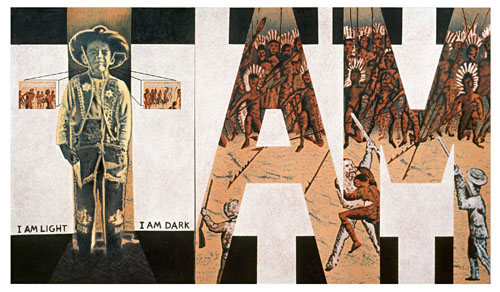
Gordon Bennett (b. 1955), “Self portrait (But I always wanted to be one of the good guys)” (1990), held in a Private collection, Brisbane; Photo by Phillip Andrews; from ABC Radio National
Filed under: art | Closed
half indian / half mexican

James Luna, "Half Indian / Half Mexican".
James Luna (b. 1950), “Half Indian / Half Mexican” (1991), held at the Denver Art Museum.
Filed under: art | Closed
Part of the global shift towards being a “First” person across the settler world (that perhaps began with the UNPFII notes), Indigenous peoples in Queensland will soon be officially recognised as First Queenslanders. From ABC Online:
Queensland Parliament has passed legislation to insert a preamble into the State Constitution.
The preamble will recognise the Indigenous people as the first Queenslanders.
Filed under: Australia, Political developments | Closed
Transference of cultural practices by close contact allows whites to write “black”, a move that, besides the ultimate (albeit one step removed) indigenisation of the Euro-Brazilian, enables another transfer: the disappearance of the black by way of simultaneous incorporation and erasure. Black autonomous authorship (a voice that Freyre perceives as emblematic of US segregationism) is thus disqualified through transfer, together with mixed race authorship, a voice Freyre accuses of being intrinsically incapable of genuinely representing either race: not the manor, not the subaltern periphery, yet alone a synthesis or Brazilian ineffable heterogeneity. Isfahani-Hammond recognises this dynamic, and sees Freyre situating “himself as a seignorial figure who has equal domain in elite and marginal sites, displacing people of mixed European/African ancestry from the embodiment of hybridization and, therein, from the ability to narrate or speak about national identity” (p. 14). Freyre finally “transfers” the south of Brazil: a site of degenerative modernisation, European immigration and influence, and, ultimately, Americanization. It is an alien and unauthentic locale; a source of foreign and therefore distorting stimuli.
At the end of a succession of discursive transfers, the white master’s claim is the last one standing. His proximity to black commodified bodies enables authentic linguistic and spiritual incorporation, something that is denied to everyone else. Only the specific conditions of the northeastern plantation and the intimate contact between masters and slaves could produce Brazil’s exceptional “Racial Democracy”: “[t]he social history of the plantation manor is the intimate history of almost every Brazilian”, Freyre concludes (quoted, p. 134). Casa Grande e Senzala is therefore exactly what the title says it is: a hierarchically organised dyad constituted by seigneural manor plus the contribution that emanates from the slave quarters. Despite their contribution, indeed exactly because of their contribution, the autonomous agency of the slaves and their descendants is effaced, and the seigneural manor remains the unique site of “genuine” Brazilian culture. Once the sequence of transfers is completed, Freyre’s “almost every Brazilian”, ends up reading like “every Brazilian who happens to be a white male seigneur who grew up in a plantation in the northeast of the country”. An exceptionally inclusive tradition is thus recast into an exceptionally selective one.
[…]
Freyre’s transferist strategy, however, is not unique. Settlers elsewhere also need to enact physical and discursive transfers against their indigenous and exogenous opponents in order to effectively claim local versions of “genuine” indigenising cultural authenticity. Freyre’s “creolization/indigenization”, Isfahani-Hammond concludes, “is nationalistic and anticolonial yet grounded in symbolically Africanized, white dominance” (p. 52). Settler indigenisations elsewhere are also nationalistic and anticolonial; settlers need to build independent nations and supersede their dependency on the motherland. Settler indigenisation, of course, is also grounded on an indigenised white dominance that effaces really existing indigenous peoples.
Filed under: Latin America, Scholarship and insights | Closed
Ewout Frankema, “The Colonial Roots of Land Inequality: Geography, Factor Endowments, or Institutions?”, The Economic History Review, 2009.
ABSTRACT
Land inequality is one of the crucial underpinnings of long-run persistent wealth and asset inequality. This article assesses the colonial roots of land inequality from a comparative perspective. The evolution of land inequality is analysed in a cross-colonial multivariate regression framework complemented by an in-depth comparative case study of three former British colonies: Malaysia, Sierra Leone, and Zambia. The main conclusion is that the literature tends to overemphasize the role of geography and to underestimate the role of pre-colonial institutions in shaping the colonial political economic context in which land is (re)distributed from natives to colonial settlers.
Filed under: Africa, Scholarship and insights | Closed
C. Drew Bednasek and Anne M. C. Godlewska, “The Influence of Betterment Discourses on Canadian Aboriginal Peoples in the Late Nineteenth and Early Twentieth Centuries”, Canadian Geographer / Le Géographe Canadien 53, 4, 2009.
ABSTRACT
Based on government archival sources, fieldwork and the historical perspectives, experiences and oral histories of Aboriginal peoples, this paper argues that late nineteenth and early twentieth century Indian policy, and more specifically the File Hills farm colony, was deeply influenced by betterment discourses. The presumption of this discourse was that Aboriginal peoples, who clearly were not vanishing as promised, could be transformed into something approaching white settlers by reshaping, controlling, and managing their environments, both private and public, and by altering their genetics and morals. While the betterment discourse and the File Hills colony have each been the focus of research, no one to our knowledge has focused on the importance of betterment thought in the establishment and application of Indian policy and its significance for the File Hills colony.
Filed under: Canada, Scholarship and insights | Closed

