Richard Phillips, “Settler Colonialism and the Nuclear Family”, Canadian Geographer / Le Géographe Canadien 53, 2, 2009:
ABSTRACT
Colonial societies revolved around nuclear families. Though they often seemed natural, universal and inevitable, colonial nuclear families were in fact produced through a series of laws and customs that regulated sex and marriage. These legal, social and cultural practices conspired to make the family an adaptable and formidable social institution, both a pillar and a beneficiary of colonization. Hegemonic but not universal, family members were privileged over other members of colonial societies, who not only survived on the margins and in the shadows of colonialism, but also played crucial roles in resettlement societies.
Filed under: Canada, gender, Scholarship and insights | Closed
what self-legislated indigeneity looks like (defined from inside-out, rather than outside-in)
A Bill has been framed in Nigeria to uphold the rights of Indigenous people there, amid a “Settler, Indigene squabble”, writes Onwuka Nzeshi of AllAfricaNews.
The Bill reads in parts: “A person is an indigene of a local government area or area council in Nigeria, if – (a) he or she or any of his parents belong to a tribe indigenous to the local government area or area council in which they reside; or (b) he or she or any of his parents is a migrant from another local government area or area council and has resided in the new local government or area council on or before the 1st day of October 1960 and continues to reside there; or (c) he or she or any of his parents is among the first to reside in the local government area or area council and he resides in it; or (d) he or she is a person born in that local government area or area council and he subsequently continues to reside in it; or (e) he or she is a spouse of a person who is an indigene by virtue of any of the circumstances mentioned in this subsection; or (e) he or she is a person who has resided in the local government area or area council for a period of at least five years.
// //“The government of every state shall ensure that – (a) all persons residing in local government areas or area councils enjoy equal economic, political and cultural rights; (b) the property, life, well-being, religion and culture of all persons residing in that state are secured, respected, honoured and protected;(c) no person suffers any form of discrimination, deprivation, disentitlement, stigmatization, or ostracisation on grounds only that such person or persons does not or do riot belong to any of the predominantly ethnic groups in which lie resides; (d) no person living in any local government area or area council in Nigeria shall be denied the right to observe and practise such cultural activities.”
The Bill also prescribes punishment for any state government that breaches the law; pointing out that the states are liable to any public disturbance resulted by indigene/settler conflict.
Filed under: Africa, Political developments | Closed
This is really captivating viewing: a YouTube clip of Eugene Terre’Blanche at the end of last year.
Yes, he’s has made a comeback, appealing to the Afrikaner Weerstandsbeweging bittereinders to adjust their rhetoric of discontent. Gone is the gun-toting hyperbole of standing their ground, and subtler is the racist language of their leader. Their new mantra, from what I’ve gathered, is one claiming that white land rights were acquired in legitimate nineteenth-century transactions, and have been rejected and ignored in the post-apartheid regime. In effect, they are deploying the same land rights discourse that indigenous peoples around the world pioneered in the 1960s and 1970s. According to the Mail and Guardian, this is part of the AWB’s plan ‘to unite 23 right-wing organisations under a single umbrella that can take the fight of “the free Afrikaner” to the International Court of Justice in the Hague’.
Filed under: Political developments, public lecture, Southern Africa | Closed
I’ve had considerable difficulty finding more details about the book launched yesterday in Sydney by former Federal Court judge, Murray Wilcox, entitled Kimberley at the Crossroads: The Case Against the Gas Plant. This from ABC Online:
“It’s a funny situation isn’t it, that Aboriginal people are expected to give up their cultural heritage for the sake of basic rights such as education and health. That isn’t a rule that is applied to the rest of the population,” he said.
“I don’t see why it should be applied to Aboriginal people.”
Judge Wilcox has the support of some Indigenous people.
Goolarabooloo lawman Joseph Roe says the proposal poses a threat to Indigenous culture.
He says he is prepared to do what is needed to stop it.
“There is people there still looking after the country in a very strong way,” he said.
“There is still people using it today for sustenance fletching, hunting, camping, all that stuff.
If anyone has a copy, or a blurb, send it on in.
Filed under: Australia, law, Political developments | Closed
In a recent hour-long podcast, two presentations are reproduced from a recent seminar “`Ike: Historical Transformations: Reading Hawaii’s Past to Probe Its Future”. It can be downloaded from Indigenous Politics: From Native New England and Beyond.
The first is by Keanu Sai, a man whose work I have only recently discovered, and the second is by J. Kehaulani Kauanui, a woman whose work on the field of Hawaiian sovereignty and colonialism is outstanding.
Their panel was called, “International Routes: De-occupation, Decolonization, and the U.N. Declaration on the Rights of Indigenous Peoples.” The mission of the session was to discuss the modern trajectory of the Hawaiian Islands within the context of Hague Regulations on the law of occupation, the U.N. Decolonization Protocols, and the U.N. Declaration on the Rights of Indigenous Peoples.
Filed under: Political developments, Scholarship and insights, Sovereignty | Closed
Upon the recommendation of Mat A., I was today directed towards a memoir by Edward Said from 2001, of a meeting with Jean Paul Sartre in 1979. Sartre, by then an old man, had lost much of the anti-colonial vigour of his earlier days (evident, for instance, in his 1961 preface to Fanon’s Wretched of the Earth), appearing decrepit and derelict in none other than Michel Foucault’s apartment.
Wrote Said of the Arab-Israeli colloquium at which he was in attendance:
[Sartre] said absolutely nothing for hours on end. At lunch he sat across from me, looking disconsolate and remaining totally uncommunicative, egg and mayonnaise streaming haplessly down his face. I tried to make conversation with him, but got nowhere. He may have been deaf, but I’m not sure. In any case, he seemed to me like a haunted version of his earlier self, his proverbial ugliness, his pipe and his nondescript clothing hanging about him like so many props on a deserted stage.
[…]As the turgid and unrewarding discussions wore on, I found that I was too often reminding myself that I had come to France to listen to what Sartre had to say, not to people whose opinions I already knew and didn’t find specially gripping. I therefore brazenly interrupted the discussion early in the evening and insisted that we hear from Sartre forthwith. This caused consternation in the retinue. The seminar was adjourned while urgent consultations between them were held. I found the whole thing comic and pathetic at the same time, especially since Sartre himself had no apparent part in these deliberations. At last we were summoned back to the table by the visibly irritated Pierre Victor, who announced with the portentousness of a Roman senator: ‘Demain Sartre parlera.’ And so we retired in keen anticipation of the following morning’s proceedings.
Sure enough Sartre did have something for us: a prepared text of about two typed pages that – I write entirely on the basis of a twenty-year-old memory of the moment – praised the courage of Anwar Sadat in the most banal platitudes imaginable. I cannot recall that many words were said about the Palestinians, or about territory, or about the tragic past. Certainly no reference was made to Israeli settler-colonialism, similar in many ways to French practice in Algeria. It was about as informative as a Reuters dispatch, obviously written by the egregious Victor to get Sartre, whom he seemed completely to command, off the hook. I was quite shattered to discover that this intellectual hero had succumbed in his later years to such a reactionary mentor, and that on the subject of Palestine the former warrior on behalf of the oppressed had nothing to offer beyond the most conventional, journalistic praise for an already well-celebrated Egyptian leader. For the rest of that day Sartre resumed his silence, and the proceedings continued as before. I recalled an apocryphal story in which twenty years earlier Sartre had travelled to Rome to meet Fanon (then dying of leukemia) and harangued him about the dramas of Algeria for (it was claimed) 16 non-stop hours, until Simone made him desist. Gone for ever was that Sartre.
Filed under: Quote | Closed
me-no-quet
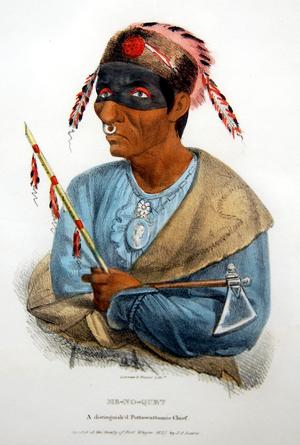
The wickedlocal reports of Early Lithographs of Native American leaders currently on loan from Fruitlands Gallery to Littleton, MA.
Filed under: art | Closed
Daniel M. Anderson, “Sexual Threat and Settler Society: ‘Black Perils’ in Kenya, 1907-30”, Journal of Imperial and Commonwealth History, 38, 1, 2010.
Abstract:
This essay deals with ‘black peril’ scares in colonial Kenya, reviewing the evidence of reported cases of sexual assaults to provide a detailed account of their social and cultural resonance for settler society. Reported cases of assault were few in number and the outbreaks of ‘peril’ more sporadic in Kenya than in other settler societies in Africa, yet the exceptional nature of individual reported incidents of sexual assault was highly significant in shaping public perceptions of the real (or imagined) threat to ‘white purity’. Sexual assault of the innocent and helpless—children and the elderly—sparked the most vociferous of Kenya’s ‘black peril’ debates, culminating in 1926 in the introduction of legislation making the rape or attempted rape of a white woman by a black man a capital offence in Kenya. Fears and anxieties about the threat of African sexuality were incubated in the hothouse of Kenya’s small and insular settler community, but were also informed by a wider discourse on social morality and miscegenation that looked to other parts of the British Empire, especially Rhodesia and South Africa, and to Britain itself. Kenya’s three ‘black peril’ episodes—1907, 1920-22, and 1924-26—are examined in turn. The concluding discussion then returns to broader questions of the explanation for and timing of the ‘black peril’ scares, setting the Kenyan experience in comparison with the other African cases.
Filed under: Africa, gender, Scholarship and insights | Closed
dear bono
Out-of-date rock star receives Santa Claus-style wishlist, reports the Aboriginal News Group:
Dear Bono,
We call on you now not to grant legitimacy to a state that practices the most pernicious form of colonialism and apartheid.
[…]
Rather than shifting the blame from the violence of the colonial oppressor to the resistance of the indigenous oppressed and characterizing the Palestinians as a population filled with “rage and despair,” it is more apt to consider them among the “aroused citizenry” responding to tyranny – Israel‘s regime of occupation and apartheid.
The Palestinian Campaign for the Academic and Cultural Boycott of Israel.
Filed under: Quote | Closed
Berghahn Books has recently re-published the edited collected, A. Dirk Moses, ed., Empire, Colony, Genocide: Conquest, Occupation, and Subaltern Resistance in World History. This collection of essays is rich in critical insight, and boasts of vast historical coverage. Its original appearance in 2008, I think, proved that the experimental fusion of genocide studies and colonial studies in the early 2000s was more than some academic mariage de convenance; and, for settler colonial studies more generally, it yielded considerable insight into the patterns of destruction and ‘logics of elimination’ implicit in settler projects, past and present. The decision to re-release the book as an affordable paperback is a good one.
Contents
Preface
A. Dirk Moses
SECTION I: INTELLECTUAL HISTORY AND CONCEPTUAL QUESTIONS
Chapter 1. Empire, Colony, Genocide: Keywords and the Philosophy of History
A. Dirk Moses
Chapter 2. Anti-colonialism in Western Political Thought: The Colonial Origins of the Concept of Genocide
Andrew Fitzmaurice
Chapter 3. Are Settler-Colonies Inherently Genocidal? Re-reading Lemkin
John Docker
Chapter 4. Structure and Event: Settler Colonialism, Time, and the Question of Genocide
Patrick Wolfe
Chapter 5. “Crime without a Name”: The Case for “Indigenocide”
Raymond Evans
Chapter 6. Colonialism and Genocides: Towards an Analysis of the Settler Archive of the European Imagination
Lorenzo Veracini
Chapter 7. Biopower and Modern Genocide
Dan Stone
SECTION II: EMPIRE, COLONIZATION AND GENOCIDE
Chapter 8. Empires, Native Peoples, and Genocide
Mark Levene
Chapter 9. Colonialism, History, and Genocide in Cambodia, 1747–2005
Ben Kiernan
Chapter 10. Genocide in Tasmania: The History of an Idea
Ann Curthoys
Chapter 11. “The aborigines… were never annihilated, and still they are becoming extinct”: Settler Imperialism and Genocide in 19th-century America and Australia
Norbert Finzsch
Chapter 12. Navigating the Cultural Encounter: Blackfoot Religious Resistance in Canada (c. 1870-1930)
Blanca Tovías
Chapter 13. Genocide in German Southwest Africa and German East Africa
Dominik J. Schaller
Chapter 14. Inner Colonization and Inter-imperial Conflict: The Destruction of the Armenians and the End of the Ottoman Empire
Donald Bloxham
Chapter 15. Inner Colonialism and the Question of Genocide in Imperial Russia and the Soviet Union
Robert Geraci
Chapter 16. Colonialism and Genocide in Nazi-occupied Poland and Ukraine
David Furber and Wendy Lower
SECTION III: SUBALTERN GENOCIDE
Chapter 17. Genocide from Below: The Great Inca Rebellion of 1780–82 in the Southern Andes
David Cahill
Chapter 18. Political Loyalties and the Genocide of a Settler Community: The Eurasians in Indonesia, 1945-46
Robert Cribb
Chapter 19. Savages, Subjects, and Sovereigns: Conjunctions of Modernity, Genocide, and Colonialism
Alexander L. Hinton
Filed under: Genocide, Scholarship and insights | Closed

